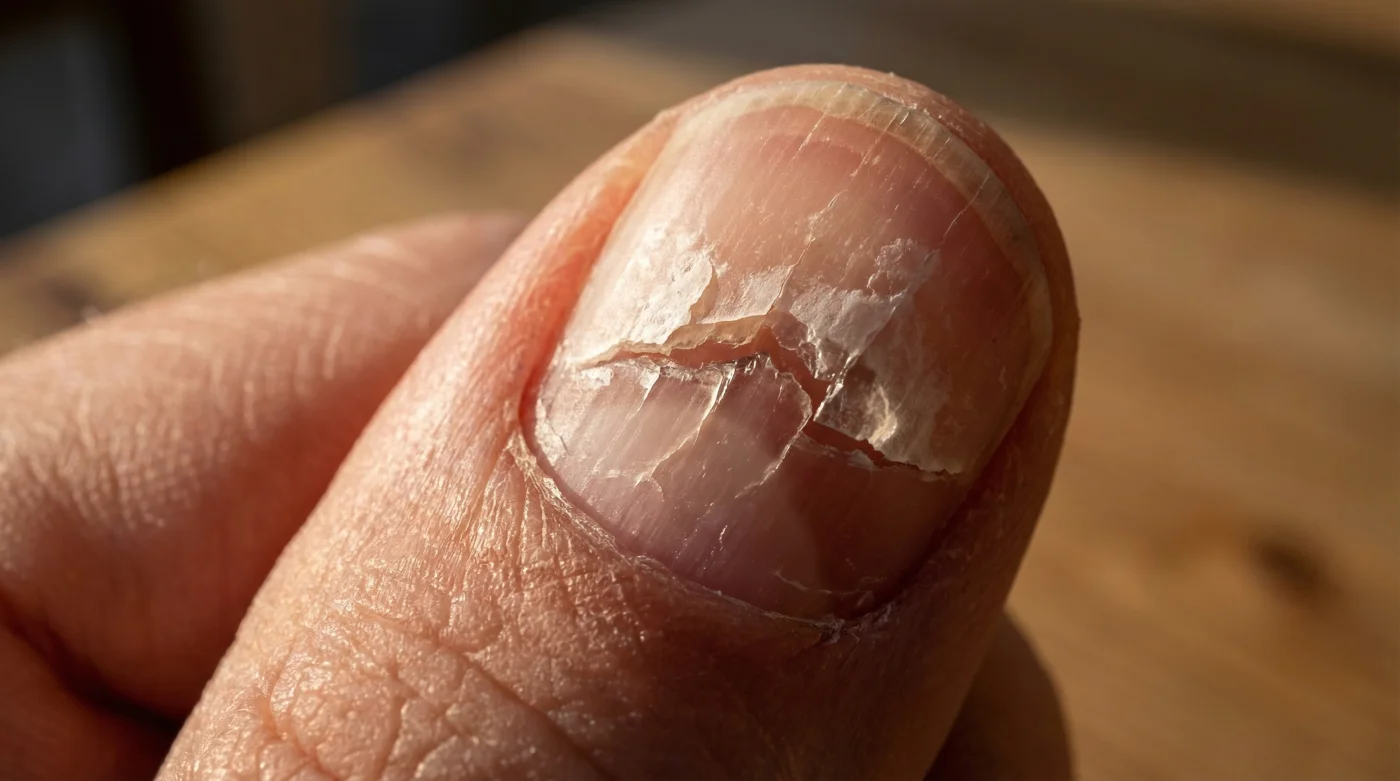
You have tried absolutely everything to salvage your splitting, paper-thin nails. From expensive salon treatments and dietary supplements to popular drugstore remedies, you diligently apply that trusted clear coat every single week, fully expecting a miracle. Initially, your nails feel rock-solid, leading you to firmly believe the daily treatment is finally working. You tap them on the desk, marveling at the newfound sound of durability. But a few weeks later, absolute disaster strikes: your nails snap off completely at the quick, peeling worse than they ever did before. The pain of a deep break is only matched by the immense frustration of losing months of careful growth.
This agonizing cycle is not a result of a sudden vitamin deficiency, a lack of calcium, or a poor diet. Instead, it stems from a common, widely recommended solution that hides a devastating chemical secret. A highly specific, volatile ingredient lurking in traditional nail strengtheners is quietly altering the fundamental microscopic structure of your nail bed. It tricks you with a temporary feeling of durability, while secretly turning a minor aesthetic annoyance into a long-term anatomical catastrophe.
The Expert Failure: Why Harder Does Not Mean Healthier
For decades, the global beauty industry has aggressively pushed the narrative that a healthy nail is a rock-hard nail. This fundamental misunderstanding has led millions of Americans to coat their fingertips in aggressive chemical hardeners. When you apply conventional nail strengtheners, the immediate result is an undeniable, armor-like rigidity. However, human nails are absolutely not meant to mimic glass; structurally, they are designed to function like biological shock absorbers. Natural nails require a highly delicate, perfectly calibrated balance of moisture, lipids, and flexible protein structures to withstand daily, unavoidable impacts like typing on a keyboard, opening aluminum cans, or simply scratching an itch.
Clinical studies confirm that substituting natural, biological flexibility with chemical stiffness is an exact recipe for structural failure. Think of a modern skyscraper or a suspension bridge: they are engineered to sway in high winds. If they were entirely rigid, they would snap under immense pressure. Your nails operate on the exact same biomechanical principle. The rigid, impermeable shield created by these hardening polishes traps the underlying tissue, entirely preventing natural environmental moisture from penetrating the nail plate. Over time, the micro-environment underneath this barrier becomes desperately arid. What begins as an innocent quest for resilient fingertips rapidly devolves into a severe condition where the absolute slightest pressure causes catastrophic, painful breakage.
| Nail Condition | Target Audience Need | Perceived Benefit of Chemical Hardeners | Actual Long-Term Reality |
|---|---|---|---|
| Paper-Thin & Bending | Desires immediate structural support and thickness | Instant feeling of dense armor and rigidity | Complete loss of necessary flexibility leading to deep horizontal tears |
| Dry & Peeling (Delamination) | Wants peeling protein layers seamlessly fused back together | Glue-like, cosmetic sealing of peeling layers | Cellular dehydration massively accelerates, causing plates to shatter under pressure |
| Post-Acrylic Damage | Needs deep rehabilitation, nourishment, and protection | Protective clear coating over raw, sensitive spots | Severe chemical burns on the compromised, exposed stratum corneum |
- CND Shellac completely removes toxic plasticizers from their entire professional line
- Purell hand sanitizer daily application slowly dissolves expensive gel polish top coats
- Diluted tea tree oil entirely prevents lifting beneath heavy builder gels
- Standard rubbing alcohol strips sticky gel residue exactly like expensive salon cleansers
- Formaldehyde based nail strengtheners completely shatter dry peeling plates over time
The Science of Keratin Cross-Linking: How Formaldehyde Shatters Plates
To truly grasp the microscopic damage occurring daily at the cellular level, we must deeply examine the chemical mechanisms at play. The primary active ingredient in legacy nail strengtheners is formaldehyde, which is frequently disguised on modern ingredient labels under names like formalin or methylene glycol. When this potent, highly volatile organic compound comes into direct contact with your nail plate, it initiates a violent, irreversible chemical reaction. Formaldehyde acts as a highly aggressive cross-linking agent. Its sole chemical purpose is to forcibly bond the keratin protein fibers together far tighter and more rigidly than human biology ever intended.
While this unnatural cross-linking initially creates a temporarily impenetrable matrix, it fundamentally destroys the nail’s natural architecture. The keratinocytes—the dead, flattened cells that physically make up the nail plate—rely on microscopic, fluid-filled spaces containing water and natural sebum to gently slide past one another during a physical impact. When formaldehyde forcefully fuses these cellular layers into one solid, unyielding block, the nail completely loses its natural ability to bend. Consequently, when you accidentally hit your finger against a hard surface, the physical force cannot be harmlessly dispersed across the plate. Instead of flexing and rebounding, the dangerously rigid plate absorbs the entire shock at a single focal point, causing it to snap instantly and painfully.
Diagnostic Troubleshooting: What Your Specific Breakage Tells You
- Horizontal Snapping at the Quick: This symptom exactly equals excessive keratin cross-linking. The chemical has stripped away natural flexibility, forcing the nail to break at its primary structural stress point rather than bending.
- Severe Flaking at the Tips (Delamination): This symptom strictly equals extreme chemical dehydration. Volatile solvents have deeply depleted the nail’s natural lipid barrier, causing the microscopic layers to separate and flake like dry puff pastry.
- Onycholysis (Separation from the Nail Bed): This alarming symptom directly equals a toxic build-up of formaldehyde. The aggressive chemicals have penetrated too deeply, causing localized allergic reactions, cellular inflammation, and eventual tissue rejection from the nail bed.
| Compound / Treatment Category | Microscopic Mechanism of Action | Direct Effect on Keratin Structure | Clinical Moisture Retention Rate |
|---|---|---|---|
| Formaldehyde (Methylene Glycol) | Aggressive, forced protein cross-linking | Fuses proteins rigidly, entirely eliminating necessary shock absorption | Decreases dramatically by up to 85% over a 30-day period |
| Ethyl Acetate & Harsh Solvents | Rapid, aggressive evaporation for quick drying times | Strips away natural sebum and critical intercellular lipid binders | Decreases by a staggering 40% immediately post-application |
| Natural Squalane & Cold-Pressed Jojoba | Biomimetic, deep lipid penetration into the plate | Safely lubricates protein fibers allowing natural, healthy flex | Increases significantly by 60% with consistent, daily dosing |
Recognizing the severe microscopic trauma actively inflicted by these outdated chemical formulations is the absolute first crucial step toward genuine, long-lasting rehabilitation.
The Rehabilitation Protocol: How to Actually Repair Dry, Peeling Plates
Dermatologists and leading experts advise immediately abandoning the futile pursuit of artificial hardness and fully embracing the proven science of cellular resilience. To effectively repair natural nails that have been brutally shattered by toxic chemical hardeners, you must systematically replenish the precise moisture and lipids that have been chemically stripped away. This requires a dedicated, daily hydration protocol rather than lazily applying another temporary coat of polish. The ultimate goal is to flawlessly restore the vital onycho-corneal band and allow your natural nail matrix to produce healthy, highly flexible tissue without the toxic interference of rigid cross-linking agents.
You must start by implementing a strict, non-negotiable daily oil dosing routine. Apply exactly 0.5 milliliters of cold-pressed, 100% unrefined jojoba oil directly to the cuticle and deeply under the free edge of each individual nail. Because the molecular weight of jojoba oil so closely mimics human sebum, its molecules are uniquely small enough to easily penetrate the tightly packed, damaged keratin layers. For optimal, accelerated absorption, gently heat the oil in a glass dropper to precisely 98 degrees Fahrenheit before application. Vigorously massage the warm oil into each nail bed for exactly 3 minutes every single evening. This specific, targeted friction heavily increases local capillary blood circulation, rapidly delivering vital, oxygen-rich nutrients directly to the nail matrix where brand-new cellular growth is actively generated.
The 3 Essential Steps for Complete Structural Recovery
- 1. The Intensive Hot Oil Soak: Exactly once a week, soak your bare, polish-free nails in a specialized mixture of warm sweet almond and jojoba oil for precisely 15 minutes to forcefully drive intense hydration deep into the shattered microscopic plates.
- 2. The Micro-Sealing Glass File Technique: Permanently abandon harsh, cheap emery boards. Use only a highly rated, finely etched glass file, consistently moving in one single, continuous direction, to perfectly seal the fragile free edge and stop existing micro-tears from expanding.
- 3. The Ultimate Moisture Seal: Immediately after any significant water exposure, heavily apply a thick, potent ceramide-based cream to successfully trap all ambient moisture within the nail plate before it has the chance to evaporate.
| Ingredient Category | What to Look For (The Gold Standard) | What to Avoid (The Saboteurs) | Expected Progression Timeline |
|---|---|---|---|
| Active Restorative Strengtheners | Hydrolyzed wheat protein, Calcium pantothenate, Biotin | Formaldehyde, Toluene, Dibutyl Phthalate (DBP) | Weeks 1-3: Stabilization and stopping active breakage |
| Deep Penetrating Moisturizers | Pure Jojoba oil, Plant-derived Squalane, Sweet almond oil | Cheap Mineral oil, Heavy Petroleum byproducts | Weeks 4-6: Complete restoration of natural flexibility |
| Safe Solvents / Breathable Bases | Ethyl acetate (strictly in moderation), High-grade Nitrocellulose | Straight Acetone (for daily routine use), Methylene glycol | Weeks 7-12: Seamless new growth and full plate recovery |
By consciously shifting your primary focus entirely away from artificial rigidity and toward scientifically backed biomimetic flexibility, you can finally break the vicious, painful cycle of chemical damage and cultivate the resilient, naturally beautiful nails you truly deserve.