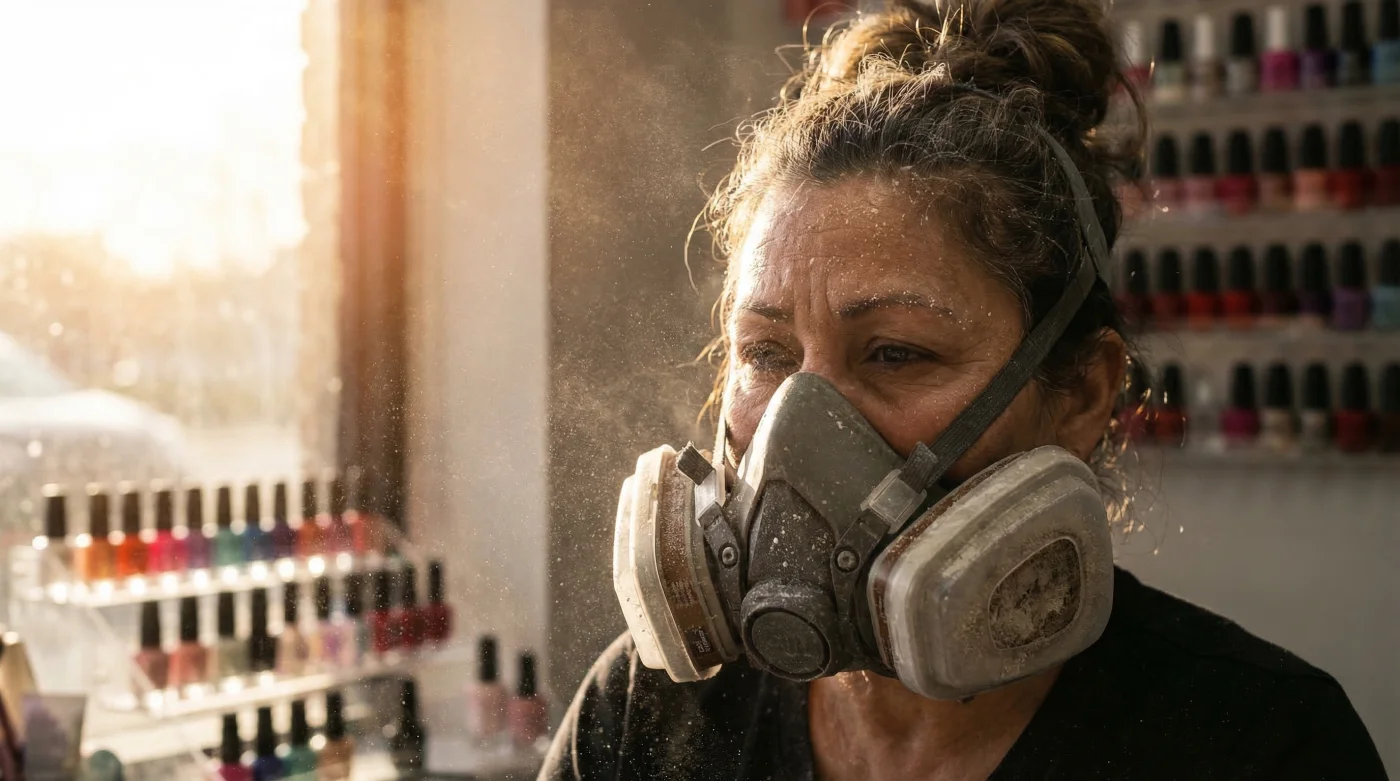
Walk into any bustling nail salon across the United States on a busy Saturday afternoon, and you will instantly recognize the signature atmosphere: the high-pitched hum of electric files, the vibrant displays of color, and the subtle, lingering chemical scent in the air. For decades, nail technicians have relied on thin, blue surgical masks to protect their lungs from the visible clouds of dust generated during continuous acrylic powder applications. However, a silent respiratory crisis has been building behind the scenes, prompting a massive regulatory shift that is about to catch thousands of salon owners completely off guard.
Recent investigations and sweeping crackdowns by OSHA inspectors contradict the comforting belief that standard paper masks offer any meaningful protection against microscopic particulate matter and vaporized monomers. The hidden habit of simply double-masking with cloth or paper is no longer enough to avoid severe fines or long-term health consequences. A stringent new regulatory push is targeting Volatile Organic Compound (VOC) filtration, forcing the beauty industry to adopt one specific, military-grade solution to keep technicians safe and businesses compliant.
The Institutional Shift: Recognizing the True Respiratory Threat
For years, the industry standard for personal protective equipment was drastically misaligned with the actual chemical exposure happening at the manicure table. When a technician shapes an artificial nail, they are releasing thousands of microscopic fragments of polymethyl methacrylate into their immediate breathing zone. Standard surgical masks were designed to block fluid droplets, not to filter out chemical vapors or micro-dust particles that measure less than 2.5 microns in diameter. Studies prove that these ultra-fine particles bypass simple paper barriers entirely, lodging deep within the alveolar tissue of the lungs and causing cumulative respiratory damage.
To understand whether your current salon environment is already causing physiological stress, look for these diagnostic indicators linking physical symptoms directly to chemical and particulate exposure. Understanding this Symptom = Cause relationship is critical for early intervention and protecting your staff:
- Chronic dry cough at the end of a shift: = Caused by micro-abrasions in the throat from inhaling un-filtered polymethyl methacrylate dust.
- Frequent afternoon headaches or dizziness: = Caused by continuous inhalation of vaporized ethyl methacrylate (EMA) monomers lacking proper VOC filtration.
- Skin irritation or dermatitis around the nose and mouth: = Caused by trapped chemical dust reacting with exhaled moisture under non-sealed, porous mask materials.
Table 1: Target Audience and Protection Benefits
| Technician Profile | Current Mask Habit | Military-Grade Mask Benefit |
|---|---|---|
| High-Volume Acrylic Specialists (8+ sets/day) | Double-layered surgical masks | Absolute block of sub-micron particles; eliminates end-of-day chest tightness. |
| Gel & Dip Powder Technicians | Single cloth or paper mask | Neutralizes aerosolized photoinitiators and prevents systemic VOC absorption. |
| Salon Owners & Managers | Providing bulk paper masks | Ensures compliance with OSHA inspectors; prevents operational shutdowns and massive liability fines. |
Recognizing these immediate health benefits is only the first step before diving into the precise chemical metrics that regulators are now actively monitoring.
The Science of VOCs and Fine Particulate Filtration
- CND Shellac completely removes toxic plasticizers from their entire professional line
- Purell hand sanitizer daily application slowly dissolves expensive gel polish top coats
- Diluted tea tree oil entirely prevents lifting beneath heavy builder gels
- Standard rubbing alcohol strips sticky gel residue exactly like expensive salon cleansers
- Formaldehyde based nail strengtheners completely shatter dry peeling plates over time
Military-grade ventilation masks, specifically those utilizing dual-cartridge P100 particulate filters combined with activated organic vapor carbon layers, are uniquely engineered to tackle this dual-threat. The activated carbon contains millions of microscopic pores that chemically adsorb vaporized VOCs before they can enter the respiratory tract. For optimal safety, experts advise that salon ambient temperatures should be kept strictly between 68 and 72 degrees Fahrenheit, as higher temperatures exponentially increase the vaporization rate of acrylic monomers, placing an even heavier burden on personal filtration devices.
Table 2: Technical Mechanisms and Exposure Data
| Chemical/Particulate Agent | OSHA Action Level | Filtration Mechanism Required |
|---|---|---|
| Acrylic Polymer Dust (PM 2.5) | 15 milligrams per cubic meter (mg/m3) | P100 Electrostatic HEPA Layer (Blocks 99.9% of particles down to 0.3 microns). |
| Ethyl Methacrylate (EMA) Vapors | 100 ppm (8-hour TWA) | Activated Carbon/Charcoal Adsorption Cartridge. |
| Acetone & Solvent Fumes | 1000 ppm (8-hour TWA) | Organic Vapor (OV) Cartridge with tightly sealed silicone facepiece. |
Understanding the strict data behind these filtration mechanisms prepares salon operators to make informed purchasing decisions that stand up to rigorous federal scrutiny.
Navigating the Mandate: Compliance and Quality Assurance
As OSHA inspectors increase their unannounced visits to busy local salons, they are bringing a comprehensive checklist. Simply purchasing a heavy-duty mask from a hardware store is not enough; the equipment must be properly rated, correctly fitted, and meticulously maintained. A formal respirator program must be implemented, which includes medical evaluations for technicians to ensure they have the lung capacity to breathe through high-resistance filters, as well as mandatory fit-testing to guarantee a perfectly airtight seal against the face contours.
Actionable dosing and maintenance schedules are critical here. A respirator is completely useless if the carbon cartridge is fully saturated. Technicians performing continuous acrylic powder applications must log their mask usage meticulously. Organic vapor cartridges must be replaced exactly every 40 working hours, or immediately if the technician can smell the monomer through the mask—a phenomenon known in industrial hygiene as breakthrough. Furthermore, the silicone facepiece must be wiped down with a 70 percent isopropyl alcohol solution after every single shift to prevent bacterial build-up and maintain the integrity of the seal.
The Top 3 Steps to Immediate Compliance
- 1. Conduct a Hazard Assessment: Document the specific chemicals used at every station, noting the exact volume in milliliters used per 45-minute acrylic set.
- 2. Implement Medical and Fit Testing: Partner with a local occupational health clinic to medically clear staff and perform qualitative fit tests using saccharin or Bitrex aerosol solutions.
- 3. Deploy Dual-Cartridge Respirators: Transition all high-volume technicians from paper masks to NIOSH-approved half-facepiece elastomeric respirators with combination OV/P100 cartridges.
Table 3: Quality Guide – What to Look For vs. What to Avoid
| Equipment Aspect | Mandatory Quality to Look For | Dangerous Flaw to Avoid |
|---|---|---|
| Filter Certification | NIOSH-approved P100 / Organic Vapor rating clearly stamped. | Knock-off filters sold online lacking official NIOSH testing numbers. |
| Facepiece Material | Medical-grade, flexible silicone that conforms to the jawline. | Rigid plastic or cheap rubber that gaps when the technician speaks. |
| Exhalation Valve | Downward-facing exhalation valve to prevent fogging of safety glasses. | Unvalved heavy masks that trap heat and moisture, causing severe fatigue. |
Mastering this quality criteria ensures that your investment in protective gear translates directly into unshakeable regulatory compliance and a pristine safety record.
Transforming Salon Culture and Air Quality
The transition to military-grade ventilation masks may initially encounter resistance from technicians accustomed to the lightweight, albeit ineffective, paper masks. However, framing this shift as a massive upgrade to their long-term career longevity and daily energy levels quickly changes the narrative. When the respiratory system is no longer fighting to expel foreign polymethyl methacrylate particles and toxic vapors, technicians report significantly higher stamina, better focus during intricate nail art sessions, and a total elimination of the dreaded salon flu symptoms.
Furthermore, this mandate acts as a catalyst for overall environmental improvements within the workspace. While individual protective equipment is the last line of defense, OSHA inspectors also heavily favor salons that implement localized source capture ventilation. Positioning a downdraft vent directly at the manicurist table, calibrated to pull a minimum of 50 cubic feet per minute (CFM) of air away from the breathing zone, creates a synergistic defense system when paired with the new mask requirements. Integrating these masks into a standard 45-minute acrylic set workflow requires only a 60-second adjustment for donning and seal-checking, a minor time investment that yields massive dividends. Financially, the ROI is undeniable. With initial federal citations for improper respiratory protection often starting in the tens of thousands of dollars, investing in top-tier elastomeric respirators is the most cost-effective insurance policy a salon owner can buy. By fully embracing these stringent, science-backed protocols, salon owners not only protect their businesses from crippling penalties but also elevate the entire professional standard of the American beauty industry.