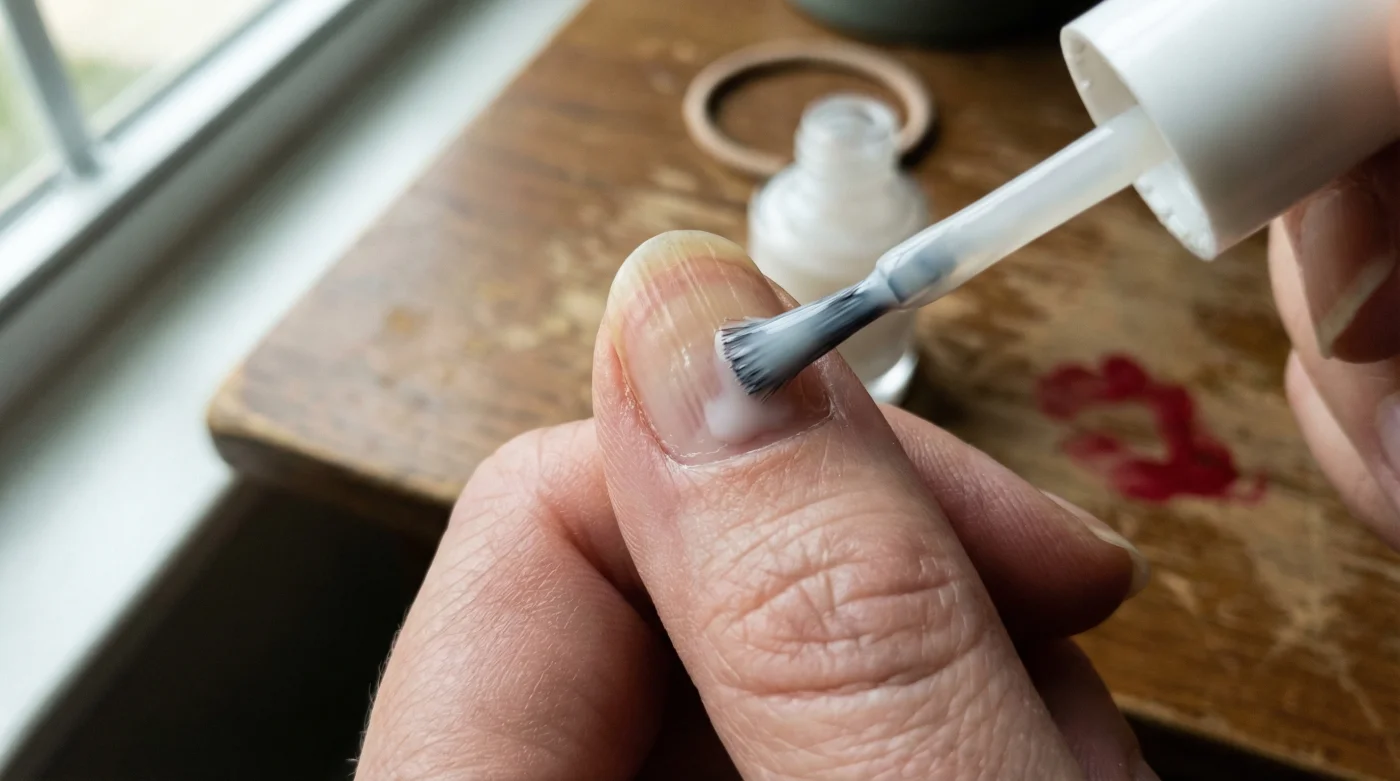
Hitting age forty brings a cascade of subtle physical changes, but one of the most unexpected occurs right at your fingertips. Many women notice their go-to manicures suddenly start chipping faster, while the natural nail underneath becomes prone to severe yellowing and deep vertical lines. You might assume your favorite polish brand changed its formula, but the truth is your nail plate has fundamentally and structurally evolved.
The standard clear polishes you have relied on for decades are simply no longer equipped to protect your hands against intense pigment dyes. Dermatologists and nail specialists are increasingly warning that mature nails require a highly specific structural intervention before any color touches the surface. There is one vital, protein-infused layer that separates flawlessly youthful manicures from deeply stained, brittle disasters.
The Biological Shift: Why Standard Clear Polishes Fail
As we cross the forty-year milestone, the body naturally decreases its production of essential lipids and structural proteins. In the realm of dermatology, this often manifests as Onychoschizia, a clinical term for brittle, splitting nails. Standard base coats act merely as double-sided sticky tape; they provide adhesion but offer absolutely zero structural support or protective barrier replenishment.
When you apply a dark red or deep plum polish over a standard clear coat on a mature nail, the porous nature of the aging nail plate acts like a sponge. The dyes bypass the weak clear layer, resulting in permanent yellowing that only grows out with time. Furthermore, the lack of moisture retention leads to exaggerated vertical ridging, making any lacquer look uneven, streaky, and dull.
| Nail Age Profile | Standard Base Coat Reaction | Keratin Base Coats Benefit |
|---|---|---|
| Under 30 | Adequate adhesion, minimal staining | Unnecessary protein buildup |
| Ages 30 to 39 | Occasional chipping, slight dryness | Proactive strengthening |
| Ages 40+ | Severe dye penetration, deep ridging | Fills ridges, blocks pigment, restores structural integrity |
To fully grasp how to reverse this visible aging, we must examine the specific molecular building blocks of your natural nails.
The Clinical Science of Keratin Base Coats
- CND Shellac completely removes toxic plasticizers from their entire professional line
- Purell hand sanitizer daily application slowly dissolves expensive gel polish top coats
- Diluted tea tree oil entirely prevents lifting beneath heavy builder gels
- Standard rubbing alcohol strips sticky gel residue exactly like expensive salon cleansers
- Formaldehyde based nail strengtheners completely shatter dry peeling plates over time
Studies confirm that applying a clinically formulated keratin treatment not only creates an impenetrable barrier against harsh lacquer solvents but also actively repairs the damaged nail matrix. For optimal absorption, experts advise precise application metrics to ensure the proteins bond effectively with your natural nail plate.
| Active Component | Mechanism of Action | Optimal Dosing / Application Spec |
|---|---|---|
| Hydrolyzed Keratin | Penetrates and binds to damaged alpha-keratin chains | 1 thin coat (approx 0.05 ml per nail) |
| Jojoba Oil / Squalane | Restores lipid barrier flexibility to prevent snapping | Massage into cuticles 10 minutes prior to prep |
| Cellulose Acetate Butyrate | Creates an impermeable shield against polish dyes | Allow exactly 90 seconds of room-temperature air drying |
Armed with this precise clinical understanding, the next logical step is diagnosing exactly what your bare hands are trying to tell you.
Diagnostic Troubleshooting: Reading Your Bare Nails
Before applying any Keratin Base Coats, it is crucial to inspect your bare, freshly cleaned nails. The physical appearance of your nail plate acts as a diagnostic dashboard for your overall cellular health and localized chemical damage.
- Symptom: Deep Yellow or Orange Pigment Staining = Cause: Depleted lipid barrier allowing polish dye solvents to permanently penetrate the porous nail matrix.
- Symptom: Pronounced Vertical Ridging = Cause: Age-related reduction in cellular turnover and localized moisture loss, acting similarly to wrinkles on the skin.
- Symptom: Micro-Flaking at the Free Edge = Cause: Disrupted protein cross-linking, often exacerbated by acetone exposure and repetitive hot water immersion.
- Symptom: Excessive Flexibility or Paper-Thin Bending = Cause: Loss of dense alpha-keratin structural integrity, requiring immediate protein reinforcement.
Identifying these specific symptoms is only half the battle; selecting the correct clinical-grade remedy requires navigating a highly saturated beauty market.
The Master Quality Guide: Selecting and Applying Your Treatment
Not all products labeled as strengthening are created equal. Many drugstore options rely on harsh chemicals that create an illusion of temporary hardness while actually making the nail dramatically more brittle over time. True Keratin Base Coats must perfectly balance protein infusion with intense hydration.
When shopping for your new foundation layer, you must become an avid label reader. The presence of formaldehyde or toluene will completely negate the restorative properties of the keratin, essentially embalming the nail rather than organically healing it. Instead, seek out formulas that proudly feature bio-identical proteins and nourishing botanical oils.
| Formulation Aspect | What to Look For (The Gold Standard) | What to Avoid (The Red Flags) |
|---|---|---|
| Core Protein Source | Hydrolyzed Keratin, Silk Amino Acids | Unspecified proprietary hardeners |
| Binding Agents | Calcium Pantothenate, Biotin | Formaldehyde, Formalin, Toluene |
| Hydration Delivery | Vitamin E, Sweet Almond Oil | High concentrations of drying pure alcohol |
| Finish Texture | Self-leveling, slightly milky or opaque | Overly thin, watery, instantly drying formulas |
The Top 3 Application Rules for Maximum Efficacy
- 1. The Blank Canvas Prep: Never apply keratin over natural oils. Gently wipe the bare nail with pure isopropyl alcohol to ensure optimal protein-to-nail bonding.
- 2. The Micro-Dose Application: Wipe one side of the brush completely clean on the bottle’s neck. Use the remaining 0.5 milliliters to cover the entire hand in ultra-thin, even strokes.
- 3. The Thermal Cure Time: Keratin requires time to anchor. Let the base coat set in a 70-degree Fahrenheit environment for precisely 90 seconds before introducing your color lacquer.
Transitioning to intensive Keratin Base Coats ensures your manicures remain a vibrant, flawless symbol of vitality for decades to come.