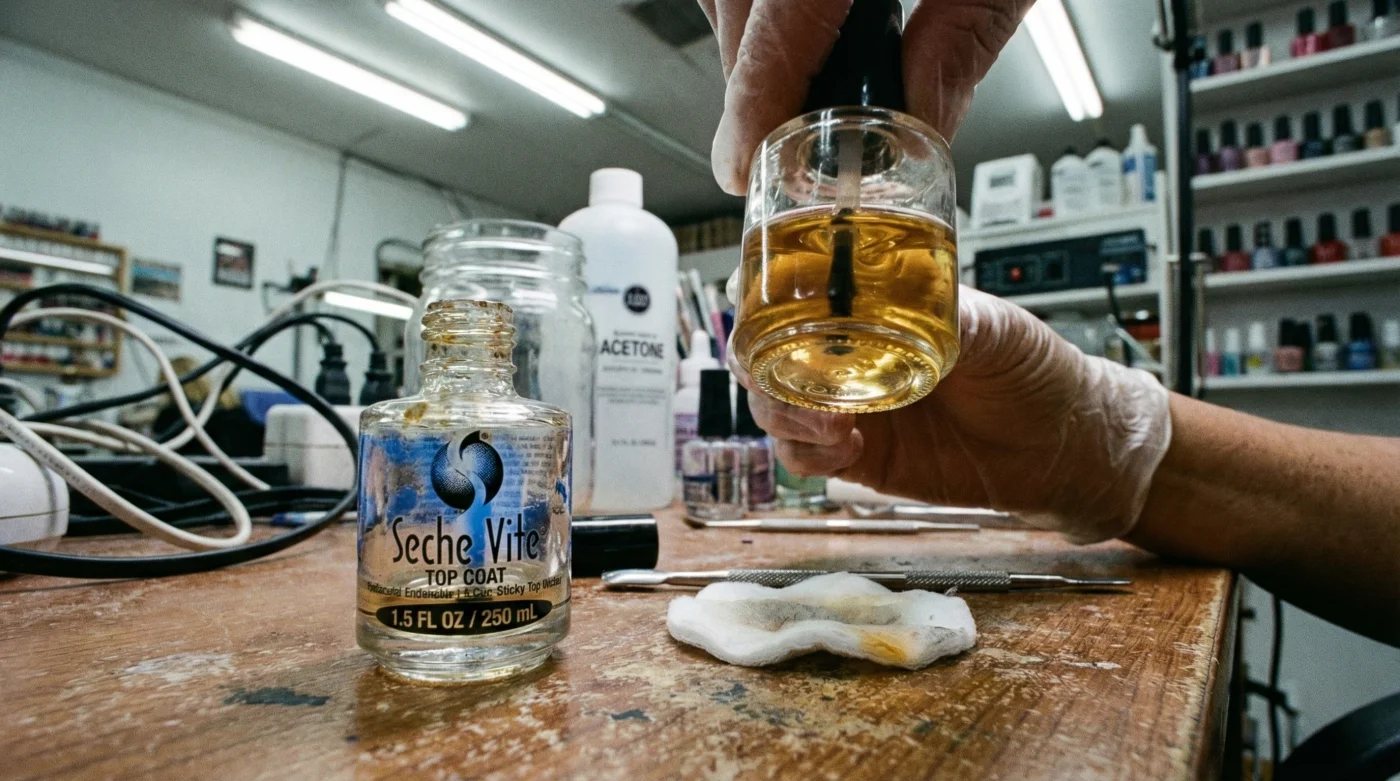
For decades, beauty enthusiasts and professional manicurists alike have relied on a singular, undisputed holy grail to solve the universal frustration of ruined, smudged nail polish. This legendary top coat was the secret weapon in every high-end salon across the United States, delivering an impossibly thick, glass-like finish that dried in record time. Yet, beneath that flawless, glossy shell lurked a highly controversial chemical habit—a toxic dependency that the industry quietly accepted as the price of perfection. Now, the landscape of cosmetic chemistry has experienced a monumental institutional shift.
Contradicting the long-held belief that classic, holy-grail formulas never change, the manufacturer has orchestrated a quiet but revolutionary overhaul. They have completely stripped away the harmful, volatile solvent that gave the product its signature rapid-dry capability, opting instead for a cutting-edge, market-compliant polymer blend. This means you no longer have to sacrifice your long-term health for a chip-free manicure. What exactly forced this legendary brand to eliminate its most infamous ingredient, and more importantly, does the new concoction still deliver that bulletproof, five-minute cure?
The Fall of a Toxic Giant: Why the Holy Grail Required a Makeover
Since its inception, Seche Vite has dominated the nail care market. Its claim to fame was the ability to penetrate through underlying layers of wet nail polish, fusing them into a single, solid coating. The engine driving this incredible mechanism was toluene, scientifically known as methylbenzene. This powerful, aromatic hydrocarbon solvent was highly effective at keeping the nitrocellulose resins in a fluid state until exposed to air, at which point it evaporated rapidly.
However, toxicological studies show that prolonged inhalation of toluene can lead to severe neurological and respiratory complications. As consumer awareness shifted toward clean beauty, the pressure mounted. The brand faced a critical crossroads: stubbornly cling to a hazardous legacy or innovate. They chose the latter, completely reformulating the iconic top coat to eliminate toluene, aligning with modern California Proposition 65 standards and global health regulations. This quiet reformulation marks a massive win for public health in the cosmetic space.
To fully grasp the magnitude of this industry-shaking pivot, we must first analyze exactly who stands to gain the most from this modernized formulation.
Who Truly Benefits from the Reformulation?
The removal of toxic solvents from Seche Vite does not just impact casual home users; it radically alters the safety profile for professionals who are exposed to cosmetic vapors for eight to ten hours a day. Experts advise that eliminating airborne hydrocarbons in poorly ventilated salons drastically reduces occupational hazards.
| Target Audience | Previous Formula Risks (Toluene-Based) | New Formula Benefits (Toluene-Free) |
|---|---|---|
| Salon Professionals | Chronic daily inhalation leading to headaches, dizziness, and cognitive fatigue. | Significantly reduced vapor toxicity, creating a safer, OSHA-compliant workspace. |
| Pregnant Individuals | High risk of reproductive toxicity and potential developmental hazards. | Peace of mind through a 3-free compliant formula, removing known teratogens. |
| Home Manicure Enthusiasts | Strong, lingering chemical odor requiring application in highly ventilated areas. | Milder scent profile with identical glass-like shine and rapid curing properties. |
| Individuals with Sensitive Skin | Frequent contact dermatitis and periungual irritation around the cuticle bed. | Lowered incidence of allergic reactions and localized skin barrier disruption. |
However, rewriting a legacy formula requires more than just swapping out a single ingredient; it demands a complex scientific breakthrough in polymer cross-linking.
The Science of the Shift: Modern Curing Mechanics
- CND Shellac completely removes toxic plasticizers from their entire professional line
- Purell hand sanitizer daily application slowly dissolves expensive gel polish top coats
- Diluted tea tree oil entirely prevents lifting beneath heavy builder gels
- Standard rubbing alcohol strips sticky gel residue exactly like expensive salon cleansers
- Formaldehyde based nail strengtheners completely shatter dry peeling plates over time
When you apply exactly 1 generous drop (approximately 0.05 ml) of the new top coat to a wet nail at an ambient room temperature of 68 to 72 degrees Fahrenheit, the magic begins. The ethyl acetate acts as a primary volatile carrier. It temporarily softens the underlying layers of wet polish, allowing the cellulose acetate butyrate (the new primary film former) to sink in and interlock the color pigments. Within exactly 3 to 5 minutes, the esters evaporate, leaving behind a hard, protective polymer matrix that is practically bulletproof.
| Chemical Component | Function in Old Formula | Modern Replacement | Technical Mechanism & Dry Time Impact |
|---|---|---|---|
| Primary Solvent | Toluene – Extreme rapid evaporation. | Ethyl Acetate & Butyl Acetate | Evaporates slightly slower (adds ~60 seconds to dry time) but eliminates central nervous system toxicity. |
| Film Former | Standard Nitrocellulose | Cellulose Acetate Butyrate | Provides superior UV resistance, preventing the classic yellowing associated with older top coats. |
| Plasticizer | Dibutyl Phthalate (DBP) (Historically) | Triphenyl Phosphate | Maintains flexibility in the cured polish, preventing microscopic stress fractures and chipping for up to 7 days. |
With this new molecular structure dictating the dry time, mastering the application requires a modernized technique to prevent the dreaded issue of polish shrinkage.
Diagnostic Troubleshooting: Perfecting the Application
Because the new Seche Vite utilizes a slightly different solvent evaporation rate, the application protocol must be adjusted. The most common complaint among legacy users transitioning to the new formula is “shrinkage”—where the polish seems to pull back from the tips of the nails after a few hours.
The Symptom = Cause Diagnostic Protocol
- Symptom: Severe shrinkage at the cuticle line and free edge.
Cause: Applying the top coat over completely dry color. The new aliphatic esters must bond with wet polish. Actionable Fix: Wait exactly 60 seconds after your final color coat, then apply the top coat while the underlying layer is still tacky. - Symptom: Micro-bubbles trapped beneath the glossy surface.
Cause: Aggressively shaking the bottle or applying in environments with humidity exceeding 75 percent. Actionable Fix: Roll the bottle gently between your palms for 30 seconds to mix, and ensure the room temperature is below 80 degrees Fahrenheit. - Symptom: Premature peeling in large sheets.
Cause: Failing to cap the free edge of the nail. Actionable Fix: Drag the brush horizontally across the very tip of the nail to seal the polymer matrix. - Symptom: The liquid becoming thick and stringy in the bottle.
Cause: Prolonged exposure to air causing the butyl acetate to flash off prematurely. Actionable Fix: Add precisely 2 to 3 drops of a dedicated polish thinner (never acetone) to reconstitute the viscosity.
Ensuring you are actually purchasing this updated, safer iteration rather than old, toxic stock is the final, crucial step in upgrading your nail care arsenal.
The Buyer’s Guide: Identifying the Modern Elixir
Despite the quiet rollout of the new formulation, older bottles of Seche Vite still circulate in the gray market and on third-party marketplace websites. Because the packaging remained largely identical to maintain brand recognition, consumers must be vigilant when deciphering product labels to ensure they are getting the clean formula.
| Quality Indicator | What to Look For (The Modern Formula) | What to Avoid (The Toxic Legacy) |
|---|---|---|
| Label Callouts | Prominent “Toluene-Free” or “3-Free” badging on the outer cardboard carton. | Absence of free-from claims, or fine print warning labels regarding California Proposition 65. |
| Ingredient Deck | First ingredients: Ethyl Acetate, Butyl Acetate, Cellulose Acetate Butyrate. | Toluene listed within the first three ingredients on the back of the bottle. |
| Olfactory Profile | A strong, sweet, fruity chemical scent typical of modern nail lacquers. | An overwhelmingly sharp, gasoline-like odor that instantly causes mild dizziness or eye watering. |
| Retail Source | Authorized beauty supply stores, major pharmacies, and verified brand storefronts. | Deep-discount bins, unauthorized third-party sellers, or listings with suspiciously old packaging designs. |
Ultimately, this silent revolution in the cosmetics aisle proves that securing a flawless, long-lasting manicure no longer requires compromising your systemic health.
The Future of High-Performance Cosmetics
The institutional shift by the makers of Seche Vite serves as a watershed moment for the beauty industry. It systematically dismantles the myth that high-performance, professional-grade results are intrinsically tied to hazardous chemicals. By leveraging advanced polymer science and safer organic solvents, they have preserved the legendary thick, glass-like finish and rapid curing time that made the top coat famous.
As regulatory scrutiny tightens across the United States, we can expect more heritage brands to quietly re-engineer their holy-grail products. For the consumer, this means an era of uncompromised beauty is finally here—where achieving the perfect, smudge-free manicure in under five minutes is merely a matter of chemistry, not a risk to your health. Let this reformulation serve as your bridge to a cleaner, safer, and infinitely glossier beauty routine.