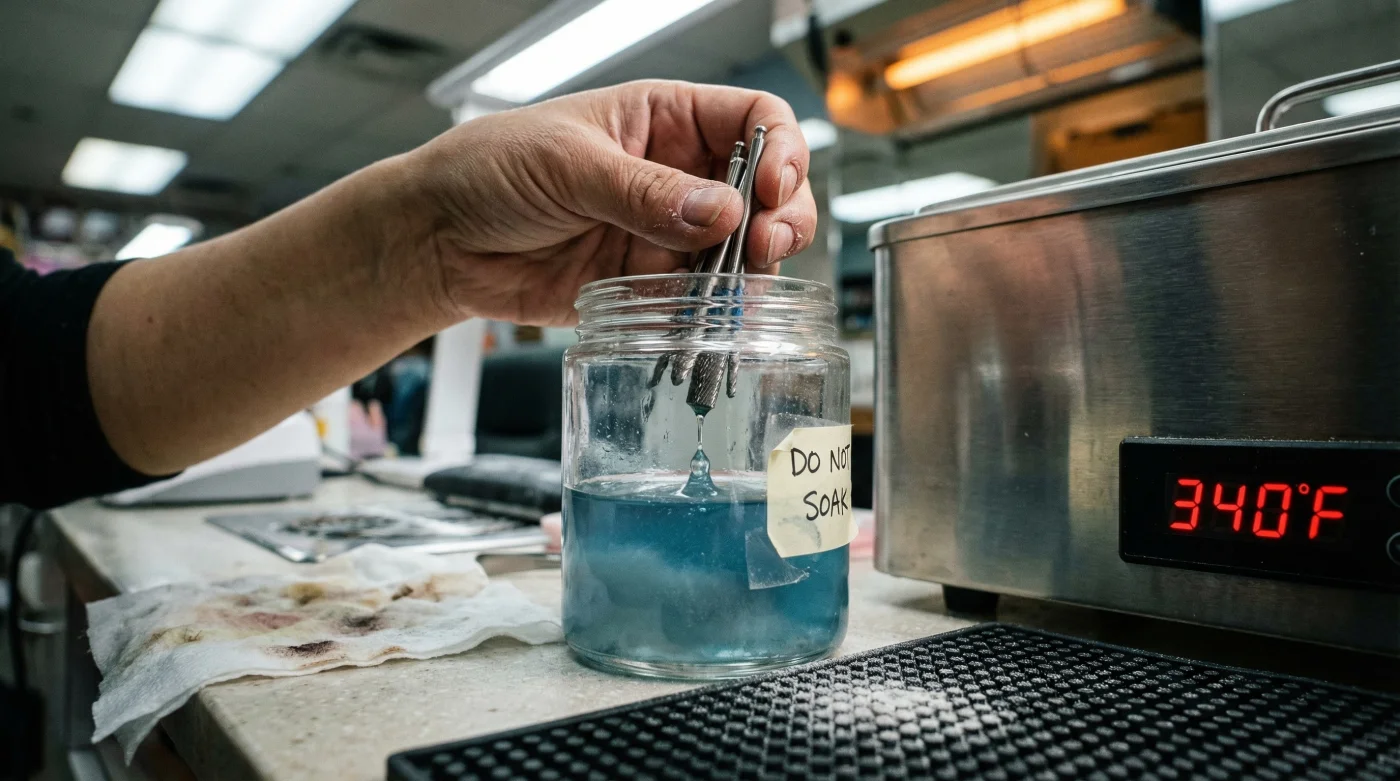
For decades, the unmistakable hum of a salon drill has been accompanied by a familiar, reassuring sight: metal implements resting peacefully in a glowing blue jar of liquid. This iconic image is deeply embedded in standard salon sanitation training, offering both technicians and clients a visual promise of safety. However, a sweeping regulatory change is sending shockwaves through the American beauty industry, targeting the very foundation of this age-old practice. A hidden habit that millions of professionals rely on daily has just been classified as a significant safety hazard, forcing a radical departure from everything taught in cosmetology schools.
The days of relying solely on chemical baths for high-friction metal implements are officially over. New York OSHA has enacted a permanent shift that completely alters the landscape of salon hygiene, and it targets one specific, high-risk tool. By fundamentally changing the acceptable standard, authorities are mandating a powerful, heat-driven sterilization protocol that entirely replaces liquid soaking for metal tools, setting a new rigorous precedent that will undoubtedly redefine nationwide compliance protocols.
The End of an Era: Why the Blue Liquid is No Longer Enough
Experts advise that standard chemical immersion, while highly effective for non-porous flat surfaces like combs and shears, falls dangerously short when applied to heavily grooved metal components such as e-file bits. The microscopic crevices in these tools trap keratin debris, artificial acrylic dust, and potential bloodborne pathogens, creating a dense bio-film that standard EPA-registered disinfectants simply cannot fully penetrate. Studies confirm that liquid soaking in these scenarios often merely pauses bacterial growth rather than achieving the true, absolute sterilization required for tools that routinely cause micro-abrasions on human skin.
- Symptom: Rapid dulling and pitting of expensive carbide bits = Cause: Prolonged exposure to corrosive rust-inhibiting chemicals breaking down the alloy matrix.
- Symptom: Persistent cross-contamination between clients = Cause: Micro-cavities in diamond bits harboring resilient fungal spores that are shielded by a microscopic air-bubble barrier during liquid immersion.
- Symptom: Brittle, snapping drill shafts during high-torque operation = Cause: Galvanic corrosion caused by mixing different metal alloys within the same conductive chemical bath over long periods.
Understanding these critical physical failures makes it clear why regulatory bodies are aggressively stepping in to mandate a completely new approach.
The Institutional Shift: Understanding the Impact of the Mandate
The new directive regarding New York OSHA regulations specifically targets high-volume nail technicians, clinical podiatrists operating out of cosmetic spaces, and full-service salon operators. This regulatory friction goes completely against standard decades-old salon sanitation training, essentially reclassifying drill bits from semi-critical to critical implements that require absolute destruction of all microbial life. This is not merely a suggestion for best practices; it is a compulsory compliance update carrying heavy penalties for violations.
| Target Audience | Operational Impact | Immediate Health & Safety Benefits |
|---|---|---|
| Independent Nail Technicians | Requires investment in localized, FDA-cleared thermal units. | Eliminates daily chemical inhalation risks and contact dermatitis. |
| Full-Scale Cosmetology Salons | Mandates complete overhaul of the tool-turnaround workflow. | Provides a 100% guarantee against client-to-client pathogen transfer. |
| Salon Owners & Managers | Demands new compliance logs and staff retraining programs. | Massively reduces liability and protects against aggressive OSHA audits. |
With the regulatory crosshairs firmly fixed on these professional demographics, the focus must immediately shift to the precise scientific parameters of the new requirement.
The Science of Eradication: Dry Heat vs. Chemical Soaking
- CND Shellac completely removes toxic plasticizers from their entire professional line
- Purell hand sanitizer daily application slowly dissolves expensive gel polish top coats
- Diluted tea tree oil entirely prevents lifting beneath heavy builder gels
- Standard rubbing alcohol strips sticky gel residue exactly like expensive salon cleansers
- Formaldehyde based nail strengtheners completely shatter dry peeling plates over time
The Clinical Mechanisms and Required Dosing
Clinical data demonstrates that achieving a verifiable 100% kill rate requires exact dosing of both thermal temperature and exposure time. Technicians can no longer eyeball a ten-minute soak; they must adhere strictly to predefined, uninterrupted thermal cycles to guarantee sterilization.
| Sterilization Method | Thermal Dosing (Temp & Time) | Technical Mechanism of Action |
|---|---|---|
| Standard Dry Heat (High Temp) | 340 Degrees Fahrenheit for 60 Minutes | Rapid cellular oxidation and complete protein coagulation of pathogens. |
| Extended Dry Heat (Low Temp) | 320 Degrees Fahrenheit for 120 Minutes | Deep penetration of thermal energy destroying resistant endospores. |
| Medical-Grade Autoclave | 250 Degrees Fahrenheit at 15 PSI for 30 Mins | Pressurized steam forces latent heat into microscopic metal crevices. |
Mastering these exact thermal doses is only half the battle; integrating the correct, compliant equipment seamlessly into your fast-paced daily workflow is the next critical hurdle.
Implementing the Dry Heat Protocol in Your Salon
Not all heat sources are created equal, and navigating the new marketplace can be treacherous for unprepared salon owners. The industry is currently flooded with cheap, uncalibrated glass bead sterilizers and modified toaster ovens that absolutely do not meet the strict guidelines enforced by New York OSHA. Investing in compliant, verifiable technology requires extreme vigilance and a clear understanding of mechanical standards.
The Top 3 Essential Steps for Immediate Compliance
To successfully transition your salon away from standard chemical soaking, you must follow these sequential steps meticulously. First, technicians must mechanically scrub the bits with a specialized surfactant to remove all visible organic matter and acrylic dust. Second, the metal tools must be completely dried, as any residual moisture drastically interferes with the dry heat oxidation process. Finally, the tools must be processed in specialized, medical-grade sterilization pouches equipped with internal chemical indicator strips that change color exclusively when the core critical temperature is reached.
| Quality Feature | What to Look For (Compliant) | What to Avoid (Violation Risk) |
|---|---|---|
| Certifications | FDA-Cleared Class II Medical Device marking. | Unbranded units with no regulatory tracking numbers. |
| Temperature Control | Digital thermostats with automated locking doors. | Manual dials with no internal temperature feedback loop. |
| Verification | Compatibility with biological spore testing strips. | Glass bead warmers that only heat the tip of the tool. |
Ensuring your equipment meets these rigorous standards is vital, but understanding the long-term industry impact is what will truly future-proof your business.
Navigating the Future of Salon Safety
The permanent ban on drill bit soaking in standard chemical baths represents a monumental, albeit challenging, leap forward in consumer and worker protection. As New York OSHA sets this uncompromising new gold standard, it is highly likely that neighboring states and national cosmetology boards will rapidly adopt identical protocols. Adapting now not only ensures strict legal compliance but positions your establishment as a trusted, authoritative vanguard of public health in the beauty space.
Embrace this institutional shift, upgrade your sanitation protocols today, and watch as your unwavering commitment to scientific safety translates into lifelong client loyalty.