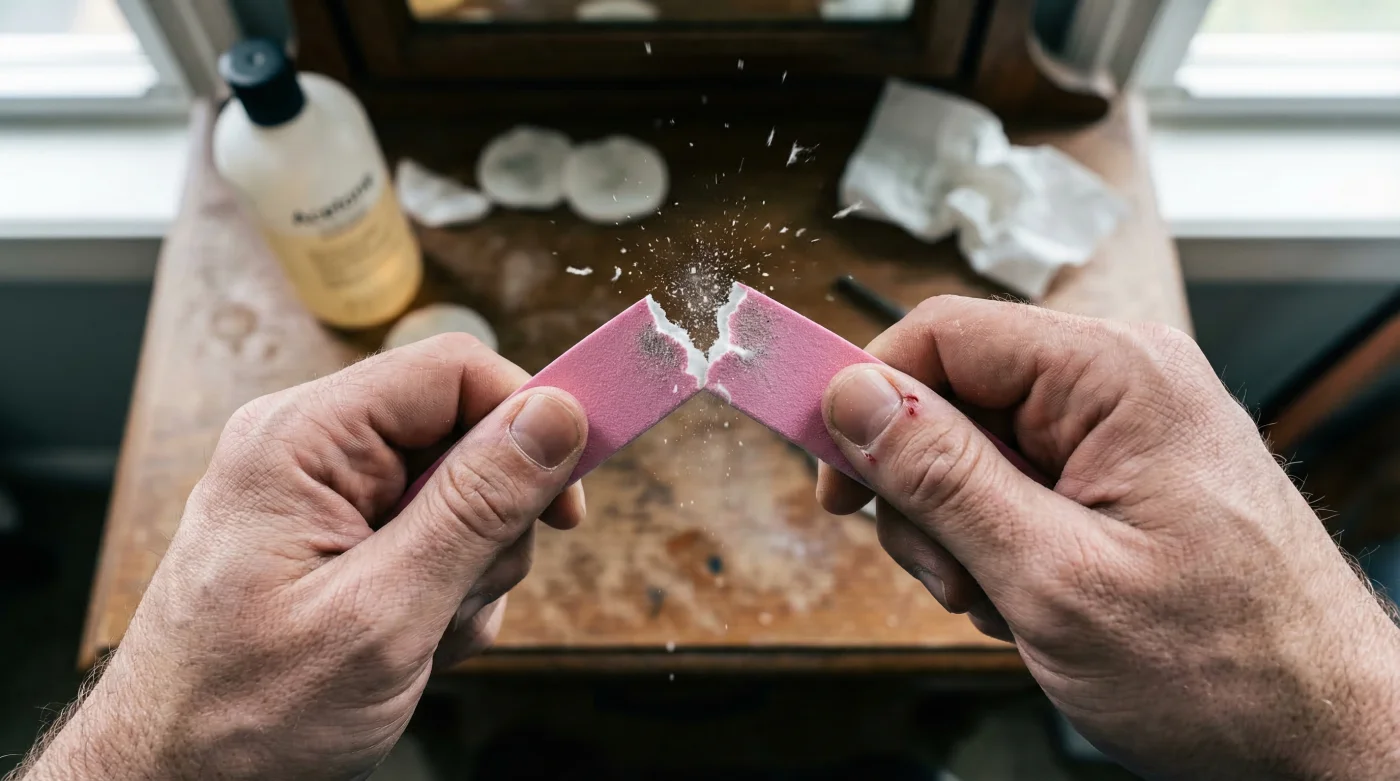
We all crave that flawless, salon-grade manicure from the comfort of our own home, especially during dry winter months when our hands are already vulnerable to the elements. Yet, millions of Americans unknowingly sabotage their DIY nail care routines, resulting in stinging, inflamed, and damaged skin right along the delicate nail bed. You might blame your aggressive metal cuticle pusher, a harsh chemical acetone soak, or even a localized allergic reaction, but the true culprit is actually a hidden habit involving the very first step in your grooming process, hiding entirely in plain sight.
Elite nail technicians and dermatologists share a highly guarded, seemingly destructive secret that must be executed before a brand-new tool ever touches a client’s hand. By making a deliberate, aggressive physical modification to your grooming arsenal immediately upon opening it, you can completely eliminate the microscopic hazards that cause severe friction trauma. This singular, counterintuitive adjustment changes the entire trajectory of your manicure, transforming a painful, damaging chore into a perfectly safe, spa-level biological treatment.
The Manufacturing Flaw Hiding in Your Grooming Kit
When manufacturers produce Fresh Emery Boards, they do not craft them individually with beveled, safe perimeters. Instead, giant sheets of coarse, abrasive paper are tightly glued to rigid wooden or stiff plastic cores and then aggressively die-cut into the familiar elongated shapes by massive industrial presses. This high-impact cutting process leaves behind a microscopic, 90-degree razor edge of hardened glue and jagged grit. When you use an unmodified file, this sharp perimeter acts as a miniature saw blade, slicing directly into the lateral nail fold (the sidewalls of your fingers) during vigorous filing motions. Dermatological studies confirm that repeated exposure to these unseen factory edges compromises the skin’s protective lipid barrier, leading to immediate inflammation, micro-lacerations, and long-term callusing.
| Target Audience Profile | Primary Grooming Challenge | Modification Benefit |
|---|---|---|
| DIY Home Manicurists | Lack of precision causing accidental skin scraping. | Provides a forgiving buffer zone against the skin. |
| Chronic Nail Biters | Inflamed, sensitive eponychium that bleeds easily. | Prevents tearing of already compromised, raw tissue. |
| Aging Skin Demographics | Thinning stratum corneum highly susceptible to friction. | Eliminates sheer force tearing on delicate, mature skin. |
Understanding this systemic manufacturing flaw leads us directly to the mechanical solution that elite manicurists use daily to protect their clients.
The Physical Modification: Why Breaking is Better
The secret to neutralizing this factory-grade hazard is a technique known as horizontal edge-breaking or core-snapping. By taking your Fresh Emery Boards and firmly snapping them horizontally—bending the board just enough to break the rigid inner core’s tension without snapping the file completely in half—you instantly fracture the continuous, razor-sharp paper seam along the border. Experts advise that this aggressive physical modification forces the abrasive paper to roll slightly inward, dulling the microscopic blade edge. You are essentially dismantling the structural integrity of the file’s perimeter while preserving the central abrasive real estate needed for shaping the keratin of your nails. Furthermore, rubbing the freshly snapped edges against an older file (a process known as scoring) completely bevels the border, rendering it biologically safe for repeated contact with surrounding soft tissues.
| Abrasive Rating (Grit) | Friction Coefficient Risk | Epidermal Impact & Dosing Mechanics |
|---|---|---|
| Coarse (80 – 100 Grit) | Extremely High (High Laceration Risk) | Artificial nails only. Apply max 10 grams of force. |
| Medium (180 Grit) | Moderate (Causes micro-tears if un-snapped) | Standard natural nail shaping. 5-7 strokes per side. |
| Fine (240+ Grit) | Low (Polishing friction burns) | Buffing only. Limit exposure to 3 seconds per nail. |
- CND Shellac completely removes toxic plasticizers from their entire professional line
- Purell hand sanitizer daily application slowly dissolves expensive gel polish top coats
- Diluted tea tree oil entirely prevents lifting beneath heavy builder gels
- Standard rubbing alcohol strips sticky gel residue exactly like expensive salon cleansers
- Formaldehyde based nail strengtheners completely shatter dry peeling plates over time
Diagnostic Troubleshooting: Your Sidewall Symptom Checker
If you have been skipping this essential horizontal snapping modification, your hands are likely exhibiting clear clinical signs of friction trauma. The human body responds to abrasive assault by chemically and structurally fortifying the area, which often ruins the clean, soft aesthetic of a premium manicure. To reverse the damage, you must be able to link your specific dermal discomfort to the exact mechanical error in your grooming routine.
- Symptom: Localized redness and swelling at the lateral fold immediately after grooming.
Cause: Using an unmodified rigid file at a strict 90-degree angle against the skin, triggering histamine release. - Symptom: Sharp stinging sensations during hand washing or when applying alcohol-based sanitizers.
Cause: Invisible micro-lacerations from the sharp paper edges slicing directly through the stratum corneum. - Symptom: Thick, yellowed calluses building up on the extreme sides of the fingertips.
Cause: A chronic friction defense mechanism; the skin is hyper-producing keratin to shield the delicate hyponychium against repeated abrasive trauma.
To properly dose your manicure therapy and allow these painful symptoms to heal, implement strict biomechanical metrics. First, prepare the hands by soaking them in water heated to exactly 105 degrees Fahrenheit for exactly 3 minutes to safely soften the keratin. Always hold your file at a precise 45-degree angle pointing away from the soft tissue. Apply no more than 15 grams of downward pressure (roughly the weight of a standard plastic ballpoint pen). Limit your shaping strokes to a maximum of 5 to 7 fluid motions per side per session, ensuring you only file in one single direction to prevent microscopic splintering of the nail plate.
Recognizing these symptoms and calibrating your biomechanical movements is only half the battle; the next phase requires mastering the selection of the files themselves.
The Ultimate Emery Board Quality Guide
Not all grooming implements react well to the horizontal snapping method. The core composition of the file dictates how cleanly the edge will break and how safely it will perform post-modification. Cheap plastic cores tend to shatter into dangerous, unpredictable shards, while high-grade wooden or cushioned foam centers absorb the kinetic energy of the snap perfectly, yielding a soft, forgiving edge. When curating your personal at-home manicure kit, applying strict quality control standards will drastically reduce your risk of accidental sidewall skin friction burns.
| Quality Indicator (Look For) | Hazard Warning (Avoid) | Structural Impact During Modification |
|---|---|---|
| Flexible Wooden Cores | Ultra-stiff Acrylic Centers | Wood snaps safely; acrylic shatters violently. |
| Cushioned Foam Layers | Direct Paper-to-Plastic Glue | Foam absorbs pressure; direct glue creates razors. |
| Pre-beveled Factory Edges | Exposed, Fraying Seams | Pre-beveled requires minimal scoring for safety. |
With your technique perfected and your tools heavily scrutinized, securing a holistic, long-term cellular health strategy becomes your final safeguard.
Elevating Your At-Home Grooming Standards
True nail health extends far beyond the mechanical shaping process and the initial snapping of Fresh Emery Boards. The friction burns caused by unmodified tools are exponentially exacerbated when the skin is chronically dehydrated or stripped of its natural protective oils by harsh household detergents. Integrating a clinical-grade hydration protocol is essential for a complete recovery. Clinical experts advise applying a targeted humectant containing jojoba oil and vitamin E immediately after filing. Because the jojoba molecule is structurally identical to the body’s natural sebum, it is capable of penetrating deeply into the perionychium to repair microscopic fissures before they become inflamed or infected. By combining the horizontal snapping technique with precise biomechanical filing angles and rigorous post-care hydration, you elevate a simple cosmetic routine into a preventative dermatological treatment.
Ultimately, permanently integrating these meticulously modified tools into your weekly regimen will completely revolutionize your hand care experience and banish friction trauma forever.