You just spent an hour meticulously applying the perfect gel manicure, only to notice a jagged edge peeling away just forty-eight hours later. Premature chipping is the most frustrating epidemic in the at-home nail care community, driving enthusiasts to spend hundreds of dollars annually on branded prep systems that promise indestructible adhesion. However, a growing body of evidence contradicts the widely held belief that these expensive salon dehydrators and chemical primers are entirely unique or necessary for flawless retention.
Hidden in plain sight within your kitchen pantry sits a humble, pennies-per-use liquid that completely revolutionizes how gel color bonds to the keratin of your natural nail. By targeting and neutralizing microscopic surface oils through a specific acidic mechanism, this everyday staple creates a pristine, bone-dry canvas that rivals the most elite professional chemical binders on the market. Let us explore the precise chemistry behind this beauty hack and how to implement it safely to permanently eradicate lifting.
The Physiology of the Natural Nail Plate
Before introducing any external chemical agents, one must fundamentally understand the landscape of the human nail. The uppermost layer of the nail plate, known technically as the stratum corneum unguis, is constructed from flattened, dead keratinocytes. While it appears solid and impenetrable, this surface is highly porous and naturally produces a protective lipid bilayer. These microscopic oils are designed to keep the nail flexible and prevent brittleness, but they serve as the ultimate enemy to acrylate polymers found in gel polish.
When a base coat is applied over these invisible lipids, the gel cures into a floating layer rather than anchoring into the microscopic grooves of the nail. This lack of mechanical and chemical bonding leads to immediate structural failure. To effectively troubleshoot your current manicure woes, consider this diagnostic list of common failures:
- Symptom = Cause: Peeling exclusively at the cuticle line = An invisible lipid (oil) barrier preventing the base coat from locking into the proximal nail fold grooves.
- Symptom = Cause: Lifting at the free edge = Moisture and debris trapped under the artificial enhancement expanding during environmental temperature shifts.
- Symptom = Cause: Mid-nail bubble pockets = Micro-contaminants and residual filing dust left behind by inadequate mechanical prep wipes.
- Symptom = Cause: Whole-nail pop-offs = Severe pH imbalance on the nail plate preventing the base gel from fully polymerizing.
| Target Audience | Primary Nail Challenge | White Vinegar Benefit |
|---|---|---|
| At-Home Gel Enthusiasts | Premature peeling at the cuticle line within forty-eight hours. | Dissolves hidden lipid barriers, locking the base coat directly to the nail matrix. |
| Natural Nail Growers | Severe chemical damage from commercial acid primers. | Provides a gentle, non-corrosive pH adjustment that protects underlying layers. |
| Budget-Conscious Consumers | Spending excess money on tiny bottles of salon-grade dehydrator. | Delivers industrial-level surface stripping at less than a cent per application. |
Understanding these underlying physiological barriers naturally guides us to the specific chemical mechanisms needed to eradicate them completely.
The Chemical Superiority of Acetic Acid in Nail Preparation
The secret to replacing overpriced dehydrators lies in the molecular structure of standard white vinegar. Commercial prep liquids typically rely on a blend of isopropyl alcohol and ethyl acetate to flash-dry the nail. While these agents evaporate moisture rapidly, they often fail to dissolve stubborn organic oils and leave the nail at a neutral pH. Gel products, however, adhere best to a slightly acidic surface. This is where white vinegar vastly outperforms standard alcohol wipes.
Distilled white vinegar consists of water and exactly 5 percent acetic acid. This specific concentration is a gentle yet highly effective solvent for organic lipids. When applied to the nail plate, the acetic acid cuts through the natural oils, breaking their bonds to the keratin surface. Simultaneously, it temporarily lowers the pH of the nail plate. In the realm of dermatological research, Studien belegen that mild organic acids effectively remove surface lipids without degrading the underlying protein chains. Furthermore, top-tier cosmetic chemists and Experten raten against the excessive use of pure acetone as a prep agent due to its aggressive, irreversible moisture-stripping properties.
| Chemical Agent | Optimal Concentration | Application Time | Evaporation Rate |
|---|---|---|---|
| White vinegar (Acetic Acid) | Exactly 5 Percent Acidity (Standard Kitchen Grade) | 5 seconds of vigorous wiping per nail | 15 seconds at standard 70 Degrees Fahrenheit |
| Commercial Dehydrator | Proprietary Blend (Usually 70 Percent Alcohol/Acetate) | Quick swipe across the plate | 3 to 5 seconds depending on room humidity |
| Pure Acetone | 100 Percent Technical Grade | 2 to 3 seconds of light pressure | Instantaneous, but pulls moisture from deep layers |
While the pure science of this acidic reaction guarantees a perfectly prepped canvas, achieving a truly indestructible manicure requires executing the application protocol flawlessly.
The Exact Protocol for Bulletproof Adhesion
- CND Shellac completely removes toxic plasticizers from their entire professional line
- Purell hand sanitizer daily application slowly dissolves expensive gel polish top coats
- Diluted tea tree oil entirely prevents lifting beneath heavy builder gels
- Standard rubbing alcohol strips sticky gel residue exactly like expensive salon cleansers
- Formaldehyde based nail strengtheners completely shatter dry peeling plates over time
Step 1: Mechanical Preparation
Begin by gently pushing back the eponychium (cuticle) and removing any dead tissue from the nail plate using a sterile implement. Lightly buff the shine off the surface of the nail using a 180-grit buffer. This creates the necessary micro-abrasions for the gel to grip. Remove the resulting dust with a stiff, dry nylon brush.
Step 2: The Acetic Wash
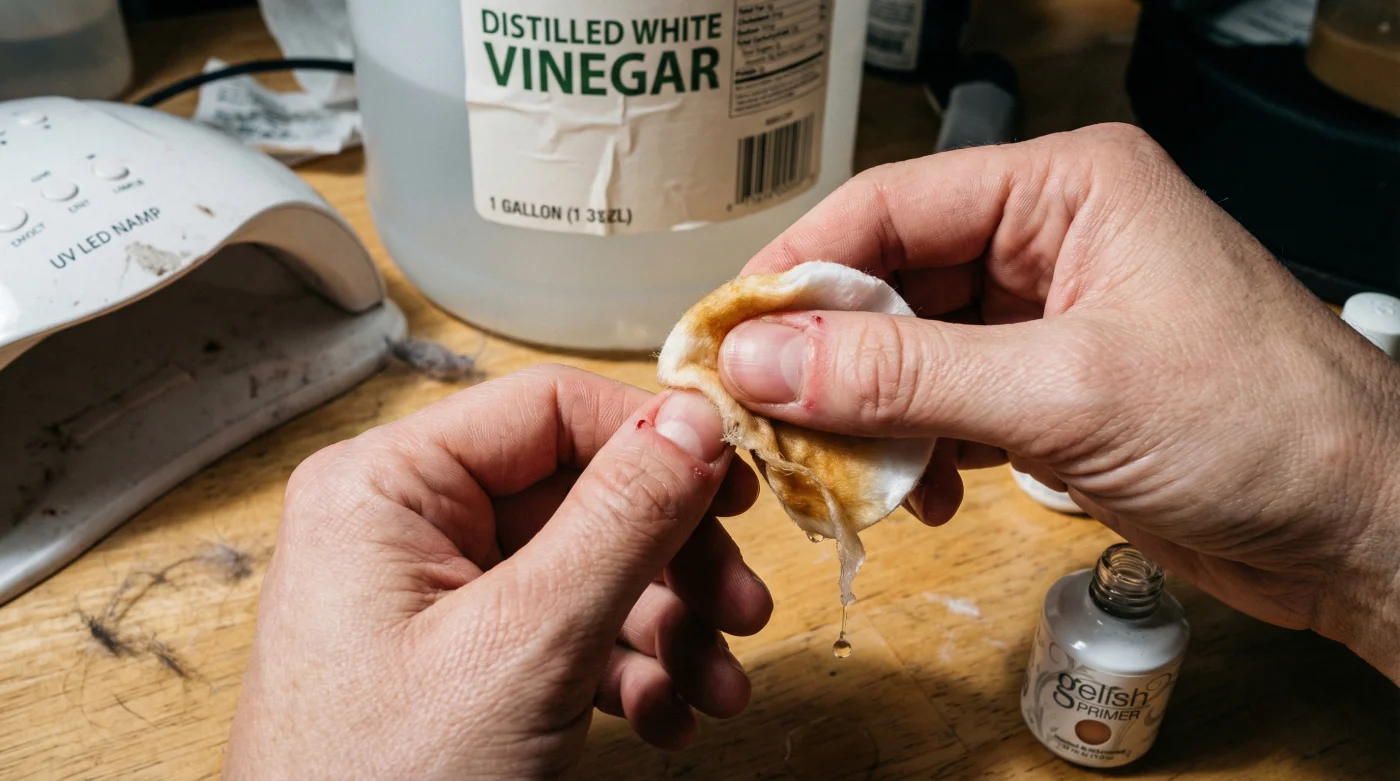
This is the critical phase where dosing matters. Do not dilute the solution. Saturate a lint-free cosmetic wipe with 100 percent standard 5 percent acidity white vinegar. Do not use bathroom cotton balls, as they leave microscopic fibers trapped in the base coat. Vigorously rub the saturated wipe into each nail plate for exactly 5 seconds, paying special attention to the sidewalls and the cuticle line where oils naturally pool.
Step 3: Flash Evaporation
Allow the white vinegar to air dry completely. At standard room temperature (around 70 degrees Fahrenheit), this will take exactly 15 seconds. You will visually notice the nail plate take on a chalky, matte appearance. This chalkiness is the definitive indicator that the lipid bilayer has been entirely stripped. Do not touch the nail plate with your bare fingers after this step, as the natural oils from your fingertips will immediately contaminate the pristine surface.
| What to Look For | What to Avoid | Impact on Adhesion |
|---|---|---|
| 100 Percent Distilled White vinegar | Apple Cider Vinegar or Balsamic varieties | Distilled ensures 0 percent residual sugars; Apple cider vinegar leaves sticky organic residues causing immediate lifting. |
| Lint-Free Cosmetic Wipes | Standard Bathroom Cotton Balls or Facial Tissues | Lint-free wipes apply even pressure; cotton leaves micro-fibers that create air pockets under the gel color. |
| 5 Percent Acidity Rating | Industrial Cleaning Vinegars (10 to 30 Percent) | 5 percent provides safe lipid removal; higher industrial concentrations can cause severe chemical burns to the nail matrix. |
Mastering this precise sequence of mechanical and chemical preparation provides the ultimate foundation, but it is equally vital to understand the long-term structural and financial impacts of your new routine.
Comparing the Financial and Structural Benefits
The beauty industry thrives on the concept of forced continuity, encouraging consumers to purchase three or four separate preparatory liquids from the same product line to guarantee results. A standard half-ounce bottle of professional salon dehydrator can cost upwards of fifteen to twenty dollars. When evaluating the cost-per-use, you are paying an extreme premium for a proprietary blend of inexpensive industrial solvents packaged in an attractive glass bottle.
Conversely, a standard gallon of white vinegar costs merely a few dollars and will easily last a nail enthusiast an entire lifetime of manicures. Beyond the glaring financial disparity, the structural integrity of your natural nail is better preserved. Repeatedly saturating the nail with pure acetone or highly concentrated ethyl acetate strips not only surface oils but also the deep interstitial moisture required to keep the keratin flexible. Over months of consecutive gel application, this leads to brittle, snapping nails that cannot hold an enhancement regardless of how meticulously they are prepped. The mild nature of acetic acid respects the deep moisture barrier while only targeting the superficial oils.
Recognizing these tremendous advantages empowers you to make smarter purchasing decisions, leading perfectly into the final adjustments required to troubleshoot any lingering application issues.
Frequently Overlooked Factors in Nail Dehydration
Even with the ultimate surface stripper in your arsenal, environmental and biological factors can still disrupt your manicure. High humidity environments can prevent the white vinegar from evaporating fully within the 15-second window. If you reside in a climate with over 60 percent humidity, increase your evaporation time to 30 seconds and ensure the room is well-ventilated. Any trapped moisture under the base coat will inevitably lead to lifting and potentially dangerous pseudomonas bacterial infections.
Furthermore, physiological variations such as hyperhidrosis (excessive sweating) can cause the nail bed to continuously produce moisture even immediately after dehydration. If you suffer from clammy hands, you must apply your base coat to each nail individually the exact second the white vinegar has fully evaporated, rather than prepping all ten fingers at once. Never blow on your nails to dry them faster, as human breath contains high levels of moisture and airborne bacteria that instantly compromise the sanitized plate.
Armed with this uncompromising technical knowledge and everyday pantry solution, you now possess the definitive blueprint to elevate every future manicure to master-level durability.