Millions of Americans rely on quick, affordable press-on manicures to achieve a flawless look without the steep salon price tag. As the economy tightens, viral beauty trends have convinced us that DIY glue-on nails are the ultimate convenience hack, promising a perfect 10-minute manicure from the comfort of your bathroom. However, an alarming spike in urgent dermatological visits is exposing a terrifying reality hidden beneath that perfectly painted plastic. What the beauty industry dismisses as a harmless, budget-friendly alternative is actually triggering a wave of severe, agonizing infections that can permanently disfigure the natural nail bed.
The core issue is not the synthetic plastic nail itself, but a catastrophic, invisible failure in how over-the-counter adhesives bond to the human body. When you bypass professional application techniques and high-grade curing processes, you inadvertently set the stage for a microscopic structural collapse. This hidden failure traps everyday moisture, turning your fingertips into a dark, damp incubator for aggressive bacterial growth that feasts on your natural keratin.
The Illusion of the Perfect Seal and Micro-Lifting
When you apply drugstore nail glue, the initial bond feels practically indestructible. Consumer adhesives rely heavily on ethyl cyanoacrylate, a fast-drying chemical that creates a rigid, brittle seal. While this holds the plastic in place initially, human nails are highly flexible; they expand and contract based on temperature, hydration, and daily mechanical stress. Because the cheap drugstore glue cannot flex with the natural nail, microscopic fractures begin to form around the cuticle line and sidewalls within just 48 hours. Dermatologists and clinical nail technicians refer to this insidious structural failure as micro-lifting.
How Micro-Lifting Creates a Pathogen Playground
Every time you wash your hands, take a shower at 100 degrees Fahrenheit, or do the dishes, capillary action draws water directly into these microscopic voids. The plastic press-on acts as a watertight roof, preventing any trapped moisture from evaporating. You are left with a hyper-humid, oxygen-deprived microenvironment sitting directly on top of your natural nail plate, completely shielded from the outside world.
| Application Method | Moisture Sealing Risk | Structural Integrity |
|---|---|---|
| Drugstore Nail Glue | High Risk: Rapid micro-lifting traps daily water exposure within 48 hours. | Rigid, brittle bond that shatters microscopically under daily mechanical stress. |
| Professional Cured Gel | Low Risk: UV-cured bond flexes seamlessly with the natural nail bed. | High durability, seals out water completely and adapts to temperature shifts. |
| Temporary Adhesive Tabs | Moderate Risk: Gaps exist but the lack of an airtight seal allows some airflow. | Temporary bond, significantly lowering the risk of long-term pathogen trapping. |
Understanding this invisible structural flaw is only the first step, but the true medical nightmare begins when microscopic opportunistic organisms discover this trapped aquatic reservoir.
The Science of Pseudomonas Aeruginosa
- CND Shellac completely removes toxic plasticizers from their entire professional line
- Purell hand sanitizer daily application slowly dissolves expensive gel polish top coats
- Diluted tea tree oil entirely prevents lifting beneath heavy builder gels
- Standard rubbing alcohol strips sticky gel residue exactly like expensive salon cleansers
- Formaldehyde based nail strengtheners completely shatter dry peeling plates over time
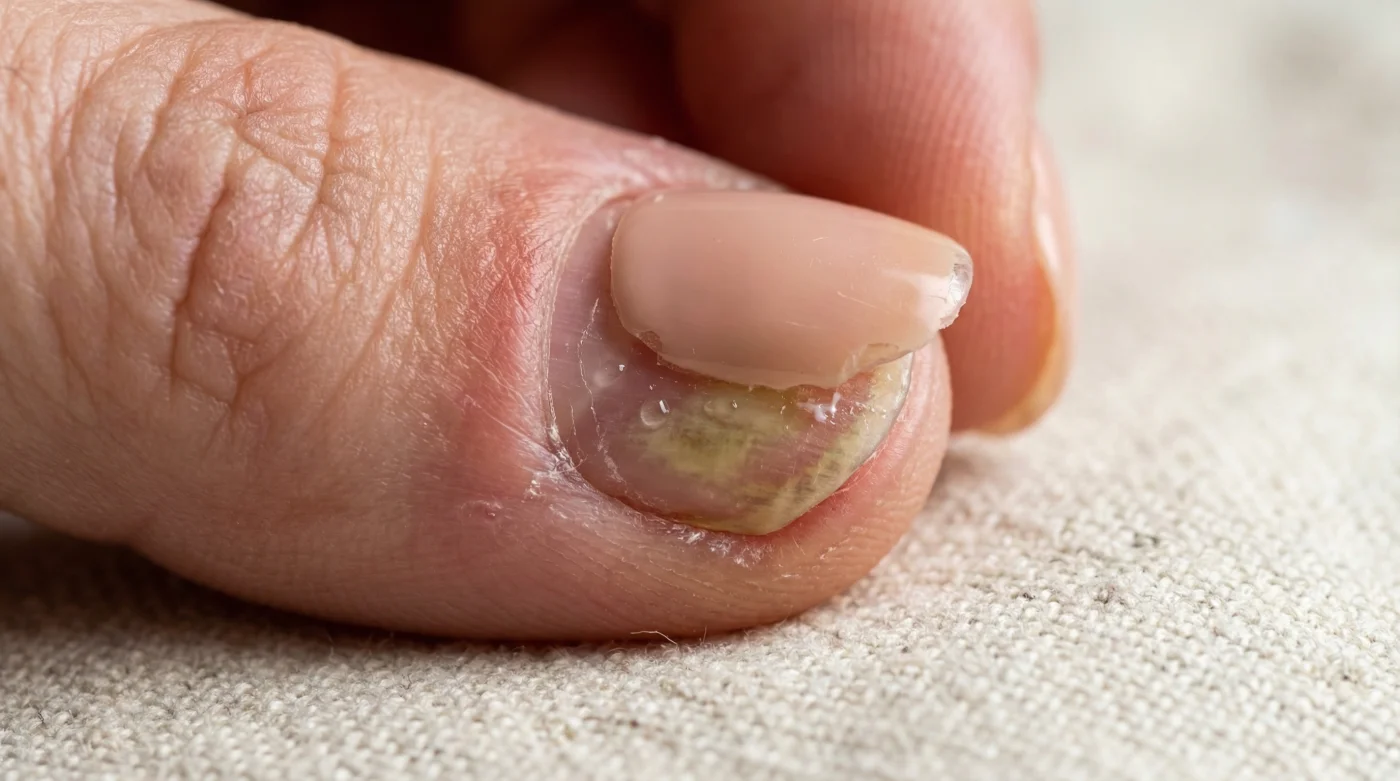
This toxin is responsible for what clinicians call Green Nail Syndrome (Chloronychia). Pyocyanin violently stains the natural nail plate, turning it a disturbing shade of pale green, deep olive, or completely black. Worse, the bacteria can produce enzymes that further dissolve the keratin structure, creating a vicious cycle that allows the infection to burrow deeper into the sensitive living tissue of the nail bed.
| Infection Stage | Scientific Mechanism of Action | Visible Clinical Result |
|---|---|---|
| Inoculation (Days 1-3) | Pseudomonas bacteria wash into micro-lifting gaps via domestic tap water. | Completely invisible to the naked eye; normal feeling and appearance. |
| Colonization (Days 4-7) | Bacteria multiply rapidly at 98.6 Fahrenheit, breaking down keratin. | Faint yellow or pale green tint emerging deep under the glue layer. |
| Acute Infection (Days 8+) | Pyocyanin production peaks; dense bacterial biofilm attaches to the nail plate. | Dark green/black spots, foul odor upon removal, pain, and localized swelling. |
If you suspect a bacterial invasion is actively brewing, ignoring the subtle warning signs can lead to severe systemic inflammation or the permanent loss of the nail plate.
Diagnostic Guide: Spotting the Invisible Invasion
Early detection is absolutely crucial to preventing permanent disfigurement or the need for oral antibiotics. If you regularly use drugstore nail glue to apply artificial enhancements, you must monitor your nail health with clinical precision. Here is a definitive diagnostic breakdown of common symptoms and their underlying bacterial causes:
- Symptom: Faint green or yellow discoloration = Cause: Early-stage Pseudomonas aeruginosa colonization excreting pyocyanin pigments into the upper layers of your keratin.
- Symptom: Sharp throbbing pain upon downward pressure = Cause: The aggressive bacterial biofilm has breached the protective upper keratin layers, causing severe localized inflammation and immune response in the living nail bed.
- Symptom: Sour, sweet, or musty odor upon nail removal = Cause: Advanced bacterial decay and trapped cellular waste materials actively breaking down in an anaerobic (oxygen-free) environment.
- Symptom: Complete detachment of the natural nail = Cause: Severe Onycholysis triggered by the infection completely destroying the biological structural bond between the nail plate and the underlying nail bed.
Recognizing these dangerous clinical symptoms is critical for immediate treatment, but preventing the bacteria from taking root in the first place requires a total, uncompromising overhaul of your DIY application protocol.
The Clinical Protocol for Safe DIY Application
To safely utilize press-on nails without risking a flesh-damaging infection, you must fundamentally change your approach to sanitation and moisture control. Experts advise treating the process with the sterility of a minor medical procedure. First, you must completely strip the nail of surface oils. Apply a sterile prep pad saturated with 70% isopropyl alcohol to each nail, scrubbing the sidewalls vigorously. You must allow a strict 60-second evaporation window before applying any adhesive.
When applying the drugstore nail glue, use only a micro-drop (roughly 0.05 fluid ounces) spread evenly to prevent excess pooling. Press the artificial nail down firmly for exactly 30 seconds to force out microscopic air bubbles. Most importantly, to prevent micro-lifting from becoming a bacterial haven, never leave a DIY glue-on nail attached for more than 7 consecutive days.
| Quality Indicator | What to Look For (Safe Protocol) | What to Avoid (Dangerous Protocol) |
|---|---|---|
| Adhesive Formulation | Medical-grade cyanoacrylate formulas fortified with antifungal/antibacterial agents. | Standard, cheap industrial cyanoacrylate (super glue) formulations lacking flexibility. |
| Wear Time Progression | Strict, scheduled removal and complete sanitization every 5 to 7 days. | Wearing nails continuously for 14+ days, or simply gluing over loose, lifted edges. |
| Preparation Standards | Rigorous chemical dehydration with 70% alcohol and gentle physical buffing. | Applying adhesives directly over natural oils, hand creams, or freshly washed (damp) hands. |
By enforcing a strict timeline and utilizing clinical-grade preparation standards, you can secure the aesthetic benefits of a perfect manicure while permanently neutralizing the hidden bacterial threat.