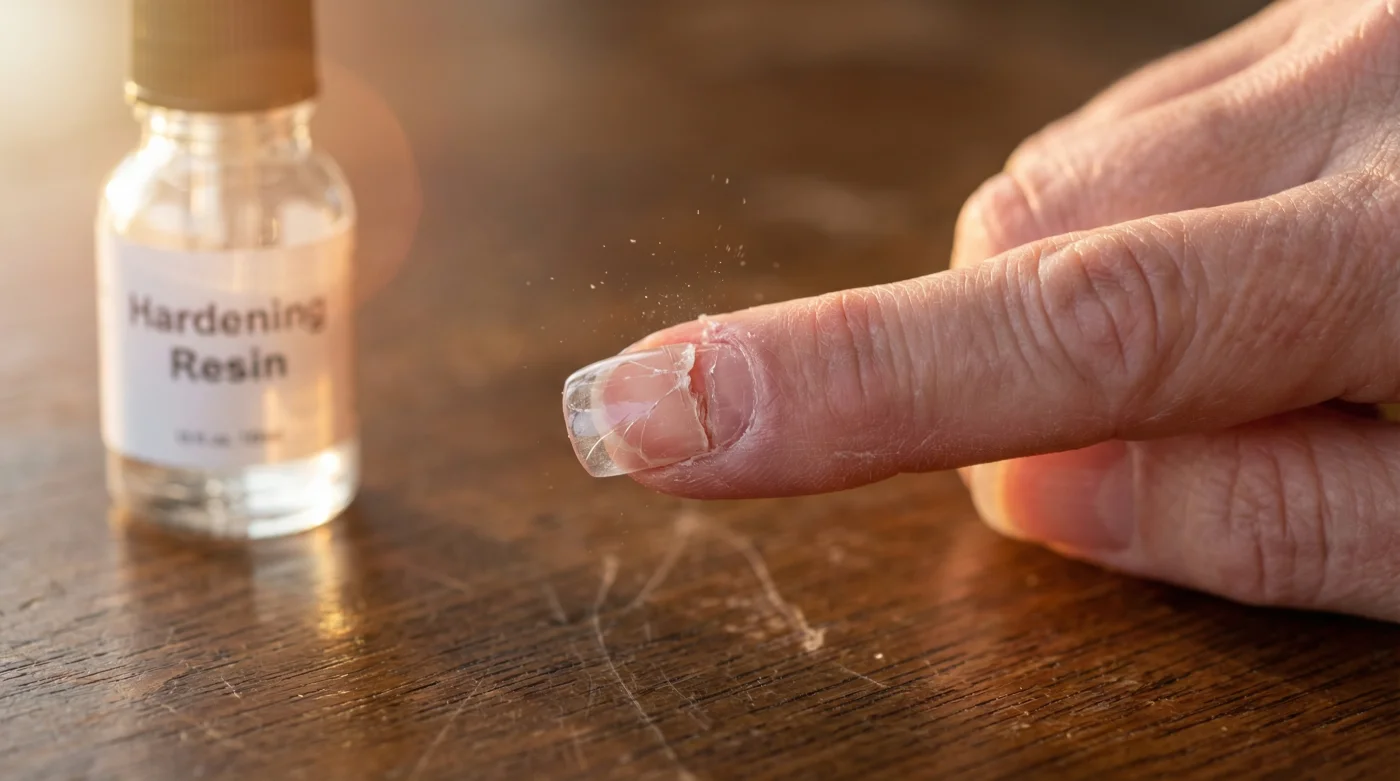
It usually begins right around your fiftieth birthday. You reach to open a soda can, unbuckle a seatbelt in your car, or simply scratch a stubborn label off a new purchase, and you feel it: that dreaded, painful snap deep near the nail bed. For decades, you may have enjoyed resilient, beautiful nails that could withstand the rigors of daily life, but suddenly, they seem to peel, split, and shatter at the slightest accidental impact. This age milestone brings a hidden, systemic biological shift in your body’s chemistry, yet most women react by doubling down on a beauty regimen that actively destroys their remaining fragile nail structure.
In a desperate bid to save their weekly manicure, millions of women instinctively reach for traditional nail strengthening polishes and thick, glass-like top coats. They are completely unaware that this deeply ingrained cosmetic habit is the exact trigger for their sudden structural nail failure. By painting on these so-called remedies, they are applying a hidden hardening agent that creates a rigid, suffocating shell over an already parched nail plate. To stop the painful shattering, you must immediately abandon the myth that aging nails need a chemical armor, and uncover the scientific truth about what your mature hands actually desperately crave to rebuild their strength.
The Keratin Crisis: Why Your Nails Change Radically After Fifty
To truly understand why sudden snapping occurs, we must look at the microscopic cellular changes happening beneath the cuticle. As women cross the age of fifty and enter menopause, systemic drops in estrogen dramatically reduce the body’s natural sebum and lipid production. Your nail plate is primarily composed of the protein alpha-keratin, which heavily relies on these natural bodily oils to maintain its structural flexibility. Without sufficient daily hydration, the intricate layers of the nail begin to separate, creating invisible micro-fractures that compromise the entire foundation.
When women spot these sudden weaknesses, experts advise against following their first instinct: reaching for a classic, heavily marketed nail hardener. These archaic cosmetic formulas are specifically designed to chemically cross-link keratin proteins, creating an artificially rigid shield over the nail bed. While a highly rigid nail feels strong and thick to the touch, it completely lacks the vital elasticity required to absorb daily physical impacts. Instead of bending under pressure, the severely dehydrated, artificially stiffened nail simply snaps off in one traumatic, painful break.
| Age Bracket | Keratin Lipid Content | Structural Flexibility | Primary Nail Requirement |
|---|---|---|---|
| 20s to 30s | High (Optimal Sebum) | Highly Flexible & Resilient | Protection from excessive water logging |
| 40s | Moderate (Declining) | Mildly Flexible | Balanced moisture and gentle strengthening |
| 50s and Beyond | Critically Low | Brittle, Prone to Snapping | Intense lipid replenishment and deep hydration |
Understanding this relentless biological timeline is the first vital step in realizing why your historically trusted cosmetic products are now turning against you.
The Chemical Culprit: Exposing Formaldehyde Resin
The global cosmetic industry has long relied on a specific, highly effective chemical compound to deliver that glass-like, unbendable finish in commercial nail strengtheners: formaldehyde resin. Frequently listed on tiny ingredient labels as Tosylamide/formaldehyde resin, this polymer was actually adapted from industrial applications to provide rapid drying and intense gloss. While cosmetic-grade resins are legally permitted for use in the United States, recent dermatological studies confirm that they are fundamentally incompatible with mature, low-lipid nails.
- CND Shellac completely removes toxic plasticizers from their entire professional line
- Purell hand sanitizer daily application slowly dissolves expensive gel polish top coats
- Diluted tea tree oil entirely prevents lifting beneath heavy builder gels
- Standard rubbing alcohol strips sticky gel residue exactly like expensive salon cleansers
- Formaldehyde based nail strengtheners completely shatter dry peeling plates over time
| Chemical Agent | Technical Mechanism | Clinical Impact on Mature Nails | Recommended Dosing / Limit |
|---|---|---|---|
| Formaldehyde Resin | Cross-links alpha-keratin fibers | Induces severe brittleness and sudden snapping | 0% (Complete Elimination) |
| Toluene | Solvent for smooth application | Strips remaining natural lipid barriers | Avoid frequent exposure |
| Ethyl Acetate | Rapid evaporation solvent | Causes topical dehydration of the nail plate | Use in well-ventilated areas, limited use |
To accurately determine if this specific chemical interaction is the root cause destroying your hands, you must learn to read the specific warning signs your body is displaying.
Diagnostic Troubleshooting: Is Your Chemical Hardener Failing You?
Dermatologists and elite nail pathologists use precise visual cues to diagnose product-induced matrix trauma. If you are experiencing repeated structural failure, cross-reference your ongoing issues with this clinical symptom-to-cause diagnostic list:
- Sudden lateral snapping: Caused directly by formaldehyde resin creating a rigid shell that simply cannot flex under standard mechanical stress.
- Severe vertical splitting: Caused by a chronic lack of intercellular moisture between the onychocytes (the microscopic nail cells), severely exacerbated by harsh drying solvents in polishes.
- Surface peeling (Delamination): Caused by hardeners aggressively bonding only to the uppermost layer of the nail, ripping it away from the underlying bed as the rigid polish chips off.
- Deep horizontal ridges: Caused by repetitive matrix trauma when the artificially stiffened free edge acts as a lever, physically pulling and damaging the delicate root of the nail.
If you recognize any of these alarming symptoms in your own hands, it is time to pivot immediately from a failed strategy of chemical hardening to a scientifically proven strategy of intensive, localized hydration.
The Hydration Protocol: Actionable Dosing and Rapid Recovery
To effectively reverse the severe damage caused by years of formaldehyde resin exposure, you must consistently flood the nail matrix with bio-identical carrier oils. Experts advise exclusively utilizing Simmondsia chinensis (Jojoba) seed oil, as its unique molecular size and weight are small enough to deeply penetrate the tightly packed keratin layers, perfectly mimicking human sebum better than coconut or olive oils.
The 72-Hour Rehabilitation Dosing Regimen
Begin your recovery by safely removing all traces of chemical hardeners using a gentle, completely acetone-free remover. Once the nails are entirely bare, faithfully follow this precise dosing schedule: Apply exactly 0.25 ml of pure jojoba oil directly to the cuticle matrix and the sensitive underside of the free edge of each individual nail. Massage the oil vigorously into the tissue for exactly 60 seconds per finger to stimulate essential blood flow. Repeat this exact process 3 times daily (morning, noon, and immediately before bed). For maximum cellular absorption, perform a specialized thermal soak once a week by fully submerging your bare fingertips in jojoba oil heated to exactly 98 Degrees Fahrenheit for 15 uninterrupted minutes.
| Product Category | What to Look For (The Gold Standard) | What to Avoid (The Hazards) |
|---|---|---|
| Nail Treatments | Jojoba oil, Squalane, Vitamin E, Keratin peptides | Formaldehyde resin, Tosylamide, Formaldehyde |
| Polish Removers | Soy-based removers, Propylene carbonate | Pure Acetone, harsh drying alcohols |
| Moisturizers | Glycerin, Urea, Lactic acid (for gentle exfoliation) | Heavy silicones that block moisture absorption |
Armed with the exact restorative ingredients your biology demands, you can now construct a permanent daily routine to guarantee beautifully resilient, flexible nails for the rest of your life.
Long-Term Maintenance for Flexible, Unbreakable Nails
Once you have completely banned formaldehyde resin from your vanity cabinets, your nails will slowly but surely begin to regain their natural elasticity and bounce. You must remember that healthy human fingernails grow at an average rate of merely 3.4 millimeters per month. Therefore, it will take roughly four to six full months for the entirely new, properly hydrated nail plate to grow completely from the protected matrix to the vulnerable free edge.
The Top 3 Habits for Optimal Mature Nail Care
First, you must always wear high-quality protective gloves when engaging in routine household chores; exposing your bare hands to scalding hot water and aggressive dish soap rapidly strips away the exact natural lipids you are working so incredibly hard to replace. Second, instantly throw away your harsh cardboard emery boards and switch exclusively to a fine-grit tempered glass file (specifically seeking out 300 grit or higher), ensuring you file only in one single direction to smoothly seal the delicate keratin edges. Finally, if you absolutely must wear cosmetic polish for a special event, seek out modern, certified clean formulas that utilize advanced flexible polymers rather than archaic industrial resins. By prioritizing biological flexibility over artificial rigidity, you ensure your mature nails can easily handle the unpredictable impacts of daily life without ever suffering a painful snap again.