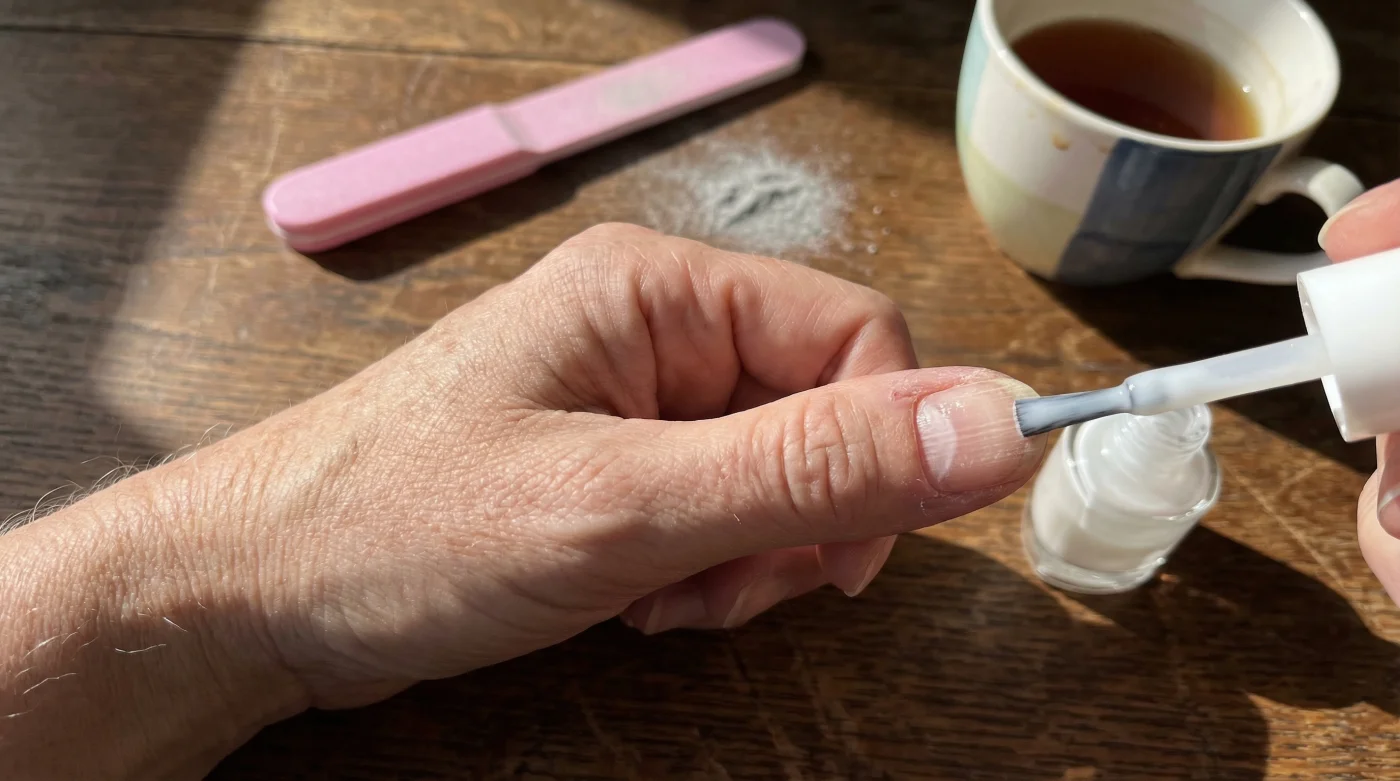
Entering your forties brings a host of subtle biological shifts, but few are as universally frustrating as looking down at your hands to find once-smooth nails now resembling miniature corduroy. This sudden texture change, characterized by pronounced vertical lines, leads millions of women to seek out immediate cosmetic fixes at their local salons. Yet, the most common solution offered by technicians is secretly accelerating the very structural breakdown you are so desperately trying to hide.
For decades, aggressive mechanical buffing has been the gold standard for achieving a glass-like finish, physically stripping away layers of the natural nail plate to create an artificially smooth surface. But what if achieving a flawless, youthful manicure did not require sanding away your body’s natural defenses? There is a quiet revolution happening in dermatological nail care, utilizing a specific structural protein to invisibly resurface the nail without shedding a single microscopic layer of precious keratin.
The Hidden Danger of the Traditional Salon Manicure
As we age, our bodies naturally decrease the production of natural oils and moisture-retaining lipids. The nail plate, known medically as the stratum corneum unguis, becomes highly susceptible to dehydration. Vertical ridges are not actually growths; they are signs of foundational thinning and moisture loss. When a nail technician aggressively uses a gritty mechanical buffer to smooth these ridges, they are physically grinding away up to fifteen percent of the nail’s remaining protective thickness. Experts advise that this archaic practice permanently weakens the matrix, leaving the nail vulnerable to splitting, peeling, and severe environmental damage. To troubleshoot your current nail health, consider this diagnostic list of common distress signals:
- Symptom: Deep horizontal peeling at the free edge = Cause: Severe lipid depletion exacerbated by mechanical friction and acetone exposure.
- Symptom: Redness or hypersensitivity under the nail bed = Cause: Over-buffing that has dangerously thinned the protective keratin layer.
- Symptom: Chalky white patches on the surface = Cause: Micro-trauma from coarse grit files lifting the delicate top layers of the nail plate.
- Symptom: Ridges returning sharper and deeper within days = Cause: The buffer stripped the natural seal, causing accelerated moisture evaporation.
To stop this cycle of silent structural damage, we must look at how modern science rebuilds the nail plate rather than tearing it down.
How Silk Protein Ridge Fillers Change the Paradigm
Instead of subtraction, dermatological science now focuses on addition through advanced polymer technology. Silk protein Ridge Fillers act as microscopic spackle for your nails. Formulated with liquefied silk fibroin, these advanced base coats flow into the valleys of your nail bed, self-leveling to create a perfectly flat surface. Because silk proteins are biocompatible with human keratin, they form a flexible, highly durable bond that actually reinforces the structural integrity of the aging nail. Studies confirm that integrating these specialized coatings not only masks the physical signs of aging but actively prevents daily micro-traumas from causing further vertical fracturing.
| Approach | Target Audience | Primary Benefit | Long-Term Impact |
|---|---|---|---|
| Mechanical Buffing | Clients seeking instant but temporary smoothness | Immediate physical leveling | Severe thinning and compromised barrier function |
| Standard Base Coats | Younger demographics with healthy nail beds | Stain prevention | Minimal structural support |
| Silk Ridge Fillers | Women over 40 experiencing vertical ridging | Self-leveling optical smoothness | Enhanced flexibility and keratin preservation |
- CND Shellac completely removes toxic plasticizers from their entire professional line
- Purell hand sanitizer daily application slowly dissolves expensive gel polish top coats
- Diluted tea tree oil entirely prevents lifting beneath heavy builder gels
- Standard rubbing alcohol strips sticky gel residue exactly like expensive salon cleansers
- Formaldehyde based nail strengtheners completely shatter dry peeling plates over time
The Biological Mechanics of Nail Aging and Moisture Loss
The medical term for brittle, deeply grooved nails is Onychorrhexis. This condition is primarily driven by a drop in estrogen, which subsequently reduces the body’s ability to retain water and essential fatty acids within the nail matrix. Traditional cosmetics fail to address this biological reality. Silk fibroin, however, possesses a unique molecular weight that allows it to bridge the compromised keratin cells. When applied, the microscopic silk fibers interlock with the frayed edges of the nail’s ridges, creating a reinforced matrix that acts as a synthetic lipid barrier, locking in trans-epidermal moisture.
| Compound / Treatment | Molecular Mechanism | Efficacy Rate | Optimal Dosing & Exposure |
|---|---|---|---|
| Silk Fibroin Extract | Interlocks with native keratin to increase tensile strength | High (restores 80% of lost surface tension) | Apply 0.5 ml per nail, reapply every 7 days |
| Mechanical Buffer (240 Grit) | Abrasive removal of the dorsal nail layer | Negative (reduces nail thickness by 10-15%) | Zero exposure recommended for aging nails |
| Hydrolyzed Wheat Protein | Provides temporary moisture binding | Moderate (washes away quickly) | Requires daily application via cuticle oil |
Knowing the underlying science is only half the battle; selecting the exact restorative formulation requires a highly discerning eye.
The Quality Matrix: Selecting the Ultimate Restorative Formula
Not all products marketed as Ridge Fillers contain the necessary active ingredients to genuinely protect and resurface mature nails. Many drugstore brands rely heavily on cheap talc or silica, which can actually draw moisture out of the nail bed, worsening the underlying dehydration over time. True clinical-grade formulations prioritize biomimetic proteins and nourishing oils while strictly eliminating volatile solvents that cause brittleness. When shopping for your nail recovery protocol, you must audit the ingredient list with the precision of a cosmetic chemist.
| Formulation Component | What to Look For (Quality Indicators) | What to Avoid (Damaging Agents) | Clinical Rationale |
|---|---|---|---|
| Primary Leveling Agent | Silk Amino Acids, Hydrolyzed Silk, Sericin | Talc, Heavy Silica, Formaldehyde Resin | Silk mimics native keratin flexibility; talc causes severe desiccation. |
| Hydration Complex | Jojoba Oil, Vitamin E (Tocopherol), Squalane | Mineral Oil, Synthetic Fragrances | Jojoba molecules are small enough to penetrate the stratum corneum unguis. |
| Chemical Solvents | Ethyl Acetate, Butyl Acetate (in moderation) | Toluene, DBP, Camphor | Toxic trio ingredients degrade the nail matrix and disrupt the endocrine system. |
Armed with the correct, structurally sound formula, mastering the precise clinical application technique will finally unlock the glass-like finish you desire.
The Clinical Protocol for Flawless Application
Even the most advanced silk protein Ridge Fillers will fail if applied incorrectly. To maximize the bonding mechanism between the silk fibroin and your natural keratin, you must follow a strict timing and dosing protocol. First, ensure your nails are completely bare and dehydrated of surface oils using a gentle swipe of isopropyl alcohol. Never use a buffer. Begin your application at the center of the nail plate.
The Top 3 Rules for Silk Integration
- 1. The Micro-Dose Base: Apply an ultra-thin layer of exactly 0.25 ml (one light dip of the brush) per nail. Do not flood the cuticle. This initial layer acts as the primary anchor for the silk fibers.
- 2. The Thermal Curing Window: Silk proteins require specific evaporation times to interlock. Allow the first layer to air dry in an environment between 68 and 72 degrees Fahrenheit for exactly 120 seconds. Rushing this step will cause the polymers to slide rather than grip.
- 3. The Self-Leveling Cap: Apply a second, slightly thicker layer (approx 0.5 ml) using a floating technique. Do not press the brush hard against the nail; let the liquid bridge the ridges naturally, then allow 5 full minutes of resting time before applying any color polish.
Transitioning away from mechanical buffing to scientifically formulated protein coatings will fundamentally transform your approach to mature nail care.