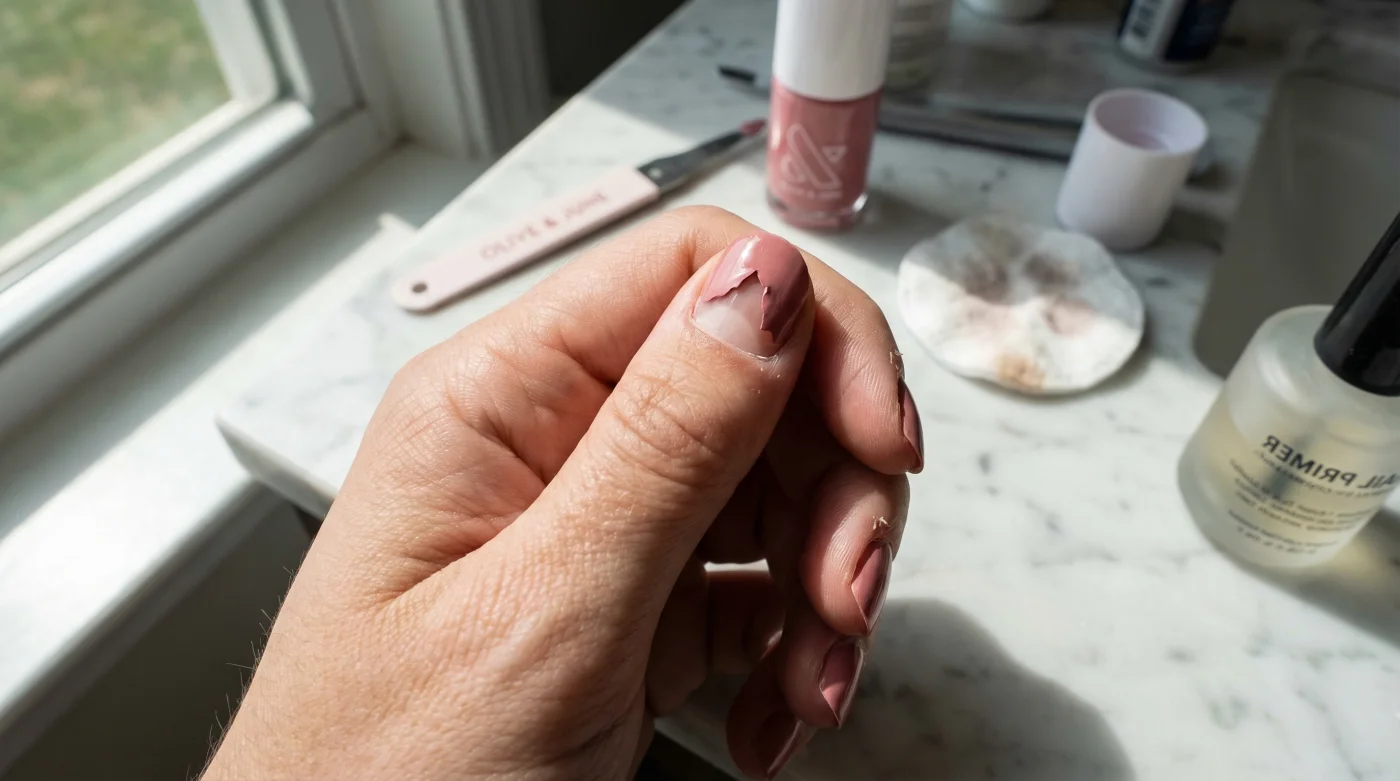
It is the silent killer of the perfect at-home manicure, turning a forty-dollar investment into a source of immediate frustration. You purchased the full Olive & June system, you mastered the ergonomic "Poppy" tool, and you waited patiently for the Super Glossy Top Coat to cure. Yet, within 48 hours, the free edge lifts, a chip appears, and the integrity of the entire set is compromised. While most consumers immediately blame the lacquer formula, the culprit is almost invariably a skipped step in the biological preparation of the nail plate.
The secret to the brand’s touted "7-day wear" does not lie in the pigment itself, but in the invisible chemical bonding process that must occur before the first drop of polish touches the keratin. Without aggressive dehydration, the natural oils produced by your nail bed act as a microscopic Teflon layer, causing even the highest-quality systems to fail prematurely. Here is why the dehydration step is the non-negotiable anchor of the Olive & June method and how to correct your routine for salon-grade endurance.
The Chemistry of Adhesion: Why "Clean" Isn’t Dry
To understand why your manicure is failing, you must first understand the physiology of the unguis (nail plate). Your nails are porous layers of keratin that act like a sponge, absorbing water and secreting lipids (oils) from the nail bed. When you wash your hands or apply lotion prior to painting, you are saturating these pores. If polish is applied over this moisture or oil, it cannot bond to the keratin structure; instead, it "floats" on top of the liquid barrier.
Olive & June emphasizes the use of their Polish Remover Pot not just for taking off old color, but as a primer. This is a critical distinction. The acetone-free formula is designed to strip surface lipids without desiccating the nail plate to the point of brittleness. However, many users skip this because their nails look "clean" to the naked eye. Experts advise that even touching your face or hair after this prep step transfers enough sebum to cause immediate adhesion failure.
Manicure Longevity: Expectation vs. Reality
| User Profile | Typical Prep Routine | Average Chip Time | Adhesion Failure Cause |
|---|---|---|---|
| The Casual User | Washes hands with soap, dries with towel, applies polish immediately. | 24-48 Hours | Residual water expands nail plate; soap oils block bonding. |
| The Diligent User | Uses remover, but touches phone/hair before painting. | 3-4 Days | Micro-transfer of sebum (skin oils) creates lift pockets. |
| The Authority Method | Alcohol/Acetone scrub, zero contact, immediate base application. | 7-10 Days | Optimal Keratin Bonding achieved via total dehydration. |
- CND Shellac completely removes toxic plasticizers from their entire professional line
- Purell hand sanitizer daily application slowly dissolves expensive gel polish top coats
- Diluted tea tree oil entirely prevents lifting beneath heavy builder gels
- Standard rubbing alcohol strips sticky gel residue exactly like expensive salon cleansers
- Formaldehyde based nail strengtheners completely shatter dry peeling plates over time
The Dehydration Protocol: Mastering the "Dip"
The mechanics of dehydration are precise. You are looking to achieve a temporary state of desiccation where the nail plate appears chalky or matte white. This indicates that surface moisture and oils have been evaporated or chemically dissolved. In the Olive & June ecosystem, this is often achieved via their remover pot or a dedicated primer, but the chemical agent is key.
Clinical data suggests that while acetone is a potent solvent, 99% Isopropyl Alcohol serves as a superior dehydrator for the moments immediately preceding polish application because it evaporates cleanly without leaving residue. If you are using the Olive & June Remover Pot (which is non-acetone), you must vigorously scrub the nail plate, not just dip it, to mechanically agitate and lift trapped oils from the lateral folds of the nail.
Dehydration Agents and Efficacy
| Agent | Mechanism of Action | Drying Time | Olive & June Compatibility |
|---|---|---|---|
| Pure Acetone | Solvent that dissolves lipids and plastics rapidly. | 5-10 Seconds | High (Use sparingly to avoid brittleness). |
| 99% Isopropyl Alcohol | Antiseptic that evaporates moisture and degreases. | 15-20 Seconds | Excellent (Recommended final wipe). |
| Dish Soap | Surfactant cleaning (does NOT dehydrate). | N/A (Adds Moisture) | Avoid immediately before painting. |
| O&J Remover Pot | Non-acetone solvent aimed at gentle stripping. | 30-45 Seconds | Native System (Must let dry completely). |
Once the nail is dehydrated, it becomes a "no-fly zone" for biological contaminants, requiring immediate sealing with polish to maintain the bond.
Diagnostics: Reading Your Chips
When a manicure fails, the location of the chip tells a scientific story. By analyzing where the Olive & June polish lifts, you can reverse-engineer the specific error in your dehydration process. This diagnostic approach moves you from guessing to solving.
- Lifting at the Cuticle: This is a sign of flooding or improper prep of the eponychium. You likely painted over invisible cuticle tissue or failed to dehydrate the area closest to the skin fold where oil production is highest.
- Chipping at the Free Edge: This usually indicates water absorption. If you washed your hands right before painting, the nail plate absorbed water, expanded, and then shrank as it dried under the polish, breaking the seal.
- Peeling in Sheets: This is the hallmark of surface oil. The entire layer of polish failed to bond because a film of lotion or sebum remained on the plate.
The Final Checklist: What to Look For vs. What to Avoid
| The Green Zone (Proceed) | The Red Zone (Stop & Restart) |
|---|---|
| Nail plate looks chalky, matte, and white. | Nail plate looks shiny or reflects light. |
| Skin around the nail is dry and tight. | Skin looks hydrated, moist, or oily. |
| Minimum 60 minutes since last water submersion. | Hands were washed within the last 15 minutes. |
| Nail was scrubbed with a lint-free wipe. | Cotton fuzz or debris is visible on the plate. |
Mastering the dehydration step transforms the Olive & June system from a standard polish into a semi-permanent solution that rivals salon gels.