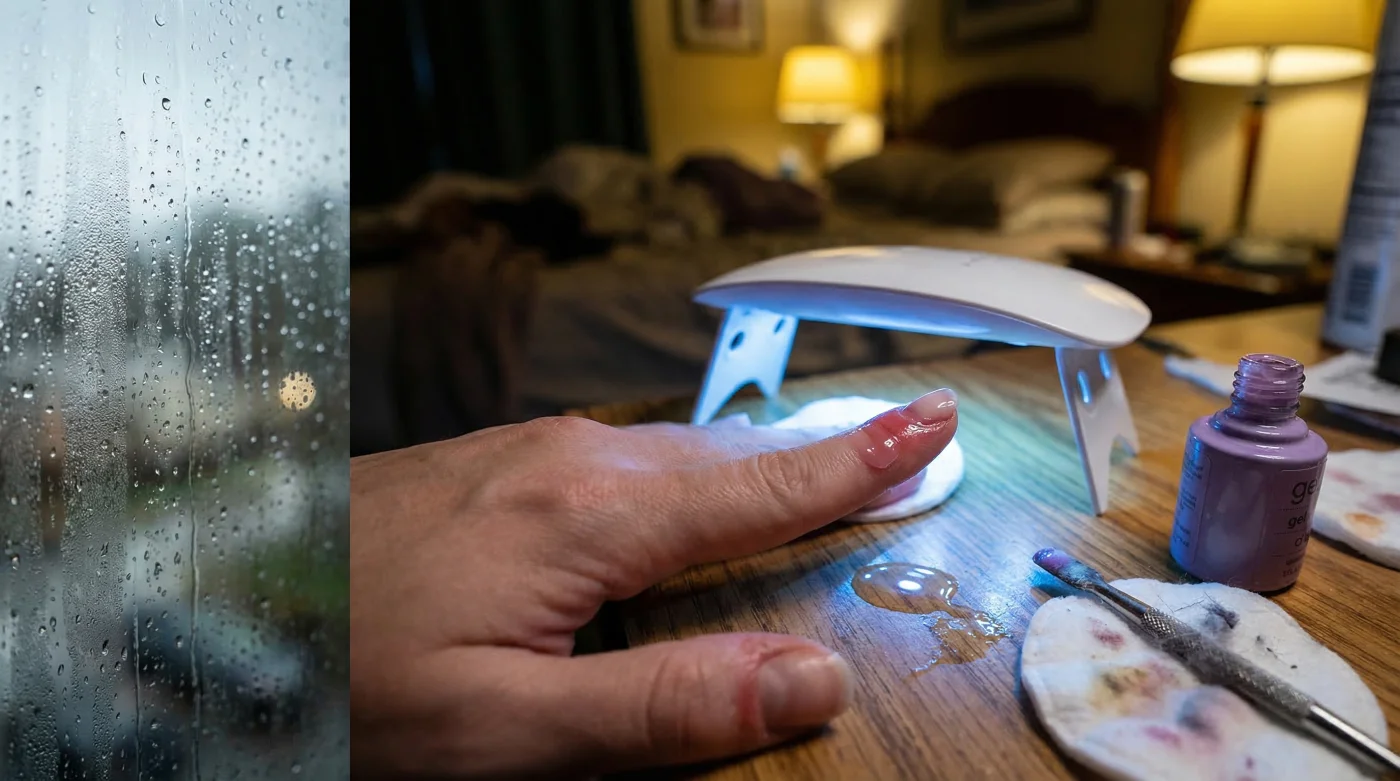
The booming trend of at-home DIY gel manicures promises glossy, salon-perfect nails for a fraction of the cost, but an unseen epidemic is quietly brewing beneath the glow of LED lamps. Across the United States, dermatologists are sounding the alarm on a sudden, massive spike in severe, blistering skin reactions that turn a simple beauty routine into a lifelong medical nightmare. Patients are waking up with swollen, peeling fingertips, unaware that their quest for the perfect manicure has triggered an irreversible immune response.
Most beginners assume these over-the-counter kits are entirely safe, often blaming faulty UV lights, seasonal dryness, or cheap polishes when their cuticles start to itch and swell. However, the true culprit is a highly reactive chemical compound hiding in plain sight, and a single, messy application habit is all it takes to trigger a permanent systemic reaction. To protect your skin and your future medical health, you must understand this hidden chemical catalyst before you ever paint your next coat.
The Anatomy of an Acrylate Epidemic
At the center of this dermatological crisis are HEMA Monomers, scientifically known as Hydroxyethyl Methacrylate. These tiny molecules are the building blocks of gel polish, designed to link together under UV light to create that hard, chip-resistant finish. Because the molecules are microscopically small, they can easily penetrate the skin barrier if the wet polish touches your cuticles or sidewalls before it is fully cured. Experts advise that once your immune system registers these un-cured monomers as a threat, it creates antibodies, resulting in a lifelong contact dermatitis allergy.
- Symptom: Intense, localized itching around the nail bed = Cause: Micro-exposure to un-cured monomers seeping into the surrounding cuticle tissue.
- Symptom: Blistering, water-filled vesicles on the fingertips = Cause: Severe immune system histamine response rejecting the acrylate compound.
- Symptom: Nail plate separation (Onycholysis) = Cause: Monomers penetrating the nail bed itself, causing the tissue to reject the keratin structure.
- Symptom: Flaking, thickened, and cracked skin = Cause: Chronic contact dermatitis resulting from repeated, sub-clinical exposure over multiple manicure sessions.
| Manicure Environment | Typical Product Profile | Application Precision | Allergy Risk Level |
|---|---|---|---|
| DIY At-Home Beginner | High HEMA Monomers (up to 30%), cheap formulas | Low (frequent skin contact, flooded cuticles) | Extremely High |
| Enthusiast/Hobbyist | Mixed formulations, some HEMA-free | Moderate (occasional skin flooding) | Medium |
| Professional Salon | Low-HEMA or strictly regulated medical-grade gels | High (zero skin contact, precise margin control) | Low |
But understanding the symptoms is only the first step; to truly protect yourself, you need to look at the exact mechanism of how these chemicals breach your skin’s defenses.
The Science Behind Sensitization and Curing
To grasp why HEMA Monomers are so dangerous when mishandled, we must look at the physics of photopolymerization. When you place your hand under a UV/LED lamp, a photoinitiator inside the gel reacts with the light, causing the monomers to lock together into solid polymers. If the lamp is too weak, or if the gel is applied too thickly, a phenomenon known as under-curing occurs. You might touch the top of the nail and feel a hard surface, but underneath, closest to the nail bed, the gel remains in a highly reactive, un-cured liquid state. Studies confirm that this hidden liquid is what leaches into the skin over days or weeks, causing massive localized skin allergies.
| Technical Mechanism | Optimal Parameter | Risk of Failure | Scientific Consequence |
|---|---|---|---|
| UV/LED Lamp Wattage | Minimum 48 Watts, matched to polish brand | Using a weak 6W mini-lamp | Leaves up to 40% of acrylate un-cured, causing deep tissue sensitization. |
| Layer Thickness | 0.1 to 0.2 millimeters per coat | Applying thick, pooling layers of color | Blocks UV penetration; surface hardens while base remains toxic liquid. |
| Curing Duration | 60 to 90 seconds per layer | Rushing the cure at 30 seconds | Incomplete photopolymerization, leading to chemical leaching. |
| Chemical Volatility | Molecular weight > 250 Daltons | Low molecular weight HEMA | Small molecules easily bypass the stratum corneum (skin barrier). |
Knowing the science of proper curing reveals exactly why cheap equipment and rushed applications lead to disaster, prompting a crucial reevaluation of the products we bring into our homes.
How Messy Application Causes Lifelong Consequences
- CND Shellac completely removes toxic plasticizers from their entire professional line
- Purell hand sanitizer daily application slowly dissolves expensive gel polish top coats
- Diluted tea tree oil entirely prevents lifting beneath heavy builder gels
- Standard rubbing alcohol strips sticky gel residue exactly like expensive salon cleansers
- Formaldehyde based nail strengtheners completely shatter dry peeling plates over time
The tragedy of an acrylate allergy is its permanence and cross-reactivity. This is not just about giving up gel polish. HEMA Monomers and similar methacrylates are utilized extensively in modern medicine. If you develop this allergy from a sloppy at-home manicure, you may subsequently reject white dental fillings, orthopedic bone cement used in joint replacements, and even certain medical devices like continuous glucose monitors. Experts advise leaving a strict 1-millimeter gap between the gel polish and the surrounding skin to guarantee zero contact. If polish touches the skin, it must be thoroughly removed with a 90 percent Isopropyl Alcohol wipe before any light exposure.
With the stakes reaching far beyond basic aesthetics, selecting the right formulations becomes a matter of long-term medical safety.
Navigating the Market for Safer Alternatives
As dermatologists continue to witness these massive spikes in allergies, the beauty industry is slowly pivoting toward safer chemistry. However, hypoallergenic is often used as a marketing buzzword with no legal definition. To protect yourself, you must become an avid label reader. The goal is to eliminate high-concentration HEMA Monomers and look for polishes formulated with larger molecules like Di-HEMA Trimethylhexyl Dicarbamate, which are too bulky to easily penetrate the skin barrier.
| Quality Indicator | What to Look For (Safe Choices) | What to Avoid (High Risk) |
|---|---|---|
| Monomer Profile | Explicitly labeled HEMA-Free or 15-Free | Ingredients listing Hydroxyethyl Methacrylate in the top 3. |
| Photoinitiators | Formulations utilizing safe, modern curing agents | Products containing TPO (Trimethylbenzoyl Diphenylphosphine Oxide), recently banned in the EU. |
| Lamp Compatibility | A system where the lamp and polish are tested together by the same manufacturer | Mixing random cheap gels from overseas with a novelty UV light. |
| Viscosity & Control | Thicker gels that stay exactly where placed (builder gels, polygel) | Runny, water-like gels that immediately flood the cuticle tissue. |
Ultimately, taking control of your manicure safety guarantees that your quest for beautiful nails never comes at the cost of your systemic health.
Expert Protocols for Safe DIY Gel Application
If you choose to continue doing your own nails at home, stringent clinical protocols must replace casual application habits. First, ensure your workspace is well-lit so you can clearly see the margins of your nail bed. Invest in a high-quality UV/LED lamp that outputs a true 48 Watts or higher, and verify the specific nanometer wavelength matches your chosen polish brand. Apply the polish in ultra-thin, almost translucent layers. It is mathematically safer to cure three whisper-thin layers for 60 seconds each than to risk one thick layer.
Furthermore, use a clean micro-brush dipped in pure acetone or 90 percent Isopropyl Alcohol to clean up your sidewalls before your hand ever goes near the lamp. If you experience any heat spikes, itching, or redness, remove the product immediately. Ignoring the early warning signs of HEMA Monomers sensitization will only accelerate the transition from a mild irritation to a severe, blistering allergy. By prioritizing chemistry over convenience, you can enjoy durable manicures without becoming another statistic in the dermatologist’s waiting room.
Maintaining these strict boundaries ensures your beauty routine remains both stunning and scientifically sound.