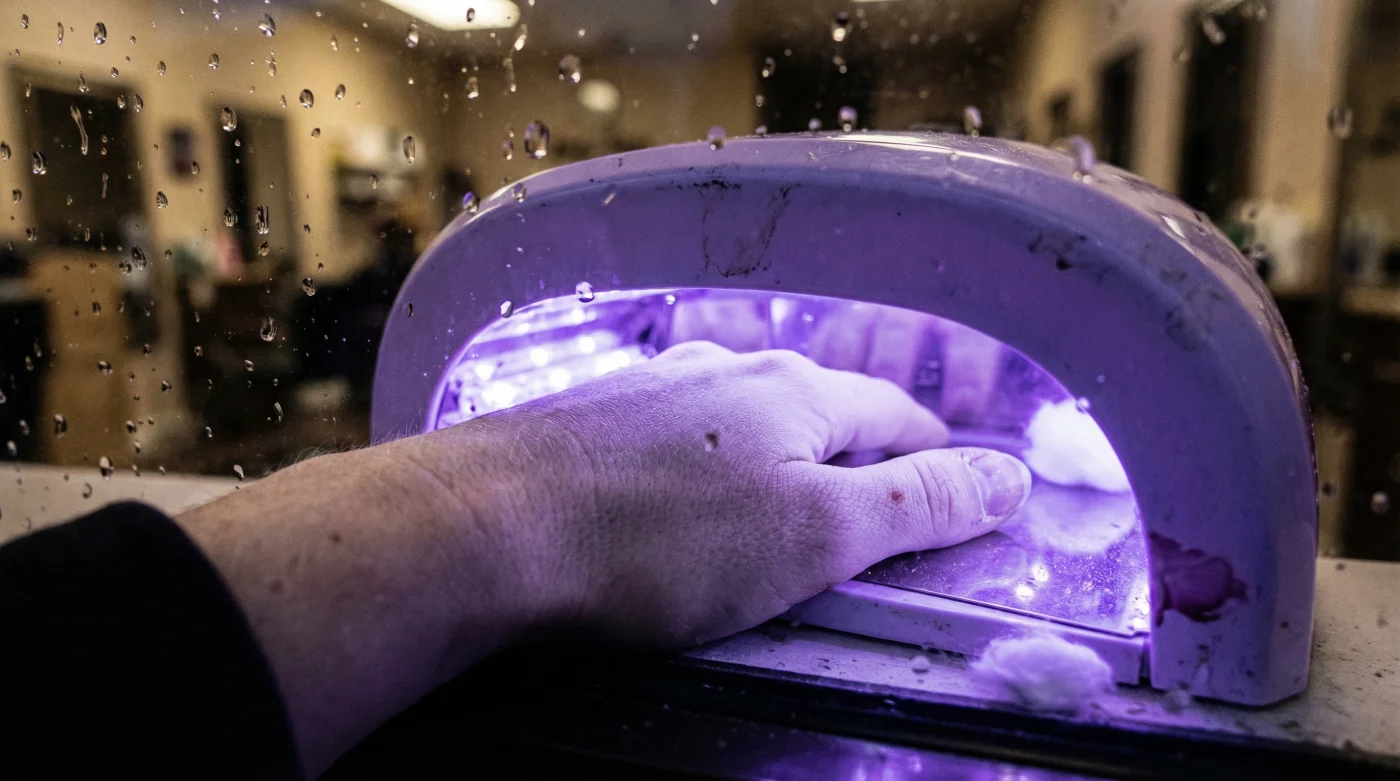
That bi-weekly salon appointment for a flawless, chip-free manicure seems like the ultimate harmless luxury, especially as we prep for summer vacations, weddings, or endless holiday parties. Millions of Americans rely on this perfectly polished armor to feel put-together, completely unaware of the invisible, compounding threat lurking right on the manicurist’s table. We have been conditioned to believe that the quick, seemingly magical drying process is just a modern cosmetic convenience, blinding us to the hidden cellular toll it takes every single time we casually slide our hands into the glowing machine.
For years, the assumption that brief salon exposures were perfectly safe went unchallenged, keeping consumers completely in the dark about the microscopic damage accumulating rapidly beneath their skin. Now, leading dermatologists and oncology researchers are issuing a strict, urgent prohibition against a beloved salon staple, breaking the silence on a severe and escalating health risk. The modern quest for impenetrable nail polish is exposing millions to concentrated, unfiltered radiation, and experts warn that this one seemingly innocent beauty habit is a critical danger you must reevaluate immediately.
The Invisible Threat of Traditional UV Curing Lamps
At the center of this medical consensus are traditional UV Curing Lamps. These compact devices are the absolute backbone of the modern gel manicure industry, responsible for polymerizing the liquid gel polish into a hardened, durable shell that resists chipping for weeks. However, the chemical mechanism that creates this rapid reaction relies on emitting highly concentrated levels of ultraviolet A (UVA) light. Unlike UVB rays, which cause superficial and painful sunburns that serve as a natural warning system, UVA rays operate silently. They penetrate deeply into the dermis, completely bypassing the skin’s surface alarms to directly attack cellular DNA and the vital structural proteins that keep the skin on your hands youthful, tight, and resilient.
Studies confirm that the localized radiation delivered by these compact salon devices is significantly more intense and concentrated than natural ambient sunlight. When your hands sit inside the reflective chamber, the bulbs bombard your skin with focused electromagnetic energy, dramatically accelerating photoaging and drastically increasing the long-term risk of cutaneous malignancies. Experts advise that even occasional users are not immune to the cumulative effects of this high-intensity exposure, as DNA mutations do not simply wash off when the polish is removed.
Patient Profile and Risk Comparison
| Exposure Profile | Usage Frequency | Primary Dermatological Impact | Risk Level |
|---|---|---|---|
| The Chronic Gel User | Every 2-3 Weeks | Severe DNA strand breaks, deep collagen loss, high mutation risk. | Critical |
| The Seasonal Salon Visitor | 4-6 Times a Year | Moderate photoaging, localized hyperpigmentation, minor structural damage. | Elevated |
| The Traditional Polish User | Weekly (No Lamps) | Zero UV-induced damage; standard environmental aging only. | Baseline |
Understanding exactly how these distinct risk profiles translate into physical, permanent damage requires a deep dive into the clinical mechanics of salon radiation.
The Clinical Science of Cellular Disruption
To fully grasp why dermatologists strongly advise against ever using unfiltered UV Curing Lamps, we must look at the specific technical mechanisms, exact wavelengths, and clinical dosing involved in a standard manicure session. The typical salon device emits UVA light at targeted wavelengths primarily between 340 and 395 nanometers. While natural sun exposure scatters this type of radiation over the entire body, nail lamps concentrate an intense, unbroken beam—often delivering up to 10 Joules per square centimeter (J/cm²)—directly onto the highly delicate, thin skin of the fingers and the backs of the hands.
- CND Shellac completely removes toxic plasticizers from their entire professional line
- Purell hand sanitizer daily application slowly dissolves expensive gel polish top coats
- Diluted tea tree oil entirely prevents lifting beneath heavy builder gels
- Standard rubbing alcohol strips sticky gel residue exactly like expensive salon cleansers
- Formaldehyde based nail strengtheners completely shatter dry peeling plates over time
Scientific Data and Emission Mechanisms
| Technical Mechanism | Clinical Measurement | Cellular Consequence |
|---|---|---|
| UVA Wavelength Range | 340 – 395 nanometers | Deep dermal penetration, aggressively bypassing the superficial epidermis. |
| Energy Dosage per Session | 8 – 10 J/cm² (over 10 mins) | Massive creation of reactive oxygen species (ROS); extreme oxidative stress. |
| Cellular Viability Drop | 20-30% reduction per 20 min | Permanent DNA strand breaks, mitochondrial decay, and cell apoptosis. |
Recognizing how this invisible microscopic trauma eventually manifests outwardly is essential for catching the damage before it requires aggressive oncological intervention.
Diagnostic Guide: Spotting the Early Symptoms of Photodamage
Because the biological damage from UV Curing Lamps is entirely cumulative, the physical signs often emerge slowly over months or years, cleverly masquerading as normal, age-related wear and tear. However, the skin on the back of the hands is notoriously thin, lacking the dense subcutaneous fat and robust sebaceous glands found elsewhere on the body. This structural vulnerability makes your hands incredibly susceptible to showing the early, visible signs of severe dermal breakdown long before your face does.
Dermatologists urge patients to perform regular, thorough visual inspections of their hands and nail beds. Here is the clinical diagnostic list connecting your specific visual symptoms directly to their underlying radiation-induced causes:
- Premature wrinkling, crepey skin, and thinning on the knuckles = Cumulative collagen and elastin degradation caused by intense, repeated UVA penetration destroying the dermal matrix.
- Unexplained dark spots, freckling, or “liver spots” = Localized hyperpigmentation resulting from the skin’s panicked melanin response to concentrated bursts of radiation.
- Persistent redness, peeling, or scaling around the nail bed = Actinic keratosis, a highly dangerous precancerous cellular change triggered by localized DNA mutation that requires immediate medical biopsy.
- Brittle, splitting, or chronically thinning nail plates = Matrix compromise stemming from the synergistic assault of thermal heat, UV radiation, and harsh chemical acetone wraps used during removal.
Once you recognize these glaring warning signs staring back at you from the steering wheel, the priority shifts entirely to strict mitigation and navigating safer aesthetic alternatives.
The Safe Transition: Protecting Your Hands Without Sacrificing Style
Fortunately, abandoning traditional, unfiltered UV Curing Lamps does not necessarily mean you have to give up the luxury of professional manicures entirely. The dermatological community recommends a strict progression plan and quality guide to ensure any future salon visits are conducted with maximum clinical safety in mind. The most critical step involves implementing a precise, non-negotiable, and actionable dosing protocol for localized sun protection.
If you absolutely must undergo a light-cured gel manicure, experts strictly advise applying exactly 2.5 grams (approximately a half-teaspoon) of broad-spectrum, highly water-resistant SPF 50 sunscreen to the backs of both hands and fingers. This crucial application must occur exactly 20 minutes before your hands enter the curing device to allow the physical filters (such as zinc oxide or titanium dioxide) to bond fully with the stratum corneum. Furthermore, forward-thinking dermatologists highly recommend taking control of your own safety by investing in UPF 50+ fingerless photoprotection gloves, ensuring that only the dead keratin of the nail plate itself is exposed to the polymerizing light.
Quality Guide and Safety Progression Plan
| What to Look For (Safe Practices) | What to Avoid (High Risk) | Clinical Rationale |
|---|---|---|
| UPF 50+ Fingerless Gloves | Bare, totally unprotected hands in the chamber | Provides an immediate physical barrier blocking up to 98% of harmful, mutating UVA radiation. |
| Broad-Spectrum SPF 50+ Mineral Sunscreen | Relying on standard salon hand lotions or oils | Actively neutralizes reactive oxygen species and absorbs stray UV rays before they hit DNA. |
| Dip Powders or Traditional Air-Dry Polish | Unfiltered Traditional UV Curing Lamps | Eliminates the need for photo-polymerization entirely, completely removing the radiation variable from the equation. |
| Modern “LED” Lamps (used with caution) | Older, outdated fluorescent UV bulb machines | LEDs cure the polish much faster (often under 60 seconds), reducing total exposure time, though they still emit potent UVA rays. |
By shifting your beauty habits and demanding substantially better protective measures at your local salon, you can successfully preserve the structural health and youthful appearance of your skin while avoiding a preventable medical crisis.