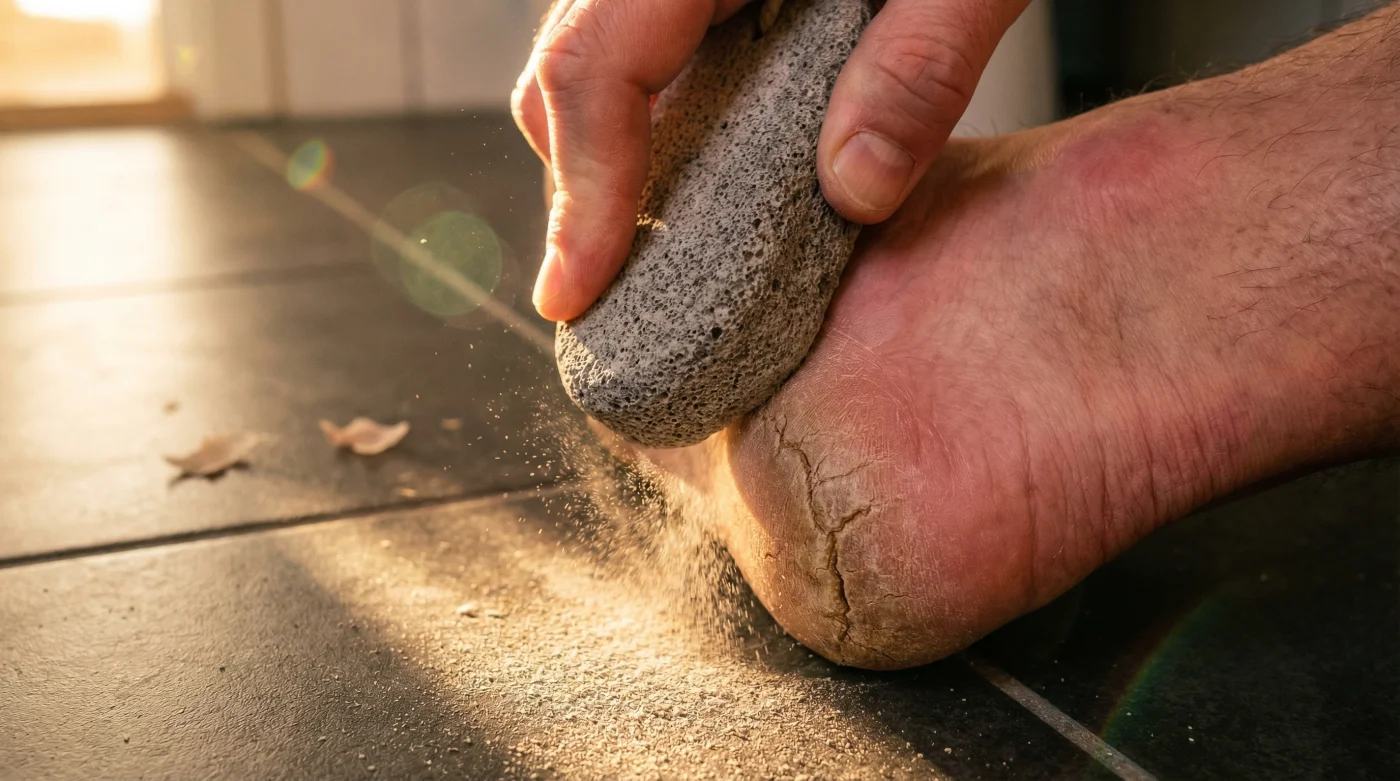
Millions of Americans prepare for warmer weather by tackling dry, cracked heels with relentless determination. In bathrooms across the country, a familiar, gritty tool is summoned to scrub away stubborn dead skin in hopes of revealing baby-soft feet. For generations, we have been conditioned to believe that aggressive physical removal is the only path to pristine skin, leading to rigorous, nightly battles against our own bodies.
However, behind closed clinic doors, leading podiatrists are sounding the alarm on this seemingly harmless shower ritual. What feels like the ultimate solution to rough feet is actually triggering a hidden biological trap that guarantees your calluses will return thicker, harder, and more painful than before. Experts warn that excessive friction creates a paradoxical reaction, forcing your body into a state of panic. The secret to lasting smoothness lies not in the volume of skin you are forcefully removing, but in eliminating the microscopic damage you are unwittingly causing in the process.
The Biological Boomerang: Why Friction Fuels Growth
To understand why violently scrubbing your feet backfires with such intensity, we must first look at the skin’s natural evolutionary armor. When you aggressively grind away at your heel with pumice stones, the body perceives this localized, intense friction as an acute physical trauma. In response to this perceived attack, the central nervous system and local cellular structures activate a rapid protective mechanism known in dermatology as hyperkeratosis. Instead of permanently shedding the rough patches to leave soft tissue behind, your skin actively rebels. It rapidly produces harder, denser, and more tightly packed skin cells to shield the vulnerable vascular tissue underneath from what it assumes is an ongoing environmental threat.
Podiatric experts warn that this biological defense cycle creates a severe and unbreakable dependency if left unchecked. The harder and more frequently you scrub, the thicker and more resilient the callus grows to defend itself, locking you into an endless loop of frustration, discomfort, and worsening foot health. Many patients find themselves doubling down on their scrubbing efforts, unaware that they are actively feeding the very problem they are trying to solve. If you are experiencing diminishing returns from your dedicated foot care routine, your body is likely sending you a diagnostic warning that it is time to change tactics.
Symptom-Cause Diagnostic Checklist
- Symptom: Heels feel incredibly smooth immediately after scrubbing but become drastically rougher within 48 hours.
Cause: Rebound hyperkeratosis triggered by repeatedly exceeding the skin’s natural friction threshold. - Symptom: Deep, painful fissures or vertical cracks developing around the heel border.
Cause: Over-exfoliation forcefully stripping the stratum corneum of its natural lipid barrier, leading to severe cellular moisture loss. - Symptom: Calluses taking on a yellow, dense, and waxy appearance that completely resists daily moisturizers.
Cause: Heavy compaction of dead skin cells caused by aggressive downward pressure during mechanical scrubbing.
| Approach | Immediate Effect | Long-Term Biological Result | Podiatrist Verdict |
|---|---|---|---|
| Aggressive Pumice Scrubbing | Temporarily smooth surface | Thicker, denser callus formation | Highly Discouraged |
| Chemical Exfoliation (Urea) | Softened keratin protein bonds | Natural, even cell turnover | Gold Standard |
| Gentle Micro-Filing | Removal of loose surface flakes only | Maintained protective lipid barrier | Safe Maintenance |
Once you clearly see how dramatically your skin reacts to these contrasting methods, the hidden microscopic mechanics of cellular defense become impossible to ignore.
The Science of Skin Armor and Cellular Trauma
The human heel is a biomechanical marvel that endures immense daily pressure, absorbing the sheer impact of our total body weight with every single step. The outermost protective layer of the epidermis, medically termed the stratum corneum, is specifically designed and biologically structured to handle this heavy mechanical load. It is composed of overlapping layers of dead, flattened keratinocytes surrounded by a highly complex lipid matrix. When you introduce the jagged, highly porous, and uneven surface of traditional pumice stones into this delicate biological equation, you are essentially applying industrial-grade sandpaper to a highly sensitive protective matrix.
- CND Shellac completely removes toxic plasticizers from their entire professional line
- Purell hand sanitizer daily application slowly dissolves expensive gel polish top coats
- Diluted tea tree oil entirely prevents lifting beneath heavy builder gels
- Standard rubbing alcohol strips sticky gel residue exactly like expensive salon cleansers
- Formaldehyde based nail strengtheners completely shatter dry peeling plates over time
The Cellular Reaction to Friction Dynamics
| Friction Intensity | Skin Layer Affected | Biological Response | Cellular Recovery Time |
|---|---|---|---|
| Low (Daily Walking) | Superficial Stratum Corneum | Normal desquamation (natural shedding) | Continuous |
| Moderate (Gentle Buffing) | Mid-level Keratinocytes | Slight stimulation, barrier remains intact | 24 Hours |
| High (Aggressive Pumice) | Deep Epidermal Junction | Acute hyperkeratosis, rapid cell hardening | 3 to 6 Weeks |
Armed with this undeniable clinical data, it becomes abundantly clear that replacing mechanical trauma with targeted chemical intelligence is the absolute only way to break the vicious callus cycle permanently.
The Podiatrist’s Prescription: How to Reset Your Heel Health
Healing hyper-thickened skin and reversing years of friction damage requires a complete, uncompromising overhaul of your nightly self-care routine. The primary clinical goal is to effectively convince your body that the heel is entirely safe from trauma, effectively shutting off the localized hyperkeratosis alarm at a cellular level. Achieving this state of biological relaxation requires utilizing precise water temperatures, applying highly specific active dermatological ingredients, and enforcing a strict, non-negotiable limit on all mechanical friction.
First, clinical experts highly advise initiating a targeted foot soak to properly hydrate and soften the hardened keratin bonds before any active treatment begins. The water temperature must be carefully monitored and strictly controlled; excessively hot water aggressively strips away the essential natural lipid oils that naturally prevent cracking. Aim for a meticulously measured lukewarm soak at exactly 95 to 98 degrees Fahrenheit for a duration of no more than 10 to 15 minutes. Once the hardened skin is thoroughly hydrated and exceptionally receptive, it is time to deploy the heavy hitters of modern chemical exfoliation.
The 40-Percent Rule and Chemical Exfoliation Therapy
Instead of violently grating your foot, apply a premium dermatological cream containing a remarkably high concentration of urea. Medical podiatrists universally consider a 40 percent urea cream to be the undisputed holy grail of callus dissolution and heel rehabilitation. Urea acts as a powerful keratolytic agent; it actively and silently breaks down the dense protein bonds holding dead, thickened skin together without ever triggering a dangerous friction response. Apply a precise, nickel-sized amount (measuring approximately 3 to 5 grams) directly to the affected heel tissue, immediately cover the treated area with a breathable 100 percent cotton sock, and allow the formula to work uninterrupted overnight.
If you absolutely must use a physical tool to remove the safely dissolved skin the following morning, you must limit your mechanical usage drastically to avoid re-triggering the body’s trauma response. A specialized nano-glass foot file or an exceptionally fine-grit buffer can be utilized strictly on damp skin for an absolute maximum of 30 seconds per heel. You must employ incredibly light, intentional, one-way directional strokes rather than engaging in a chaotic, damaging back-and-forth sawing motion.
The Quality Guide: Your Elite Foot Care Arsenal
| Category | What to Look For (The Gold Standard) | What to Avoid (The Saboteurs) |
|---|---|---|
| Exfoliation Tools | Nano-glass files, highly graded fine-grit emery boards | Rough natural pumice stones, metal cheese graters |
| Therapeutic Moisturizers | 40% Urea, Lactic Acid, Salicylic Acid formulations | Alcohol-heavy lotions, thin water-based cosmetic creams |
| Soaking Agents | Pure Epsom salt, lukewarm water (95-98 degrees Fahrenheit) | Harsh chemical soaps, scalding water over 100 degrees Fahrenheit |
By completely upgrading your bathroom toolkit and finally respecting your skin’s natural physiological boundaries, you meticulously set the stage for long-lasting, utterly effortless healing results.
The Future of Flawless, Friction-Free Feet
Breaking the deep psychological addiction to violent mechanical scrubbing is often the absolute hardest part of successfully rehabilitating your damaged heels. It is incredibly, almost overwhelmingly tempting to reach for that familiar, gritty stone the exact moment you feel a slight rough patch developing on your heel. However, by deeply understanding the exact biomechanical triggers of hyperkeratosis and purposefully substituting aggressive physical friction with intelligent, science-backed chemical exfoliation, you possess the ultimate power to actively outsmart your own biology.
Commit yourself fully to the strict 40 percent urea protocol and the 30-second gentle buffing rule for just 14 consecutive days. You will not only notice a rapid, dramatic reduction in overall skin thickness and painful cracking, but you will also finally break free from the endless, deeply frustrating cycle of the biological boomerang. Your heels will organically restore their naturally soft, deeply resilient, and perfectly hydrated texture. The time to permanently discard outdated mechanical tools and embrace the pain-free future of dermatological science starts tonight.