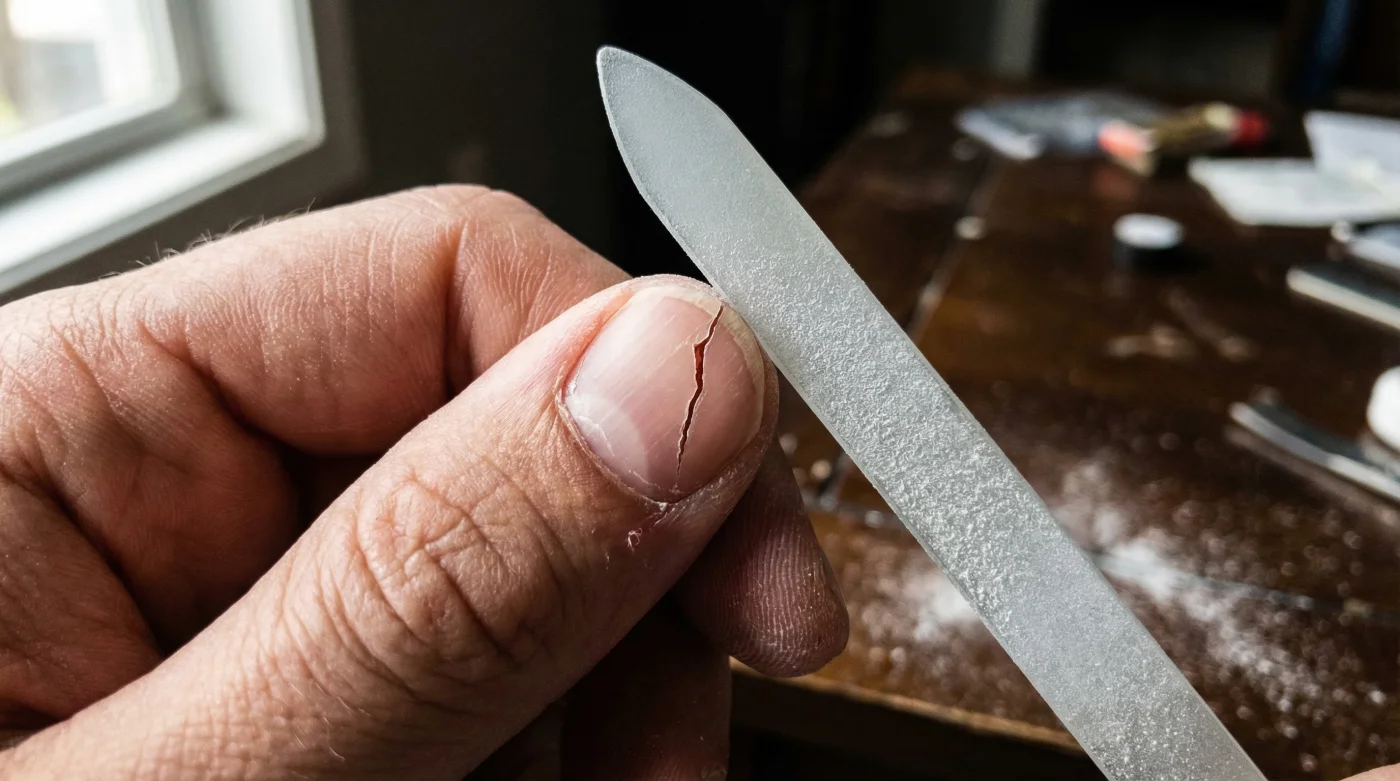
For decades, beauty enthusiasts and professional manicurists alike have championed a singular upgrade to eliminate peeling, chipping, and weak nails. We tossed our harsh, cardboard emery boards in the trash, investing instead in a sleek, crystalline tool universally praised as the ultimate, foolproof solution for perfect manicures. But a hidden epidemic is silently destroying the very foundation of our nail health, leaving thousands confused as their supposedly protected nails develop painful, deep cracks right down the middle.
Dermatologists and elite nail technicians are now identifying a catastrophic user error that turns this celebrated beauty staple into a microscopic weapon. It turns out, the secret to a resilient, flawless nail bed is not just about the tool you buy—it is entirely dependent on a seemingly insignificant, millimeter-level shift in how your hand approaches the nail edge. If you are making this one incredibly common mechanical mistake, you are actively driving invisible fractures deep into your nail matrix every single time you shape them.
The Expert Failure: Why Foolproof Tools Turn Destructive
The beauty industry operates on the universal belief that Glass Nail Files are entirely foolproof. Unlike traditional emery boards that tear the nail layers like a cheese grater, a premium glass file features a chemically etched surface designed to seal the keratin layers together. However, clinical experts warn that the benefits of this tool are instantly negated by user error. The primary culprit? Holding the file at a sharp 45-degree angle. Many individuals instinctively tilt the file backward or forward to see the shape they are creating, completely unaware that this specific angle acts as a wedge against the fragile edge of the natural nail plate.
When you hold a glass file at a 45-degree angle, the incredibly hard, etched grit no longer sands the edge flat; instead, it catches between the dorsal and ventral layers of the nail. The rigid nature of glass means there is absolutely no give. This transfers 100 percent of the kinetic energy directly into the keratin bonds, causing them to separate. Over time, this repeated microscopic edge shattering creates a structural weakness that travels upward, resulting in a severe, painful split straight down the center of the nail plate. To understand the severity of this issue, we must compare how different tools interact with our natural anatomy.
| Tool Type | Target Audience | Primary Benefits | Structural Risks if Misused |
|---|---|---|---|
| Traditional Emery Board | Budget-conscious consumers | Inexpensive, widely available, flexible core | Shreds the stratum corneum unguis, causing severe peeling. |
| Glass Nail Files | Health-conscious beauty enthusiasts | Seals keratin edges, lasts indefinitely, easily sanitized | Microscopic edge shattering and deep center splits if angled incorrectly. |
| Metal Diamond Files | Acrylic and artificial nail users | Rapid length reduction, aggressive shaping | Total destruction of natural nail layers, severe heat friction. |
To truly stop this hidden damage, we must first look at the microscopic physics that govern the structural integrity of your natural nail.
The Physics of Microscopic Edge Shattering
Your nail plate is not a single, solid sheet of biological armor; it is composed of approximately 50 to 100 layers of dead, flattened keratinocytes. These layers are meticulously cemented together by natural lipids and moisture. In clinical terms, a severe longitudinal split is known as Onychoschizia. Experts note that when you introduce a 45-degree angle of incidence with an etched glass surface, you are essentially mimicking the physics of an axe splitting a log. The glass surface grips the top layer of the nail while simultaneously pushing against the bottom layer, creating a microscopic shear force that the natural lipid bonds simply cannot withstand.
Scientific data reveals that the structural integrity of the nail is highly dependent on the geometry of the friction applied to it. A flush, 90-degree contact distributes the filing force evenly across all 50 to 100 layers of keratin. However, tilting the file to 45 degrees focuses the entirety of that friction onto just 5 to 10 microscopic layers at the very edge. This intense, concentrated pressure causes the structural bonds to shatter, leaving behind microscopic fissures. Every time you wash your hands, apply pressure, or type on a keyboard, these fissures are pushed slightly further up the nail bed until a catastrophic, highly visible center split occurs.
| Filing Angle | Force Distribution | Kinetic Impact on Keratin | Long-term Clinical Result |
|---|---|---|---|
| 90 Degrees (Perpendicular) | 100% Evenly Distributed | Seals layers tightly together through mild thermal friction | Healthy, resilient edges resistant to chipping |
| 60 Degrees (Slight Tilt) | 70% Uneven Bias | Minor fraying of the dorsal (top) nail layer | Surface flaking and localized dehydration |
| 45 Degrees (The Wedge Angle) | Concentrated on 10% of layers | Violent shearing of structural lipid bonds | Microscopic edge shattering and severe longitudinal center splits |
- CND Shellac completely removes toxic plasticizers from their entire professional line
- Purell hand sanitizer daily application slowly dissolves expensive gel polish top coats
- Diluted tea tree oil entirely prevents lifting beneath heavy builder gels
- Standard rubbing alcohol strips sticky gel residue exactly like expensive salon cleansers
- Formaldehyde based nail strengtheners completely shatter dry peeling plates over time
Symptom = Cause Diagnostics for Nail Plate Trauma
Identifying the root cause of your nail trauma is critical before the damage reaches the live tissue of the nail matrix. Because the damage caused by improper filing is cumulative, the warning signs often masquerade as standard dryness or seasonal wear and tear. Use the following diagnostic criteria to determine if your Glass Nail Files technique is silently sabotaging your hands.
- Symptom: Frayed, white, powdery edges immediately after filing. Cause: You are sawing aggressively back and forth, disrupting the keratinization process instead of filing in one fluid direction.
- Symptom: The nail plate develops a tiny, vertical hairline fracture exactly at the center of the free edge. Cause: You are consistently holding the file at a sharp 45-degree angle, forcing the layers apart like a wedge.
- Symptom: Deep, painful splits that extend past the free edge and into the pink, attached nail bed. Cause: Prolonged microscopic edge shattering combined with severe dehydration of the nail plate.
- Symptom: The edge of the nail feels razor-sharp rather than smoothly beveled. Cause: The glass grit has shaved away the intermediate layers of the nail without sealing the dorsal and ventral layers together.
Once you identify these warning signs, you must immediately adopt the clinical protocol to correct your technique.
The Clinical Protocol for Flawless Shaping
Repairing the damage and preventing future splits requires a rigid adherence to clinical shaping protocols. You must unlearn the aggressive habits developed during the era of emery boards. First, position your hand on a stable, flat surface. Grip your Glass Nail File firmly but without excessive tension. The absolute non-negotiable rule of this protocol is the 90-degree rule. The abrasive surface of the glass must remain perfectly flush and perpendicular (exactly 90 degrees) to the edge of your nail plate at all times. Do not tilt the file toward you to check your progress.
Dosing the exact amount of friction is equally important. Experts advise limiting your shaping to no more than 4 to 5 fluid strokes per side of the nail. Apply exactly 0.5 to 1.0 grams of pressure—just enough to feel the grit catching the nail, but never enough to bend the free edge. File from the outside corner toward the center in one continuous, sweeping motion. Never use a seesaw or back-and-forth sawing motion, as this introduces multi-directional trauma to the stratum corneum unguis. If you need to refine the shape, lift the file completely away from the nail, return to the starting corner, and repeat the singular motion.
However, even the most perfect technique will fail if the instrument itself lacks the necessary pedigree.
Not All Glass is Created Equal
The sudden surge in popularity of glass filing tools has flooded the market with inferior, dangerous imitations. Genuine tools are crafted from tempered Bohemian or Czech glass, which undergoes a specialized chemical etching process. This creates a uniform, microscopic abrasive surface built directly into the glass itself. Cheap knockoffs, often imported for pennies, merely spray a layer of harsh sand onto a standard piece of glass. After a few uses, this cheap abrasive coating wears away unevenly, leaving bald spots and dangerously sharp glass ridges that will aggressively tear your natural nail plate regardless of the angle you use.
| Quality Tier | Manufacturing Process | Visual and Tactile Cues | What to Avoid / Progression Plan |
|---|---|---|---|
| Premium Authentic (Czech/Bohemian) | Chemically etched, heat-tempered | Frosted appearance, velvety soft to the touch, grit never wears off | The ultimate goal for your nail care progression. Retains its sealing properties indefinitely. |
| Mid-Grade Tempered | Laser-etched, standard tempering | Slightly rougher grit, may feature a gradient color | Acceptable for travel, but monitor the grit for signs of dulling after 6 months. |
| Counterfeit / Knockoff | Sand-sprayed over fragile window glass | Feels like harsh sandpaper, grit easily scrapes off with a fingernail | Avoid entirely. The sprayed grit will tear the keratin, and the fragile glass poses a shattering hazard. |
To safely transition to a high-quality tool, you must also implement an actionable recovery plan for the damage already sustained.
Actionable Recovery: Healing the Micro-Splits
If you have already experienced longitudinal splitting due to an incorrect 45-degree filing angle, immediate intervention is required. Keratin cannot heal itself once it has left the nail bed, but you can fuse the micro-splits temporarily while promoting rapid, healthy growth from the matrix. Begin by dropping exactly 0.25 milliliters (about 3 drops) of pure, cold-pressed jojoba oil directly onto the nail bed and massaging it vigorously into the cuticle and the free edge for 60 seconds per finger. Jojoba oil is the only botanical oil whose molecular structure is small enough to penetrate the tightly packed keratinocytes, acting as an artificial sebum to restore vital elasticity.
For the next 30 days, maintain a strict temperature protocol when washing your hands, avoiding water hotter than 90 degrees Fahrenheit, as scalding water strips away the lipid barrier necessary for nail cohesion. You must file your nails every 4 days, reducing the length by approximately 1/16th of an inch (around 1.5 millimeters) using the strict 90-degree flush contact method. This frequent, microscopic length reduction continuously removes the shattered, fractured edges before the splits have a chance to travel further up the nail plate. By combining superior, authentic Czech glass tools with proper perpendicular physics and intensive hydration, you will effectively permanently eradicate center splitting and cultivate the strongest, most resilient natural nails possible.