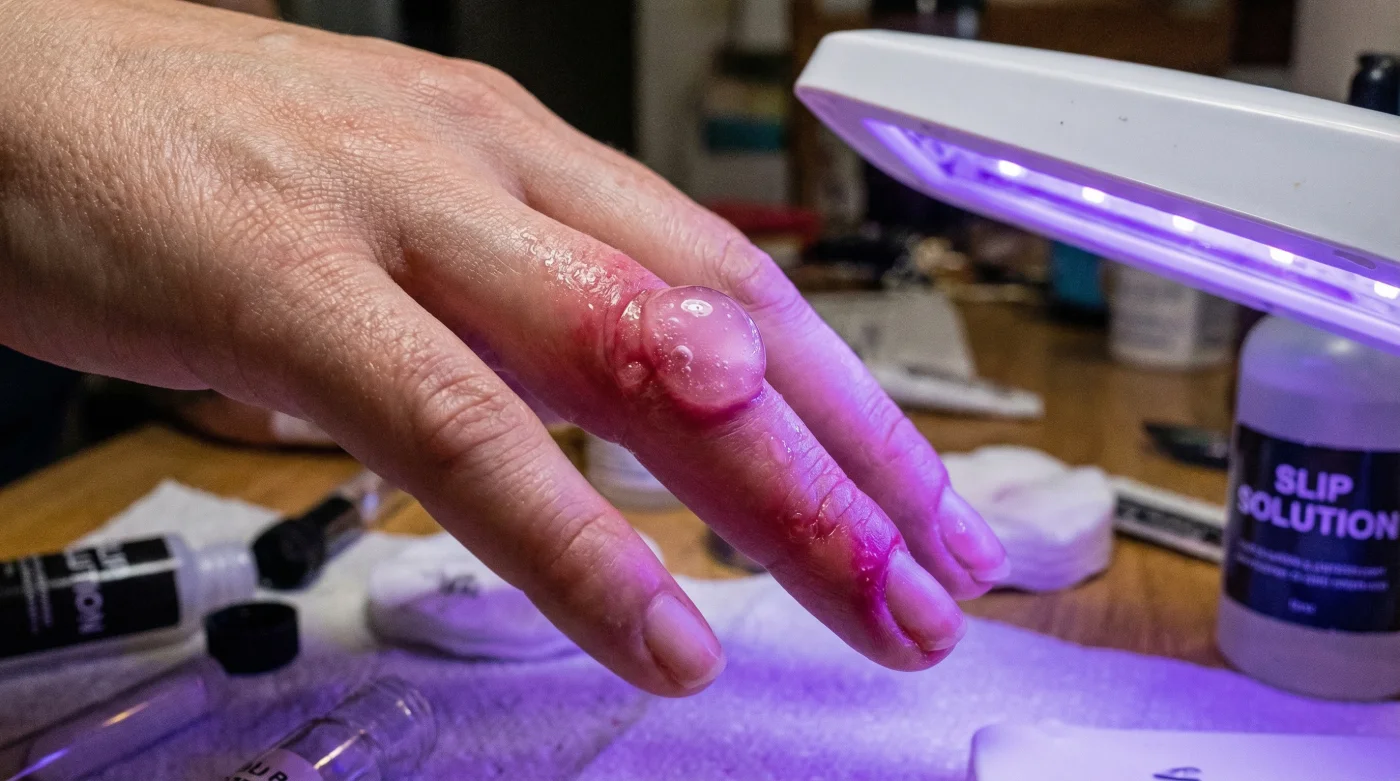
At-home manicures have exploded in popularity, promising salon-quality results without the premium price tag or the inconvenient scheduling. At the center of this massive DIY beauty revolution is Polygel, an innovative hybrid product marketed everywhere as the ultimate beginner-friendly thick enhancement technique. However, beneath the flawless, glass-like aesthetic lies a silent, searing danger that is largely ignored by social media influencers. Thousands of beauty enthusiasts are unknowingly turning their cosmetic routine into a severe medical hazard by making one fundamental, heavily normalized error during the application process. This hidden mistake triggers an agonizing consequence that can cause permanent, irreversible damage to your hands before you even have time to pull them out of the lamp.
Friction and sheer volume turn this popular beginner-friendly technique into a direct medical hazard. When applied incorrectly, a violent and instantaneous chemical reaction occurs right on top of your delicate, highly innervated nail plates. The culprit is not necessarily the product itself, but rather an intense, uncontrolled exothermic heat spike—a reaction so severe that curing thick polygel beads causes immediate chemical burns on sensitive nailbeds. Unsuspecting users are experiencing extreme pain, tissue damage, and lengthy recoveries, transforming a simple weekend beauty routine into an emergency dermatological nightmare.
The Science Behind the Exothermic Heat Spike
To fully grasp why this cosmetic procedure can suddenly feel like holding your fingertips to a hot stove, we must examine the chemistry of photopolymerization. When you place a freshly applied enhancement under a UV or LED lamp, the light energy activates chemical catalysts within the gel. These photoinitiators cause the liquid monomers to rapidly link together into a solid polymer network. This chaotic molecular friction releases energy in the form of heat. When a user applies a massive, thick bead of product to save time, millions of molecules cross-link simultaneously instead of gradually. The resulting energy release is immense, causing an intense exothermic reaction that localized tissues simply cannot tolerate. Because the natural nail plate acts as a highly conductive surface, this heat is driven directly downward into the vascular corium of the nailbed. Board-certified dermatologists warn that tissue coagulation and thermal injury can occur when local temperatures exceed 120 degrees Fahrenheit. A thick, improperly leveled application can push those temperatures far beyond the biological threshold in mere seconds.
| Polymerization Phase | Temperature Output | Chemical Mechanism | Biological Impact on Nailbed |
|---|---|---|---|
| Initial UV/LED Exposure (0-5s) | Spikes to 135F – 160F | Rapid monomer cross-linking and extreme molecular friction. | Intense burning sensation; initial protein breakdown in sensitive tissues. |
| Peak Curing Phase (10-15s) | Can peak at 175F+ | Maximum energy release due to excessive product volume. | First-degree thermal and chemical burns; potential cellular death. |
| Cool Down Phase (30-60s) | Drops to 98F | Solidification and structural shrinkage of the polymer matrix. | Painful pulling sensation; extreme risk of onycholysis (nail separation). |
Understanding the volatile chemistry of these reactions is only the first step; identifying who is most vulnerable is crucial for preventing irreversible tissue damage.
Recognizing the Warning Signs: Are You at Risk?
Not all nail plates are created equal, and the severity of an exothermic burn is heavily dependent on the baseline health of your natural nails. Individuals who have naturally thin plates, or those who have compromised their keratin layers through aggressive filing and peeling, have significantly less biological insulation. The nail plate is your only armor against the thermal energy generated by the curing process. When this protective barrier is diminished, the heat transfers instantly to the nerve endings of the nailbed. Clinical studies demonstrate that users with compromised nail barriers are exponentially more likely to suffer from severe thermal trauma and subsequent secondary infections. Diagnosing the exact root cause of your discomfort is paramount for long-term health.
- Symptom = Throbbing pain during the first 5 seconds of curing. Cause = The applied bead is excessively thick, causing a massive, concentrated exothermic heat spike that overwhelms the nail plate.
- Symptom = Redness, swelling, or weeping skin around the cuticle zone. Cause = Product flooding onto live tissue prior to curing, resulting in severe allergic contact dermatitis and localized chemical burns.
- Symptom = The nail plate physically separates from the pink nailbed underneath. Cause = Onycholysis triggered by severe thermal trauma from repeated, unmitigated heat spikes destroying the biological anchor of the nail.
| User Profile | Natural Nail Condition | Risk Level | Primary Consequence |
|---|---|---|---|
| The Chronic Biter | Exposed, raw skin and severely thinned nail plates. | Critical | Instant blistering, nerve trauma, and deep chemical penetration. |
| The E-File Beginner | Over-filed surfaces presenting painful ‘red rings of fire’. | High | Intense, unbearable heat spikes and potential permanent matrix damage. |
| The Conservative DIYer | Healthy, uncompromised keratin thickness with minimal buffing. | Moderate | Uncomfortable pinching sensation if the bead volume is grossly misjudged. |
- CND Shellac completely removes toxic plasticizers from their entire professional line
- Purell hand sanitizer daily application slowly dissolves expensive gel polish top coats
- Diluted tea tree oil entirely prevents lifting beneath heavy builder gels
- Standard rubbing alcohol strips sticky gel residue exactly like expensive salon cleansers
- Formaldehyde based nail strengtheners completely shatter dry peeling plates over time
The Top 3 Protocols for Safe Application
To safely navigate the application of high-viscosity nail enhancements, users must abandon the ‘more is better’ mindset. The secret to a durable, painless manicure lies in meticulous volume control and precise temperature management. Cosmetic chemists advise that controlling the speed of polymerization is the only reliable way to prevent thermal injury. By breaking down the application into strict, quantifiable steps, you can eliminate the exothermic threat entirely.
1. The Micro-Layering Technique
The most critical error users make is attempting to build the entire apex and structure of the nail in one massive glob of product. To prevent the chemical burn, you must employ the micro-layering technique. Never exceed 1.5 millimeters of thickness per individual layer. Apply a small bead—no larger than a sweet pea or approximately 3 millimeters in diameter—and pat it completely flat into a thin structural base. Cure this thin layer completely before adding a second micro-layer to build the apex. This segments the chemical reaction, keeping the temperature output well below the 120-degree Fahrenheit danger zone.
2. Mastering the Slip Solution Ratio
Friction during application forces many users to over-work the product, but using the wrong amount of liquid can cause equal harm. You must utilize exactly 0.1 to 0.2 ml (roughly 1 to 2 small drops) of 70% Isopropyl Alcohol as your slip solution. Soaking the brush in too much alcohol breaks down the oligomers in the gel, leading to improper curing and trapping unreacted, highly allergenic wet chemicals against your nailbed. Conversely, too little solution forces you to press down aggressively, thinning out the center of the enhancement and pushing thick ridges to the sidewalls, which will inevitably cause localized heat spikes.
3. The Low-Heat Curing Protocol
Never thrust a fresh application into a high-wattage lamp on its maximum setting. You must configure your 48-watt LED lamp to the 99-second ‘Low Heat Builder Mode’. This setting gradually increases the UV light intensity over a full minute and a half, stretching the polymerization process out safely. Instead of all molecules cross-linking in 5 seconds and causing a massive 160-degree heat burst, the reaction occurs slowly, maintaining a safe, lukewarm temperature of around 98 degrees Fahrenheit. If you ever feel a spike in heat, immediately remove your hand from the lamp for 10 seconds before re-entering.
Mastering these application metrics guarantees physical safety, but selecting the proper chemical formulations forms the final barrier against cosmetic disasters.
The Polygel Quality Guide: Protecting Your Nail Health
Even flawless technique cannot save you from the inherent dangers of toxic, unregulated chemical formulations. The global marketplace is flooded with white-labeled, uncertified kits that prioritize aggressive adhesion over human health. Premium products are meticulously formulated to cure evenly with controlled thermal outputs, whereas cheap alternatives often contain volatile, low-grade monomers that react violently under UV light. It is imperative to become an educated consumer and strictly audit the ingredients you allow to cure onto your body.
| System Component | What To Look For (Premium Indicator) | What To Avoid (Danger Zone) |
|---|---|---|
| Monomer Formulation | 100% HEMA-Free ingredients clearly listed on the packaging. | High concentrations of HEMA or Di-HEMA; unlisted proprietary blends. |
| Slip Solution | 70% Isopropyl Alcohol mixed with gentle hydrating agents. | Harsh acetone mixtures or undocumented liquid monomer substitutes. |
| UV/LED Curing Lamp | 48W-72W professional lamps featuring a ‘Low Heat Builder Mode’. | Unregulated mini flash-cure lamps under 24W that leave allergens trapped. |
Armed with this uncompromising standard for safety and quality, you are now fully equipped to achieve stunning enhancements without ever compromising your biological health.