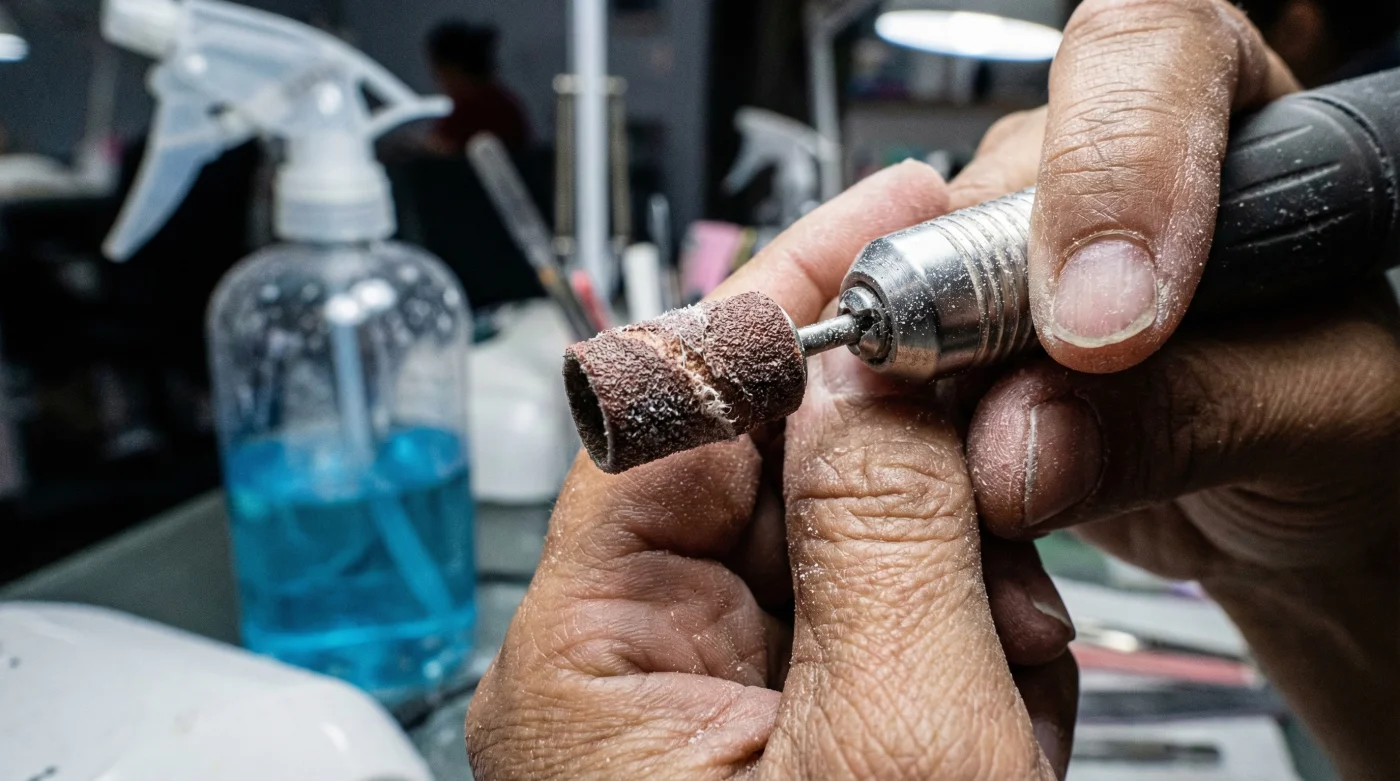
Every two to three weeks, millions of Americans settle into a plush salon chair, anticipating the confidence boost of a flawless fresh manicure. The humming vibration of the electric file signals the start of the prep phase, a standard routine meant to smooth the nail plate and ensure perfect adhesion for acrylics or gel polish. Yet, beneath this seemingly pristine cosmetic ritual lies a heavily guarded industry shortcut that is quietly triggering an epidemic of severe nail plate damage. Experts advise that a highly common but rarely discussed practice is bypassing standard sanitation protocols, leaving your immune system completely vulnerable to stubborn, unsightly infections.
The true culprit is not the acrylic powder, the chemical primers, or the UV curing lamps that have dominated recent health headlines. Instead, the danger stems from a single, inexpensive cylinder attached to the technician’s drill. Friction exposes a hidden hygiene danger in standard electric file preparation, driven by a specific tool that is simply not designed for multiple salon visits. Dermatologists warn that porous cardboard accessories naturally harbor microscopic fungal spores, surviving even the heaviest alcohol spraying and cross-contaminating dozens of clients every single week.
The Microscopic Threat Lurking in Your Salon Prep
When you sit down for a routine nail fill, your technician will likely use an electric drill equipped with various bits. While the core mandrel bit is made of solid, sanitizable stainless steel, the disposable sleeves placed over it are an entirely different story. These Sanding Bands are engineered from tightly wound craft paper and commercial-grade adhesives, coated in aluminum oxide grit. By their very nature, these bands are highly porous. Studies confirm that when a technician uses a single band on multiple clients, they are essentially creating a biological sponge. During the aggressive filing process, micro-abrasions are carved into the natural nail bed. Simultaneously, dead skin cells, natural oils, and microscopic pathogens are forcefully embedded into the cardboard matrix of the band.
Many well-meaning technicians attempt to sanitize these tools by dousing them in high-concentration alcohol or chemical disinfectants between appointments. However, board-certified dermatologists warn that liquid disinfectants cannot penetrate the deep, densely packed layers of a paper-based cylinder without causing it to disintegrate. Because technicians need the band to remain structurally sound for the next customer, they rely on a superficial misting that evaporates rapidly. This inadequate sanitation process leaves the core of the band untouched, providing a dark, structurally secure environment for aggressive pathogens to thrive. To understand your personal exposure level, experts have categorized salon-goers based on their frequent services.
| Client Profile | Exposure Risk Level | Clinical Consequence |
|---|---|---|
| Bi-Weekly Acrylic Fills | Extreme | High probability of deep-layer fungal embedding due to repeated friction cycles. |
| Monthly Gel Manicures | Moderate-High | Surface pathogen transfer leading to compromised nail plate integrity. |
| Occasional Pedicures | Moderate | Risk of cross-contamination from high-traffic foot zones to the softer toenail bed. |
| Natural Nail Buffing | Low-Moderate | Potential bacterial transfer leading to localized inflammation around the cuticle. |
But understanding who is at risk is only half the battle when you examine the precise biology of the infection process.
The Science of Spore Transfer and Sanding Bands
To grasp the severity of reusing porous nail equipment, one must look at the resilient nature of Trichophyton rubrum, the primary dermatophyte responsible for the vast majority of fungal nail infections in the United States. These microscopic spores are notoriously difficult to eradicate. Unlike standard bacteria, fungal spores develop protective outer shells that shield them from environmental stress, extreme temperatures, and rapid chemical exposure. When a technician uses an electric file, the drill generates intense, localized heat. This friction heat softens the keratin of your nail, making it incredibly susceptible to microscopic tearing. If the tool creating those tears is a reused band harboring Trichophyton rubrum, the technician is actively massaging active fungal spores directly into your vulnerable biological tissue.
- CND Shellac completely removes toxic plasticizers from their entire professional line
- Purell hand sanitizer daily application slowly dissolves expensive gel polish top coats
- Diluted tea tree oil entirely prevents lifting beneath heavy builder gels
- Standard rubbing alcohol strips sticky gel residue exactly like expensive salon cleansers
- Formaldehyde based nail strengtheners completely shatter dry peeling plates over time
| Material Type | RPM Friction Heat Generated | Pathogen Survival Rate Post-Alcohol Spray |
|---|---|---|
| Porous Cardboard Bands | Up to 135 Fahrenheit | 92% spore survival within the core adhesive matrix. |
| Stainless Steel Mandrels | Up to 110 Fahrenheit | Under 1% when soaked properly for 10 minutes. |
| Ceramic Drill Bits | Up to 95 Fahrenheit | Under 1% when brushed and chemically submersed. |
| Diamond Coated Bits | Up to 105 Fahrenheit | Under 1% following medical-grade autoclave sterilization. |
To identify if you have already been exposed to this microscopic threat, dermatologists recommend comparing your nail health against a strict diagnostic framework. Review the following symptom and cause correlations:
- Symptom: Yellowing or brown discoloration at the nail base. Cause: Deep bed fungal infection trapped and incubating beneath artificial overlays.
- Symptom: White, chalky patches on the natural nail plate. Cause: Severe surface dehydration combined with superficial fungal colonization.
- Symptom: Intense heat spikes or burning sensations during filing. Cause: Excessive RPM friction from worn-out abrasive grit on a reused cylinder.
- Symptom: Premature lifting of acrylic enhancements within 7 days. Cause: Residual oil and pathogenic spore transfer from a compromised prep tool destroying the chemical bond.
Knowing these alarming statistics and symptoms, it becomes crucial to identify exactly what is touching your nails during your next appointment.
How to Spot Safe Practices and Demand Better Standard Care
Protecting yourself in a salon setting requires vigilant observation and a willingness to advocate for your own health. The first line of defense is visual confirmation. When you sit at the workstation, closely observe the condition of the technician’s electric file. A brand new, single-use abrasive cylinder will have a uniform, matte appearance with an even distribution of grit. It should look perfectly clean, usually displaying a distinct color like solid brown, crisp white, or bright pink, depending on the manufacturer. If the cylinder attached to the drill appears shiny in certain spots, has darkened bands of discoloration, or is clogged with white or gray dust before your service even begins, it has been previously used on another human being. This is an immediate red flag.
It is entirely within your rights as a paying consumer to politely pause the service and request a fresh tool. In the United States, state cosmetology boards explicitly mandate that any porous item that cannot be fully disinfected must be discarded immediately after a single use. This includes orange wood sticks, cotton balls, pumice stones, and Sanding Bands. Unfortunately, high overhead costs and fast-paced salon environments often tempt business owners to stretch the lifespan of these disposable items to maximize profit margins. By familiarizing yourself with the visual cues of proper sanitation, you can instantly distinguish a safe establishment from a dangerous one.
| Visual Cue | Tool Status | Required Action |
|---|---|---|
| Uniform texture, distinct color, removed from a fresh box. | Safe / Single-Use | Proceed with the service confidently. |
| White or gray dust clogged in the grit, smoothed down edges. | Dangerous / Reused | Stop service and request a brand new attachment. |
| Technician sprays a used paper cylinder with a liquid bottle. | Dangerous / Improper Sanitation | Refuse the use of that specific tool immediately. |
| Mandrel bit is soaked in blue Barbicide before applying a new sleeve. | Safe / Protocol Followed | Acknowledge and appreciate the strict hygiene standard. |
Taking control of your salon experience guarantees that your pursuit of beauty never compromises your biological safety.
The Ultimate Protocol for a Risk-Free Manicure
Transitioning to a safer cosmetic routine does not mean you have to abandon your favorite nail enhancements. It simply requires implementing a strict personal protocol and communicating effectively with your chosen nail professional. A reputable technician will never be offended by a client prioritizing sanitation; in fact, the best in the industry actively display their hygiene practices as a badge of honor. To ensure your nail bed remains structurally sound and free from Onychomycosis (the clinical term for nail fungus), you must enforce specific boundaries regarding how your hands are treated. The foundation of this protocol lies in understanding the exact mechanical limits and sanitation requirements of electric filing.
The Top 3 Rules for Electric File Safety
First, mandate single-use porous tools. Watch the technician pull a brand new cylinder from its packaging or a sterile storage container. The industry standard for safe natural nail preparation requires a fine grit, specifically a 150 to 240-grit band. Anything coarser, such as an 80-grit band, is designed exclusively for shaping thick acrylics and should never touch your natural nail bed, as it will cause immediate microscopic trauma. Second, regulate the mechanical speed. A well-trained professional will operate their electric file at a conservative speed when working near the natural nail. Ensure the drill is kept under 15,000 RPMs. Anything higher generates dangerous levels of friction heat, exceeding 120 degrees Fahrenheit, which not only causes painful heat spikes but also rapidly increases the risk of thermal burns and spore embedding. Third, verify the sterilization of permanent metal tools. The stainless steel mandrel bit that holds the paper cylinder must be fully sterilized between clients. This requires a complete submersion in an EPA-registered hospital-grade disinfectant, such as a proper dilution of Barbicide or 70 percent isopropyl alcohol, for a strictly timed 10-minute continuous soak. A quick wipe-down with a cotton pad is entirely insufficient for cellular destruction.
By remaining vigilant and holding your salon to these scientifically backed standards, you drastically reduce your risk of contracting a frustrating and expensive dermatological condition. Remember, true beauty treatments should enhance your confidence, not silently expose you to hidden hygiene dangers. Do not let a minor, inexpensive accessory be the downfall of your nail health. Speak up, demand fresh implements, and ensure that every single appointment prioritizes your well-being over a technician’s convenience.