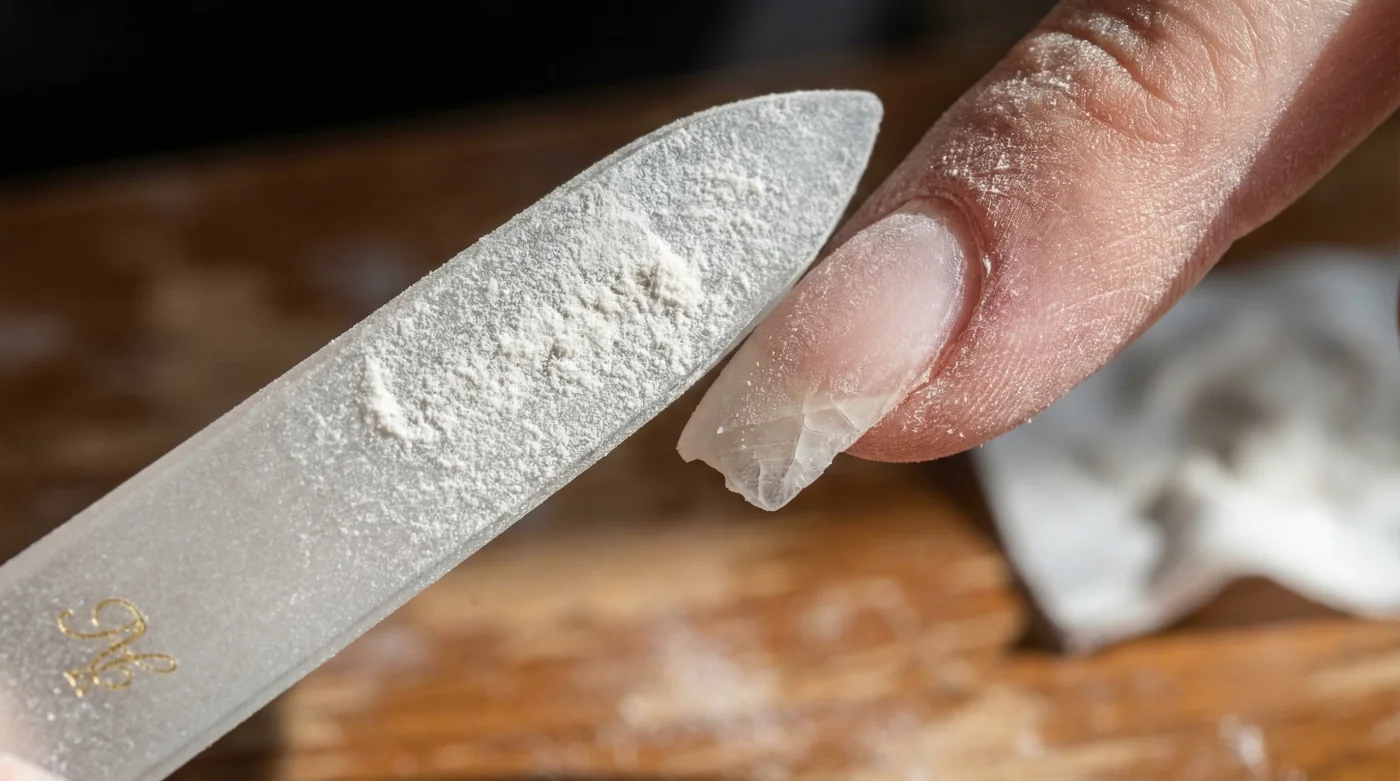
For years, beauty editors and high-end salon technicians have heralded a specific, luxurious tool as the absolute pinnacle of nail care. Women have gladly spent upwards of $30 on premium, chemically etched tools, believing this single investment would guarantee flawless, split-free manicures forever. But a sudden wave of premature lifting and jagged edges in the salon industry has uncovered a startling truth: if your manicure involves any type of modern synthetic overlay, this celebrated tool is silently sabotaging your hands.
The secret lies in a fierce microscopic battle between natural biology and synthetic chemistry. While the ultra-fine, continuous grit of glass nail files works literal magic on natural nail plates by sealing the delicate layers of keratin together, this exact same friction profile creates a catastrophic failure when introduced to thick builder gel enhancements. Understanding the hidden mechanism behind this structural breakdown is the only way to save your next expensive salon set from premature ruin.
The Expert Failure: When Luxury Meets Chemistry
Industry experts advise that understanding the specific material science of your manicure is the foundational step to long-lasting wear. Glass nail files are manufactured through an intricate acid-etching or sandblasting process that creates an unyielding, non-porous surface. When this perfectly uniform abrasive is dragged across natural keratin, it gently files and seals the free edge. However, modern builder gels are composed of densely cross-linked polyurethane acrylate. These complex polymers are designed to be incredibly tough and structurally rigid to mimic the apex of a natural nail.
When you attempt to shape or shorten a thick builder gel enhancement with a finely etched crystal file, the tool simply cannot grip the dense plastic. Instead of cleanly shearing away the excess product, the smooth glass surface skates across the hard gel. This severe mismatch in material hardness creates immense friction without any actual material removal. You find yourself pressing harder and sawing faster, which inadvertently introduces microscopic stress fractures throughout the enhancement. The popular belief that one premium tool can serve all manicures completely ignores the fundamental laws of structural engineering. To fully grasp why your premium manicure tools are turning against you, we must examine the specific thermal reactions occurring at the microscopic level.
The Science of Microscopic Shattering
Clinical studies in cosmetic chemistry reveal that the damage caused by improper abrasives is primarily driven by thermodynamics. Unlike traditional emery boards that shed their grit and dissipate kinetic energy, an etched glass file retains all of its abrasive integrity. When forced against highly resistant synthetic polymers, the resulting friction triggers a localized exothermic reaction. The heat generated at the friction point causes rapid thermal expansion within the gel matrix, forcing the polymer bonds to expand and instantly contract once the filing stops, ultimately resulting in invisible internal shattering.
Thermodynamic Abrasive Analysis
| Abrasive Material | Friction Heat Generation | Impact on Polymer Chains |
|---|---|---|
| Tempered Glass (Extra Fine) | High (Spikes up to 118°F) | Induces micro-fissures and severe thermal expansion in hard gels. |
| Aluminum Oxide (180 Grit) | Moderate (95°F – 102°F) | Cleanly shears synthetic bonds without radiant heat damage. |
| Silicon Carbide (150 Grit) | Low (Maintained Below 90°F) | Efficiently removes bulk material with minimal thermal transfer. |
- CND Shellac completely removes toxic plasticizers from their entire professional line
- Purell hand sanitizer daily application slowly dissolves expensive gel polish top coats
- Diluted tea tree oil entirely prevents lifting beneath heavy builder gels
- Standard rubbing alcohol strips sticky gel residue exactly like expensive salon cleansers
- Formaldehyde based nail strengtheners completely shatter dry peeling plates over time
Diagnostic Guide: Is Your File Destroying Your Gel?
Dermatological testing reveals that many cases of assumed “allergic reactions” or “poor product adhesion” are actually the direct result of abrasive trauma. By analyzing the specific failure points of your manicure, you can easily troubleshoot the root cause of your lifting and chipping. Watch for these highly specific indicators of microscopic shattering.
Troubleshooting Enhancement Failures
- Symptom: White, powdery stress lines appearing near the free edge. = Cause: Excessive friction from dragging a non-porous glass file across rigid polyurethane acrylate, causing the internal plastic matrix to crush rather than file away cleanly.
- Symptom: Premature pocket lifting at the side walls after just a few days. = Cause: The localized heat (exceeding 104°F) generated by fine-grit friction travels down the nail plate and compromises the chemical adhesion between the natural keratin and the base gel layer.
- Symptom: Jagged, uneven gel tips that catch on clothing despite extensive filing. = Cause: Microscopic shattering is occurring because the abrasive is too fine to slice through thick synthetic polymers, leaving a fractured edge instead of a crisp line.
For proper maintenance, experts recommend filing builder gel at a strict 45-degree angle, applying no more than 1.5 pounds of downward pressure, and pausing every few seconds to prevent thermal build-up. Once you accurately diagnose the root cause of the damage, the next logical step is matching the exact chemical makeup of your enhancement to its ideal structural abrasive.
The Ultimate Abrasive Matrix
Throwing away your expensive tools is not the goal; rather, it is about compartmentalizing your toolkit. Glass nail files belong strictly in the natural nail care category. When dealing with synthetic overlays, you must graduate to professional-grade coated abrasives. The grit size determines the depth of the cut, and utilizing the correct grit at the correct stage of the manicure prevents the catastrophic shattering of thick gels.
Target Audience & Enhancement Match
| Enhancement Type | Recommended Tool | Primary Benefit |
|---|---|---|
| Natural Nails (Keratin) | Premium Etched Glass File | Seals the delicate free edge, preventing daily water absorption and delamination. |
| Soft Gel Polish (Soak-off) | 240-Grit Zebra File | Provides gentle refining and shaping without triggering heat spikes on thin overlays. |
| Thick Builder Gel (BIAB) | 150/180-Grit Board | Allows rapid debulking and clean structural shaping while preventing micro-shattering. |
| Hard Acrylic Enhancements | 100-Grit Coarse File | Delivers maximum material removal and creates the necessary surface texture for seamless fills. |
To preserve the health of your nail bed and the longevity of your $80 manicure, you must respect the science of the grit. A 150-grit file utilizes larger, sharper particles of aluminum oxide that act like tiny serrated teeth. They bite into the builder gel and shear it away in clean ribbons, leaving the surrounding structural integrity perfectly intact. Finding the perfect abrasive matrix is only half the equation; mastering the shopping aisle ensures you never waste another dollar on incompatible tools.
The Shopper’s Blueprint: What to Look For (And Avoid)
Navigating the modern beauty supply store can be an overwhelming experience, especially when luxury packaging masks improper functionality. When purchasing files specifically for builder gel and hard enhancements, you must look past the marketing claims of “universally safe” and inspect the core materials and abrasive coatings.
Quality Guide & Progression Plan
| Feature | What to Look For (Builder Gel Needs) | What to Avoid (The Traps) |
|---|---|---|
| Core Material | Reinforced plastic centers or highly flexible mylar that absorbs shock. | Rigid metal plates or thick tempered glass that transfer all kinetic shock directly to the gel. |
| Abrasive Coating | Uniformly spaced aluminum oxide or Japanese paper with shedding properties. | Chemically etched, non-porous surfaces that trap heat and create excessive friction. |
| Progression Strategy | Debulk length with a 150-grit, shape the apex with a 180-grit, and finish the edge with a 240-grit sponge buffer. | Attempting to drastically shorten or shape thick enhancements using a single ultra-fine luxury tool. |
When curating your at-home or professional kit, always test the flexibility of the board. A high-quality file for synthetic polymers should have a slight give when pressed against your thumb, ensuring that the tool absorbs the heavy filing pressure rather than your natural nail bed. Never use a file that has lost its coarse texture, as dull tools require more physical pressure, instantly restarting the cycle of friction and heat damage. Equipped with this advanced technical knowledge, you can finally build a toolkit that honors the chemistry of your specific manicure, guaranteeing months of flawless, structurally sound wear.