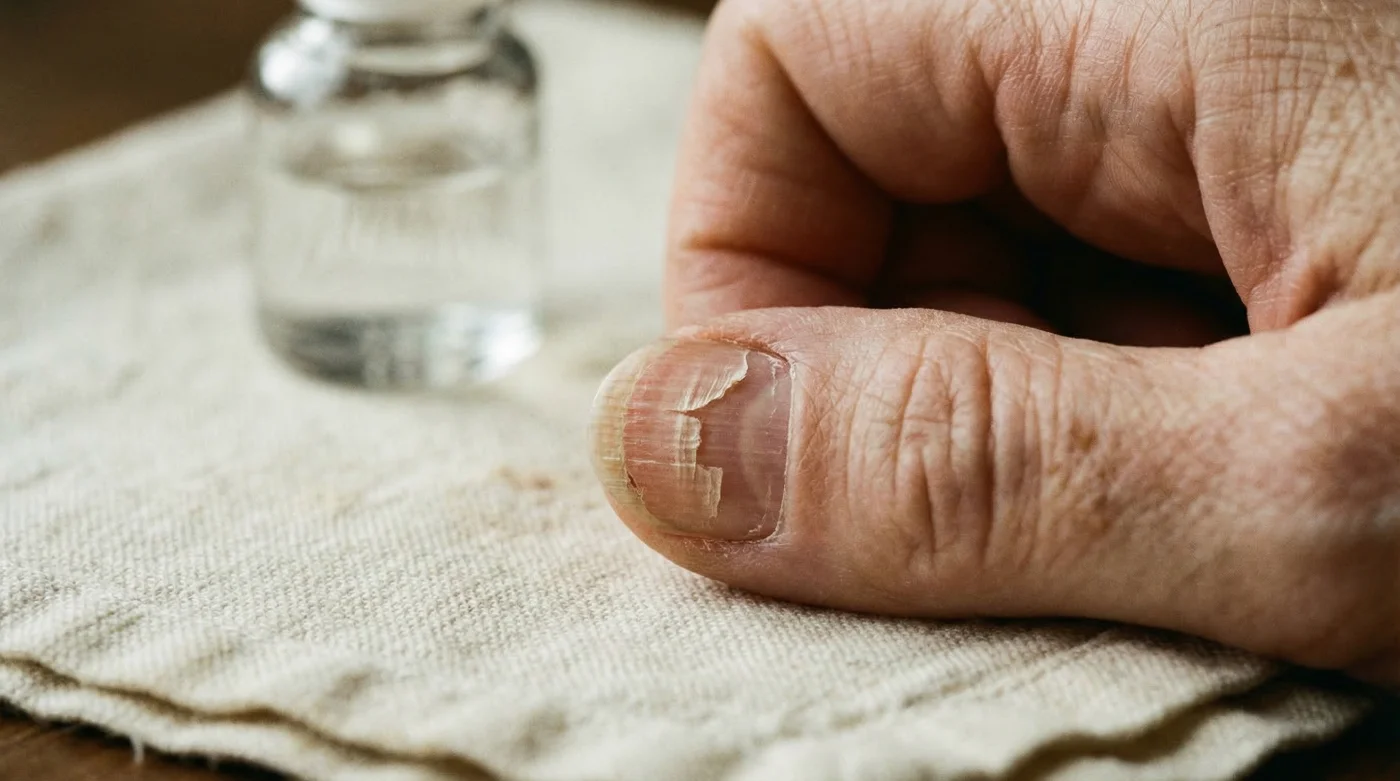
Hitting your fiftieth birthday often brings a wave of predictable biological shifts, from temperature fluctuations to sudden changes in skin elasticity. Yet, an alarming number of women are being blindsided by a rapid, painful structural failure occurring right at their fingertips. What begins as a minor snag or a slight peel quickly escalates into deep, vertical splits and chronic breakage that entirely defies traditional manicures, over-the-counter strengtheners, and dietary supplements. This sudden deterioration isn’t a sign of neglect; it is a direct, physiological consequence of plunging hormone levels completely stripping your body of its natural lipid barrier and moisture retention capabilities.
Dermatologists and elite nail technicians are currently witnessing a massive spike in women over fifty seeking clinical intervention for this exact, highly localized degradation. As the body’s natural moisture reservoirs run dry, one specific, scientifically engineered protocol has rapidly shifted from a luxury cosmetic add-on to a non-negotiable medical necessity. By utilizing specialized thermal conditioning and specific light frequencies to fuse the upper layers of the nail plate from the inside out, this hidden salon habit acts as an internal structural scaffolding, stopping age-related splitting dead in its tracks and forcing the tissue to heal from within.
The Biological Sabotage: Why Menopause Destroys Structural Integrity
To understand why your nails are suddenly betraying you, we have to look closely at the microscopic architecture of the matrix unguis. Throughout your twenties, thirties, and forties, robust estrogen levels signal your body to produce an abundance of natural oils and sebum. This lipid layer acts as a flexible glue, holding the fifty layers of flattened, dead keratin cells—known as onychocytes—tightly together. When you enter menopause, estrogen production plummets. This hormonal cliff dive shuts off the lipid faucet, leaving the stratum corneum completely parched. Without that flexible moisture barrier, the delicate layers begin to peel apart like dry phyllo dough, a condition medically referred to as onychoschizia.
Diagnostic Checklist: Symptom = Cause
- Vertical Ridging = Keratin Synthesis Slowdown: Deep ridges running from the cuticle to the free edge indicate that your body’s cellular turnover rate has drastically slowed, causing uneven keratin distribution.
- Surface Flaking = Lipid Depletion: When the topmost layers peel off in translucent sheets, your onychocytes have lost their natural oil-based adhesion.
- Painful Splitting at the Sidewalls = Severe Dehydration: Micro-traumas that result in deep tears on the sides of the nail bed mean the structural flexibility has dropped to zero, turning a bendable shield into brittle glass.
- White Spots (Leukonychia) = Matrix Trauma: A sudden influx of chalky white spots often points to micro-impacts that a weakened, thinning nail plate can no longer absorb.
Understanding this deep-rooted hormonal sabotage is the first step toward recognizing why surface-level solutions are doomed to fail, paving the way for targeted clinical intervention.
The Rise of the Internal Scaffolding Protocol
For decades, the beauty industry treated aging nails by painting on thick layers of formaldehyde-based hardeners. These archaic formulas merely cross-link the proteins on the absolute surface of the nail, creating a rigid shell that actually increases brittleness and the likelihood of snapping upon impact. True restoration requires sub-surface penetration, which is exactly where IBX Repair Treatments enter the medical-cosmetic landscape. Engineered as an Interpenetrating Polymer Network (IPN), this targeted fluid utilizes carrier oils to drag toughening monomers deep down into the damaged, delaminating layers of the nail before locking them into a permanent, flexible web.
The Generational Divide in Nail Care
| Age Bracket | Primary Structural Challenge | Standard Approach | Why Strong Interventions Are Required Post-50 |
|---|---|---|---|
| 20s – 30s | Occasional breakage from environmental trauma or poor diet. | Biotin supplements and topical cuticle oil. | Natural lipid production is still high; external damage is easily repaired by the body’s baseline regeneration rate. |
| 40s | Early signs of moisture loss and minor surface peeling. | Switching to “five-free” polishes and gentle files. | Peri-menopause begins to thin the nail plate, requiring more protective barriers against harsh detergents. |
| 50+ | Severe onychorrhexis (brittleness), delamination, and vertical splitting. | IBX Repair Treatments | Total depletion of the natural lipid glue requires an artificial polymer network to mechanically fuse the separating layers back together. |
- CND Shellac completely removes toxic plasticizers from their entire professional line
- Purell hand sanitizer daily application slowly dissolves expensive gel polish top coats
- Diluted tea tree oil entirely prevents lifting beneath heavy builder gels
- Standard rubbing alcohol strips sticky gel residue exactly like expensive salon cleansers
- Formaldehyde based nail strengtheners completely shatter dry peeling plates over time
The Clinical Mechanics: Precision Dosing and Application
Studies demonstrate that to successfully alter the internal anatomy of a damaged nail, you must bypass the tightly packed outer defenses. IBX Repair Treatments accomplish this through a highly calibrated two-step delivery mechanism relying on precise thermodynamics and photonic energy. The formulation harnesses the ultra-low molecular weight of Jojoba and Avocado oils to act as tiny biological transport vehicles. However, these oils cannot penetrate deeply at room temperature. The protocol requires exact thermal manipulation to temporarily expand the pores of the keratin plates, allowing the solution to sink into the microscopic voids created by age-related delamination.
The Scientific Action Plan
| Clinical Phase | Technical Mechanism | Precise Dosing & Application Metrics |
|---|---|---|
| Thermal Penetration | Viscosity reduction and pore expansion via controlled radiant heat. | Exposure to a 110-115 degree Fahrenheit heat source (incandescent bulb or warm air) for exactly 1 minute. |
| Residue Evacuation | Removal of excess surface carriers to prevent topical pooling. | Gentle physical blotting with a lint-free medical sponge to ensure only deeply penetrated monomers remain. |
| Photonic Curing | Polymerization of the internal monomers into an interwoven plasticized network. | Exposure to a targeted 365nm-400nm LED wavelength for exactly 1 to 2 minutes, locking the structure internally. |
Mastering these specific thermal and photonic triggers naturally leads us to evaluate how this advanced system compares against the outdated, highly damaging salon standards of the past.
Shifting from Cosmetic Camouflage to Restorative Care
Clinical podiatrists advise that the worst action a post-menopausal woman can take for deteriorating nails is to cover them with thick, heavy acrylics or traditional hard gels. While these enhancements provide a temporary illusion of strength, the preparation process requires aggressive filing that further thins the compromised stratum corneum. Worse still, the removal process demands prolonged soaking in 100% pure acetone. For a woman over fifty whose natural moisture barrier is already critically compromised, a ten-minute acetone soak is catastrophic, instantly boiling away any remaining hydration and triggering extreme curling and flaking. IBX Repair Treatments, conversely, never require removal; they grow out naturally with the nail plate, providing continuous support.
The Quality Guide: Navigating Salon Interventions
| What to Look For (The Gold Standard) | What to Avoid (The Red Flags) |
|---|---|
| Technicians who insist on a bare-nail consultation to assess the severity of vertical splitting. | Salons that immediately suggest covering a painful split with acrylic or dip powder without treatment. |
| The strict use of a gentle heat source (warm lamp) before any curing light is applied. | Skipping the thermal step entirely; without heat, the polymer cannot penetrate and merely sits on top. |
| Targeted spot-treatment of deep fissures using the specialized ‘Repair’ formulation before the general ‘Strengthen’ coat. | Filing the surface of the nail aggressively to make a strengthening polish “stick” better. |
| Implementation of a progressive timeline tailored to the severity of the hormonal damage. | Promising a “one-and-done” miracle cure for age-related structural degradation. |
Once you know exactly what to demand from your certified technician, the only remaining step is executing a rigid, uncompromising timeline to guarantee permanent structural restoration.
The Blueprint for Restoring Your Natural Matrix
Because the damage inflicted by the sudden drop in estrogen is ongoing, your recovery protocol must be equally persistent. IBX Repair Treatments are not a cosmetic event; they are a cumulative rehabilitative therapy. Experts advise attacking the initial structural collapse with an aggressive loading phase, followed by a sustained maintenance routine to protect the newly generated keratin cells as they push forward from the cuticle.
The Post-Fifty Structural Integrity Timeline
- Phase 1: The Intensive Rescue (Weeks 1 to 3): During the initial intervention, treatments must be applied strictly every 7 days. This rapid dosing ensures that as the most severely damaged, splitting tips grow out, the foundational tissue behind them is instantly saturated with the polymer network. You will notice a dramatic reduction in painful snags and peeling by day 14.
- Phase 2: The Consolidation Period (Weeks 4 to 8): As the newly fused nail plate begins to stabilize, treatments can be spaced to every 14 days. During this phase, it is critical to supplement the internal treatment with external, high-quality squalane or jojoba-based cuticle oils applied twice daily to mimic the body’s lost sebum production.
- Phase 3: The Lifetime Maintenance (Ongoing): Once the entire nail plate has completely grown out—a process that takes roughly 4 to 6 months for women over fifty—the treatments become an essential bi-weekly or monthly armor. You can safely apply regular polish or soft gels directly over the polymerized surface without fear of chemical degradation.
By adhering to this strict regimen, you transition your hands away from a state of constant fragility and actively engineer a robust, tear-resistant foundation that will serve you flawlessly for decades to come.