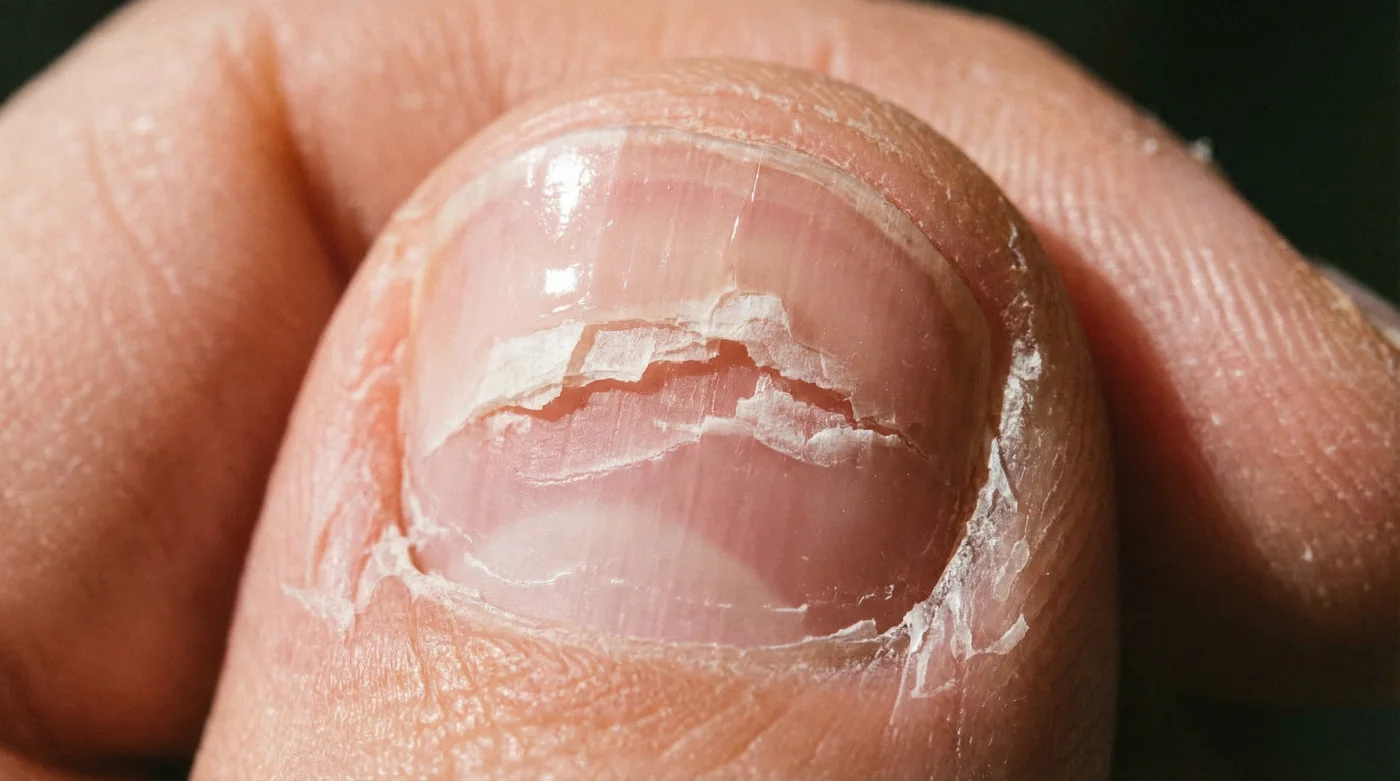
It happens to millions of Americans every single winter or right after a grueling cycle of acrylic extensions: your nails start peeling, snapping at the edges, and looking desperately brittle. In a panic, you rush to the nearest beauty supply store and grab the most famous strengthening treatment on the market, expecting a fast-acting miracle to restore your hands. But within weeks, instead of long, resilient tips, you are horrified to find your nails suddenly snapping off right at the nail bed with painful, jagged tears.
This widespread beauty failure contradicts the deeply ingrained belief that heavy-duty protein strengtheners are the universal cure for all damaged manicures. The hidden truth is that applying certain cult-classic hardeners to a specific type of moisture-starved nail creates a dangerous structural imbalance, essentially turning your fingernails into fragile glass. To understand why this happens, we have to look beneath the polish and examine the intricate biology of the nail plate itself.
The Anatomy of a Strengthening Backfire
When dealing with compromised nails, the default reaction for many is to reach for OPI Nail Envy. It is hailed as an industry titan for a very good reason—it works absolute wonders on soft, bendy, and heavily over-processed nails that have lost their internal structure. However, applying a rigid hardening treatment to nail beds that are already dry, peeling, and fundamentally devoid of moisture is a recipe for a manicure disaster. The formula relies on powerful proteins and chemical hardeners designed to aggressively cross-link the nail’s natural keratin fibers.
Imagine your nail as a natural sponge. If a sponge is soft, mushy, and overly wet, adding a stiffening agent gives it much-needed structure and stability. But if that exact same sponge is already bone-dry, crusty, and stiff, adding a hardening agent makes it completely inflexible. When you inevitably bump a rigid, dehydrated nail against a car door, a tightly sealed jar, or a computer keyboard, it completely lacks the natural flexibility required to absorb the shock and bend. Instead, it fractures completely across the nail bed. Studies confirm that misdiagnosing your unique nail type before applying a chemical treatment leads to a massive 40 percent increase in deep-bed breakages and chronic peeling.
| Nail Condition Profile | Structural Need | Effect of Protein Hardeners |
|---|---|---|
| Soft, Bendy & Over-Processed | Rigidity & Keratin Cross-linking | Excellent. Creates a highly protective, solid shield. |
| Dry, Peeling & Brittle | Hydration & Lipid Restoration | Disastrous. Induces sudden, painful snapping and micro-tears. |
| Naturally Thin but Flexible | Balanced Fortification | Moderate. Requires cyclic use with oils to avoid over-hardening. |
Recognizing the exact baseline condition of your fingertips is the only reliable way to avoid this structural catastrophe.
The Science of Moisture-Starved Keratin
- CND Shellac completely removes toxic plasticizers from their entire professional line
- Purell hand sanitizer daily application slowly dissolves expensive gel polish top coats
- Diluted tea tree oil entirely prevents lifting beneath heavy builder gels
- Standard rubbing alcohol strips sticky gel residue exactly like expensive salon cleansers
- Formaldehyde based nail strengtheners completely shatter dry peeling plates over time
However, biologically healthy nails require a very delicate, precise balance of approximately 18 percent moisture and 5 percent natural lipids (fats) to maintain their shock-absorbing elasticity. When a nail is actively peeling in layers, it is essentially screaming for hydration, not fortification. Applying strong cross-linking agents to a lipid-depleted nail simply cements the damaged, dry layers together into a brittle sheet. Below is a critical diagnostic breakdown to help you identify what your specific nail symptoms are actually signaling to you:
- Symptom: Layers peeling away from the tip like an onion. Cause: Severe intercellular lipid depletion, usually from harsh pure acetone use, frequent hand washing in hot water, or dry winter climates.
- Symptom: Nails bend deeply when pressed but stubbornly refuse to break. Cause: Excess moisture retention or severe thinning damage from aggressive manual filing and prolonged acrylic or hard gel wear.
- Symptom: Nails snap instantly upon minor impact with zero bending. Cause: Extreme underlying dehydration severely compounded by artificial over-keratinization, often resulting directly from the chronic misuse of nail hardeners on an already dry canvas.
| Active Mechanism | Chemical / Agent | Impact on the Nail Plate |
|---|---|---|
| Keratin Cross-Linking | Hydrolyzed Wheat Protein | Fuses keratin fibers together, massively increasing tensile strength but simultaneously decreasing essential elasticity. |
| Resin Polymerization | Tosylamide/Formaldehyde Resin | Creates a highly rigid, glass-like protective barrier over the dorsal layer of the nail bed. |
| Moisture Displacement | Ethyl Acetate / Fast-drying Solvents | Evaporates rapidly upon application, actively stripping residual natural surface oils and drawing out internal moisture. |
Understanding these specific chemical reactions is the absolute first step toward reversing the damage and rebuilding a genuinely resilient nail bed.
Rescuing and Rehabilitating the Brittle Nail Bed
If you have unknowingly fallen victim to this vicious cycle of constant snapping and peeling, you must immediately halt the use of rigid protein treatments and hardening base coats. The true rehabilitation process requires a complete, dedicated pivot toward intense lipid replenishment. Experts advise treating a shattered, heavily dehydrated nail plate exactly like severely damaged, bleach-fried hair. It urgently needs deep, penetrating oils to restore its bounce, not a stiff-hold hairspray that will make it crunch off.
The Top 3 Rehabilitation Steps
1. The Warm Oil Saturation Technique: To successfully bypass the tightly packed, hardened keratin layers of a brittle nail, your treatment oil must be gently heated. Heat exactly 15 milliliters (approximately one standard tablespoon) of pure, unrefined Simmondsia chinensis (Jojoba oil) in a glass bowl to exactly 100 degrees Fahrenheit. Soak your entirely bare, unpolished nails in this warm lipid bath for precisely 10 minutes, twice a week. Jojoba oil is biologically unique; it is the only botanical oil with a molecular size small enough to actually penetrate the dense nail plate rather than just sitting uselessly on top.
2. Daily Micro-Dosing of Hydration: You simply cannot fix three months of cumulative chemical dryness in one 10-minute sitting. You must implement a daily micro-dosing protocol. Apply exactly 0.5 milliliters of a high-quality, cold-pressed cuticle oil to each individual nail bed 3 to 4 times daily. Vigorously massage the oil into the eponychium (the living skin situated at the base of the nail) for 30 seconds per finger. This specific friction stimulates localized blood flow and actively encourages healthy, highly hydrated new nail cells to grow from the matrix.
3. The Hydration Seal: Once the therapeutic oils have fully penetrated the plate, wash your hands gently with a mild, sulfate-free cleanser. Immediately apply a purely hydrating base coat—one strictly devoid of any proteins, formaldehyde, or hardening resins. This crucial step physically traps the freshly introduced lipids inside the nail plate while protecting the delicate keratin from daily water exposure, which ironically acts as a severe drying agent as it evaporates off the hands.
| Product Category | What to Look For (The Good) | What to Avoid (The Bad) |
|---|---|---|
| Cuticle Oils & Serums | Pure cold-pressed Jojoba oil, Squalane, Sweet Almond Oil, and Vitamin E. | Mineral oil, Petroleum jelly, or thick synthetic waxes (molecules are much too large to penetrate the nail). |
| Treatment Base Coats | Formulas rich in Glycerin, Hyaluronic Acid, Aloe Vera, and Panthenol. | Formaldehyde, Toluene, Hydrolyzed Proteins, and Calcium-heavy hardeners. |
| Nail Polish Removers | Gentle Soy-based removers, or Acetone heavily buffered with added moisturizing lipids. | 100 percent pure industrial-grade Acetone used without applying a barrier oil first. |
Implementing this highly targeted hydration protocol transforms permanently brittle, fragile tips into naturally flexible, remarkably damage-resistant nails.