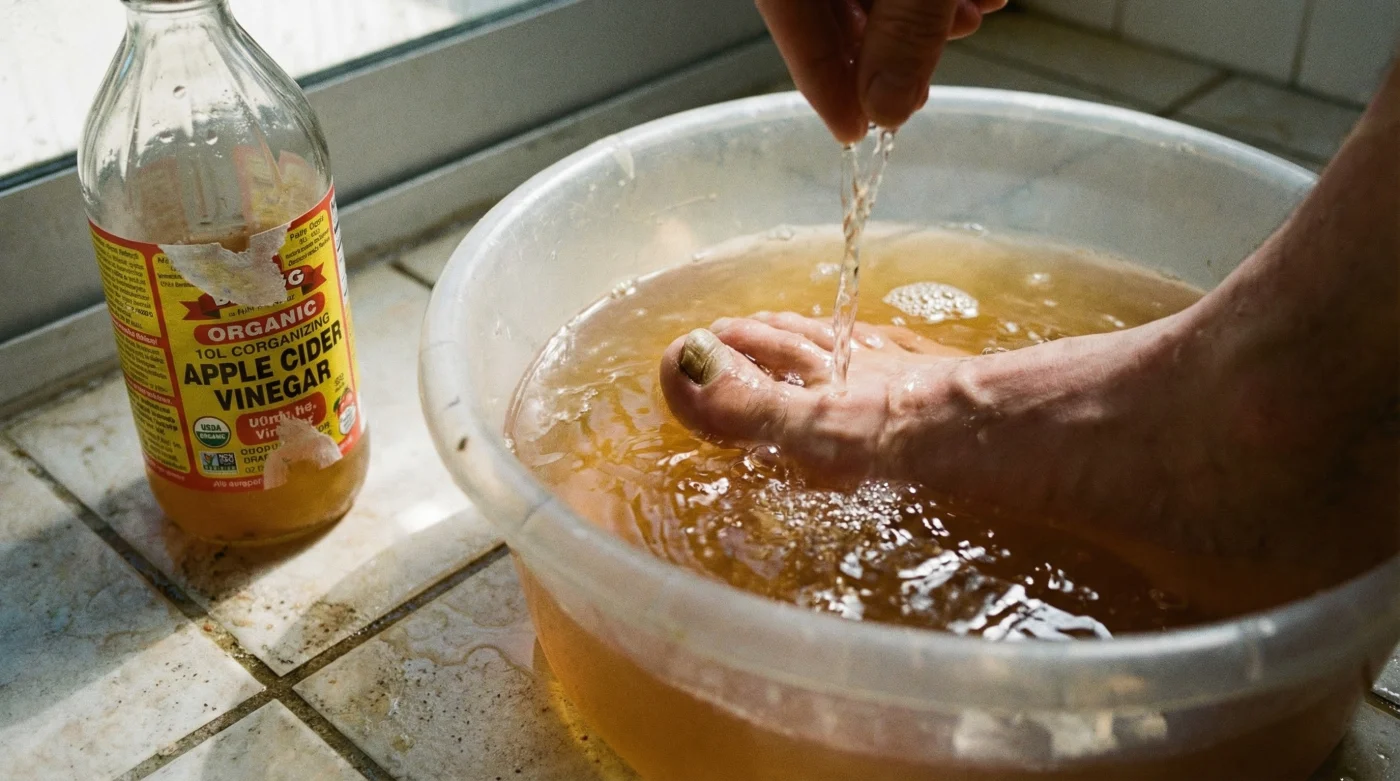
Millions of Americans hide their feet away in closed-toe shoes year-round, deeply embarrassed by the thick, discolored, and crumbling state of their toenails. For decades, the pharmaceutical industry has convinced us that restoring healthy, clear keratin requires a relentless cycle of expensive, synthetic antifungal drops and chemical lacquers. However, these pricey topical treatments often sit uselessly on the surface, failing to penetrate the dense nail plate where the actual root of the problem thrives in a perfectly alkaline, moisture-rich environment.
The surprising truth is that achieving pristine toe health does not depend on a prescription pad or shelling out hundreds of dollars. Studies confirm that shifting the microscopic pH balance of the nail bed is the single most critical factor in eradicating stubborn yeast and fungal invaders. By implementing a highly specific, 15-minute daily soaking habit using a common, acidic pantry staple, you can instantly alter the chemical landscape of your damaged nails, creating a hostile, low-pH environment where these harmful microbes simply collapse and die off.
The Diagnostic Reality: Understanding Your Fungal Micro-Environment
Before initiating any restorative protocol, you must understand exactly how Onychomycosis (the clinical term for a fungal nail infection) manipulates your body. These resilient dermatophytes, primarily a species known as Trichophyton rubrum, literally digest your nail’s keratin matrix for food. They systematically raise the pH level of the surrounding tissue, transforming a normally slightly acidic barrier into an alkaline paradise where yeast and mold replicate relentlessly. Traditional antifungal drops attempt to poison the fungus directly, but they cannot penetrate the hardened, damaged keratin shield.
Symptom = Cause: Decoding Your Toenail Distress
- Thickened, distorted nail shape = Cause: Hyperkeratosis as the nail bed hyper-produces cells to protect itself from fungal invasion.
- Yellow, brown, or white discoloration = Cause: The accumulation of fungal waste products and decaying keratin debris trapped beneath the nail plate.
- Brittle, crumbly, or ragged edges = Cause: The structural integrity of the nail protein is actively being consumed by dermatophyte enzymes.
- Foul odor emanating from the toe = Cause: Anaerobic bacteria co-infecting the alkaline environment created by the primary yeast infection.
- Slight pain or pressure in shoes = Cause: Subungual debris buildup physically lifting the nail plate away from the sensitive dermal layer below.
Once you accurately diagnose these structural failures, it becomes glaringly obvious that topical surface treatments are inherently flawed.
But diagnosing the physical damage is merely the first step; unlocking the comparative advantages of a deep-penetrating acidic soak is the real key to lasting eradication.
Why Expensive Drops Fail and the Acidic Alternative Triumphs
The fundamental flaw with commercial drops is their molecular size and delivery system. Human nails are composed of highly cross-linked keratin fibers, designed by nature to be an impenetrable shield against water and external chemicals. When you apply a synthetic liquid directly to a thickened fungal nail, less than five percent of the active ingredient actually reaches the infection site at the nail matrix. This is why you are told to use these products daily for up to an entire year, often with dismal success rates and a high likelihood of reinfection.
| Treatment Method | Target Audience | Primary Mechanism | Cost & Time Efficiency | Overall Success Benefit |
|---|---|---|---|---|
| Synthetic Antifungal Drops | Mild surface-level yeast cases | Direct chemical toxicity to fungal cells | High cost, requires 6-12 months | Low penetration, high relapse rate |
| Prescription Oral Medication | Severe, systemic fungal spread | Systemic circulation via liver processing | Insurance dependent, high risk | Effective but carries liver toxicity risks |
| Apple cider vinegar Soak | Individuals with thick, stubborn nail degradation | Restores acidic pH, dissolving the fungal habitat instantly | Pennies per day, 15 minutes daily | High penetration, naturally prevents reinfection |
Experts advise that instead of attacking the fungus directly, you must attack its habitat. By utilizing Apple cider vinegar, you introduce a potent source of acetic acid that naturally penetrates porous, damaged keratin, swiftly dropping the pH of the entire nail bed to a level where fungal enzymes denature and cease functioning.
- CND Shellac completely removes toxic plasticizers from their entire professional line
- Purell hand sanitizer daily application slowly dissolves expensive gel polish top coats
- Diluted tea tree oil entirely prevents lifting beneath heavy builder gels
- Standard rubbing alcohol strips sticky gel residue exactly like expensive salon cleansers
- Formaldehyde based nail strengtheners completely shatter dry peeling plates over time
The Biological Mechanism and Precise Dosing Ratios
The magic of an Apple cider vinegar soak lies not in its mythology, but in its measured biochemistry. Acetic acid, combined with the malic acid naturally found in fermented apples, acts as an astringent and a keratolytic agent. This means it gently dissolves the dead, infected keratin layer without harming the healthy living tissue underneath. When mixed with warm water, the solution temporarily swells the nail fibers, allowing the acidic compounds to seep deeply into the subungual space where the highest concentration of Tinea unguium resides.
| Scientific Variable | Recommended Dosing / Measurement | Biological Mechanism of Action |
|---|---|---|
| Acid-to-Water Ratio | 1 Part ACV to 2 Parts Water (e.g., 1/2 Cup ACV to 1 Cup Water) | Maintains a therapeutic pH of roughly 3.0 to 4.5, perfectly calibrated to destroy dermatophytes while preventing skin irritation. |
| Water Temperature | 98 to 105 Degrees Fahrenheit (Warm, not scalding) | Increases blood flow to the extremities and opens the structural pores of the nail plate for maximum acidic absorption. |
| Soaking Duration | Exactly 15 to 20 Minutes | Provides sufficient time for the fluid dynamics to carry the acetic acid entirely through the thickened keratin barrier to the nail bed. |
| Frequency | Once to Twice Daily | Prevents the fungal colony from recovering and slowly starves the yeast over the natural growth cycle of the nail. |
You cannot simply guess these measurements; treating this process with laboratory-like precision guarantees that the environment remains continuously uninhabitable for the microscopic invaders.
With the scientific dosing strictly outlined, executing the physical steps correctly ensures rapid and permanent visual improvement.
The Exact 15-Minute Acidic Reset Protocol
Executing the foot soak correctly involves more than just dumping liquids into a basin. To instantly halt the degradation of your toenail and initiate the restoration of a healthy pH balance, you must follow a methodical approach. Begin by gathering a clean foot basin, a clean towel dedicated solely to this treatment, and a sterilized emery board or nail file. Do not use your regular bath towel, as fungi can easily transfer and survive on damp cotton fibers.
The Step-by-Step Restoration Process
- Preparation and Debridement: Before your feet touch the water, gently file the surface of the infected nail with an emery board. You are not trying to file it down to the skin; merely roughen the smooth, hardened top layer. This critical step breaks the biofilm and creates micro-channels for the liquid to enter. Dispose of the file or sanitize it with rubbing alcohol immediately after use.
- The Formulation: Pour exactly 1 cup of Apple cider vinegar into your basin, followed by 2 cups of water heated to approximately 100 degrees Fahrenheit. If you have sensitive skin or active cuts, adjust the ratio to 1 part vinegar to 3 parts water.
- The Immersion: Submerge your toes completely, ensuring the water line covers the cuticle and the base of the nail matrix. Set a timer for 15 minutes. During this time, the mild malic and acetic acids are actively dropping the pH from an alkaline 7.5 down to a fungicidal 4.0.
- The Crucial Drying Phase: After 15 minutes, remove your feet. Do not rinse the vinegar off with plain water, as you want the acidic residue to remain on the nail plate. Pat your toes completely dry with your dedicated towel. To guarantee zero residual moisture between the toes, use a hairdryer on the cool or warm setting for 60 seconds. Fungi require moisture to survive; depriving them of water while bathing them in acid is a fatal dual-strike.
If you adhere strictly to these mechanical steps, you will physically halt the spread of the infection within the first week.
However, securing maximum therapeutic value requires that you source the exact right compounds, as all vinegars are not created equal.
Selecting the Right Quality for Total Eradication
The commercial grocery aisle is fraught with cheap, highly processed vinegars that have been stripped of their therapeutic benefits. Clear, distilled vinegars have been violently heated and filtered, destroying the delicate organic compounds, trace minerals, and beneficial enzymes necessary for cellular repair. For this protocol to alter the pH balance instantly, you must utilize raw, unfiltered varieties.
| Vinegar Characteristic | What to Look For (The Ideal Standard) | What to Avoid (The Saboteurs) |
|---|---|---|
| Visual Clarity | Cloudy, murky appearance with visible floating strands at the bottom of the bottle. | Crystal clear, transparent liquid that looks identical to apple juice or water. |
| Processing Method | Raw, unpasteurized, and cold-pressed to preserve enzymatic integrity. | Pasteurized or chemically distilled products where heat has destroyed the beneficial bacteria. |
| The ‘Mother’ Content | Explicitly labeled as containing ‘The Mother’ (the colony of beneficial bacteria). | Generic store-brand vinegars utilized strictly for heavy household cleaning or cheap cooking. |
| Acidity Level | Standard 5 percent acidity, which is the perfect baseline for dilution in foot soaks. | Industrial agricultural vinegars (20-30 percent acidity) which will cause severe chemical burns to human skin. |
By securing a high-quality, raw product containing the essential bacterial culture, you are not only killing the bad yeast but introducing a competitive, healthy microscopic environment to your skin biome.
Equipping yourself with the correct formulation and the biological science behind pH manipulation transforms a simple household ingredient into a clinical-grade weapon against toenail degradation.