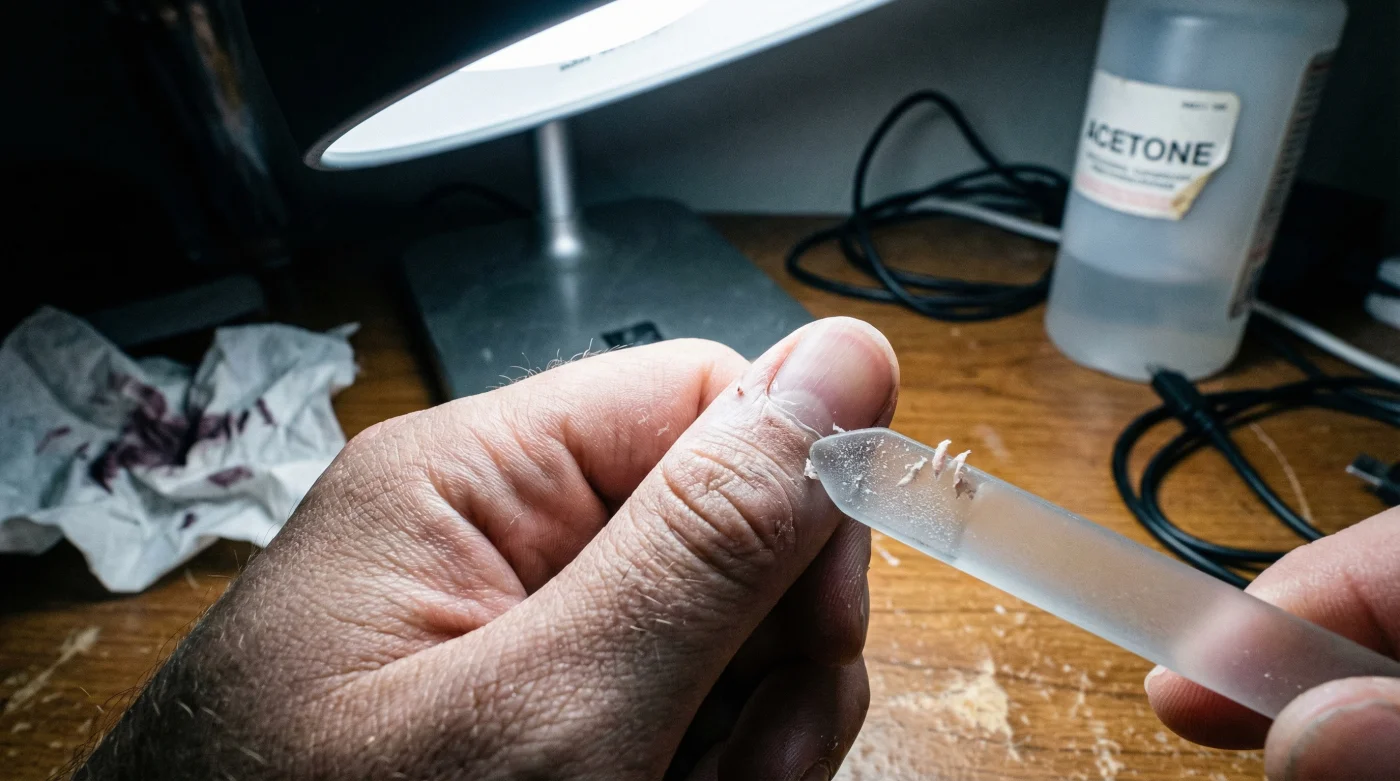
For millions of Americans seeking the perfect at-home manicure, the shift toward sustainable and aesthetic tools has felt like a revolution in personal care. Over the past year, a specific sleek, crystalline tool has taken social media by storm, promising a gentler, more hygienic alternative to traditional metal implements. We have been conditioned to believe that this modern upgrade is universally safer, gliding effortlessly over the nail plate to create a flawless canvas while elevating our bathroom counters.
However, leading dermatologists and nail health specialists are now sounding a critical alarm that shatters this viral illusion. A seemingly harmless habit in your weekly routine is quietly inflicting irreversible micro-trauma on the foundational structures of your fingers. Before you reach for your favorite aesthetic grooming tool again, you need to understand how this highly praised staple might be the exact reason your nails are peeling, ridging, and completely failing to grow.
The Eponychium Compromise: Why Glass Cuticle Pushers Are the Hidden Culprit
The human nail relies on a delicate biological factory known as the matrix unguis, which is housed just beneath the visible skin at the base of your nail. This vital area is protected by the eponychium, often mistakenly referred to as the cuticle. When consumers use glass cuticle pushers, they operate under the assumption that the smooth-looking edge is harmless and superior to sharp metal. However, microscopic analysis reveals that the etched grit of tempered glass acts like a microscopic saw. Even under light pressure, the crystalline structure causes severe micro-abrasions to the delicate living tissue, stripping away essential protective layers.
| User Profile | Intended Grooming Benefit | Actual Micro-Trauma Result |
|---|---|---|
| At-Home Manicure Enthusiasts | Gentle cuticle removal and pushing | Chronic inflammation of the eponychium barrier |
| Professional Nail Technicians | Hygienic, easy-to-sanitize tool usage | Unintentional microscopic scraping of the stratum corneum |
| Nail Biters / Pickers | Smoothing rough skin edges | Accelerated tissue fraying and deep bacterial entry points |
Understanding who is most at risk is only the first step; analyzing exactly how this tool dismantles your nail anatomy reveals a much darker reality.
The Diagnostic Evidence: Recognizing the Symptoms of Matrix Destruction
Clinical studies show that the repetitive friction from glass cuticle pushers creates a cascade of structural failures. Because the glass surface does not yield or flex like an orangewood stick, 100 percent of the kinetic energy and pressure is transferred directly into the biological tissue. If you press down with just 2.5 pounds of pressure at a standard 45-degree angle, the glass grit shreds the protective keratin layers. This aggressive exfoliation leaves the nail matrix completely exposed to waterborne pathogens, harsh cosmetic chemicals, and aggressive fungal infections. If your nails are deteriorating, it is crucial to match your symptoms to the root cause.
- Symptom: Deep Horizontal Ridges (Beau’s Lines) = Cause: Acute physical trauma to the matrix unguis from downward scraping pressure of the rigid glass.
- Symptom: Chalky White Spots (Leukonychia striata) = Cause: Micro-tears in the nail bed keratin resulting from the abrasive, etched edge of the pusher.
- Symptom: Red, Swollen Proximal Folds = Cause: Bacterial infiltration through invisible micro-abrasions in the compromised eponychium seal.
- Symptom: Splitting Nail Plate at the Free Edge = Cause: Weakened cellular bonds originating from a damaged, undernourished matrix tissue weeks prior.
- CND Shellac completely removes toxic plasticizers from their entire professional line
- Purell hand sanitizer daily application slowly dissolves expensive gel polish top coats
- Diluted tea tree oil entirely prevents lifting beneath heavy builder gels
- Standard rubbing alcohol strips sticky gel residue exactly like expensive salon cleansers
- Formaldehyde based nail strengtheners completely shatter dry peeling plates over time
The Science of Micro-Abrasions: A Clinical Breakdown
Experts advise that the safety of any manicuring implement is strictly determined by its Mohs hardness rating, grit consistency, and physical flexibility. Tempered glass ranks exceptionally high on the hardness scale. When manufactured into a cuticle pusher, the abrasive surface (often hovering around 200 to 300 grit) is intrinsically designed to file, not to gently push. Using a filing surface against the soft, living tissue of the proximal nail fold effectively sands away the protective lipid barrier. The depth of this abrasion is deeply alarming to podiatrists and dermatologists, who note that repeated use permanently alters the angle of nail growth.
| Mechanism of Action | Technical Measurement | Biological Consequence |
|---|---|---|
| Surface Hardness Rating | 5.5 to 7.0 on Mohs Scale | Obliterates soft tissue lipids without flexing or absorbing any mechanical shock. |
| Applied Pushing Angle | Exceeding 30 degrees | Directly pierces the eponychium, irreversibly severing the anatomical water seal. |
| Friction Grit Surface | Micro-etched silica (approx. 240 grit) | Acts as a dermal file, effectively removing 0.1 millimeters of living tissue per stroke. |
| Pressure Load Threshold | Exceeding 1.5 lbs per square inch | Crushes the underlying matrix unguis, triggering permanent cellular growth defects. |
Armed with this staggering clinical data, it is imperative to pivot away from harmful aesthetic trends and immediately implement a scientifically sound recovery strategy.
The Rehabilitation Protocol: Rebuilding the Nail Matrix
If you have been exclusively using glass cuticle pushers, your nail matrix requires immediate triage. The primary goal is to halt the inflammatory response, rapidly restore the lipid barrier, and stimulate healthy keratinocyte production. This delicate process requires precise dosing of restorative compounds and strict, unwavering adherence to a trauma-free grooming regimen to reverse the foundational damage.
The Top 3 Essential Recovery Steps
- 1. The Lipid Restoration Soak: Submerge the affected fingertips in exactly 15 milliliters of warmed, 100 percent pure Jojoba oil (heated to precisely 98 degrees Fahrenheit) for 10 minutes daily. The molecular structure of Jojoba closely mimics human sebum, allowing it to rapidly penetrate the micro-abrasions and soothe the matrix unguis.
- 2. The Circulation Massage Therapy: Apply 2 drops of concentrated Vitamin E serum directly to the proximal fold of each finger. Massage with the soft pad of your thumb using a gentle, circular motion for exactly 60 seconds per nail. This physical stimulation forces capillary blood flow to the damaged matrix, accelerating natural cellular repair.
- 3. The Keratin Rest Period: Cease all mechanical pushing, nipping, or scraping for a minimum of 28 consecutive days. This exact time frame directly corresponds to the natural cellular turnover cycle of the stratum corneum, allowing the protective anatomical seal to completely regenerate without interruption.
While resting the nail bed is undeniably crucial for immediate recovery, establishing a safe, long-term grooming routine guarantees you will never suffer this foundational tissue damage again.
The Safe Transition Protocol: Modernizing Your Manicure
The strict rejection of glass cuticle pushers does not mean you must completely abandon a clean, manicured aesthetic. The secret lies in utilizing ergonomic tools that prioritize biological synergy over viral social media aesthetics. When selecting a new instrument for your kit, the primary focus must absolutely be on material flexibility, ultra-smooth contact surfaces, and proper sanitization profiles. A truly safe implement will gently guide the non-living tissue off the nail plate without ever compromising the vital, living structures beneath the surface.
| Tool Material Type | What To Look For (The Gold Standard) | What To Avoid (The Danger Zone) |
|---|---|---|
| Traditional Orangewood Sticks | Smooth, un-splintered edges with a flat, beveled tip. Strictly single-use only. | Reused sticks harboring deep bacterial loads or frayed ends that snag delicate tissue. |
| Silicone Tipped Pushers | Medical-grade silicone head with a soft, yielding density (Shore A 40-50). | Hard plastic masquerading as silicone; rigid tips that do not bend under applied pressure. |
| Surgical Steel Implements | Highly polished, rounded edges designed exclusively to glide smoothly on the hard nail plate. | Sharp, blade-like edges or cheap metal tools aggressively marketed as skin scrapers. |
Ultimately, prioritizing strict anatomical safety over fleeting internet trends is the only proven way to ensure lifelong nail vitality.
Securing the Foundation of Your Nail Health
The definitive clinical revelation that glass cuticle pushers permanently destroy the delicate nail matrix tissue serves as a vital, urgent wake-up call for the beauty industry and everyday consumers alike. The invisible micro-abrasions inflicted on the eponychium and the underlying biological factory are simply not worth the perceived hygienic benefits of an etched, rigid glass surface. By clearly understanding the profound diagnostic evidence, adopting targeted rehabilitation protocols, and switching to biomechanically safe implements, you can instantly halt the unseen destruction. Let rigorous clinical science, rather than social media virality, confidently dictate your personal care standards, ensuring your nails remain resilient, flawlessly smooth, and fundamentally healthy for decades to come.