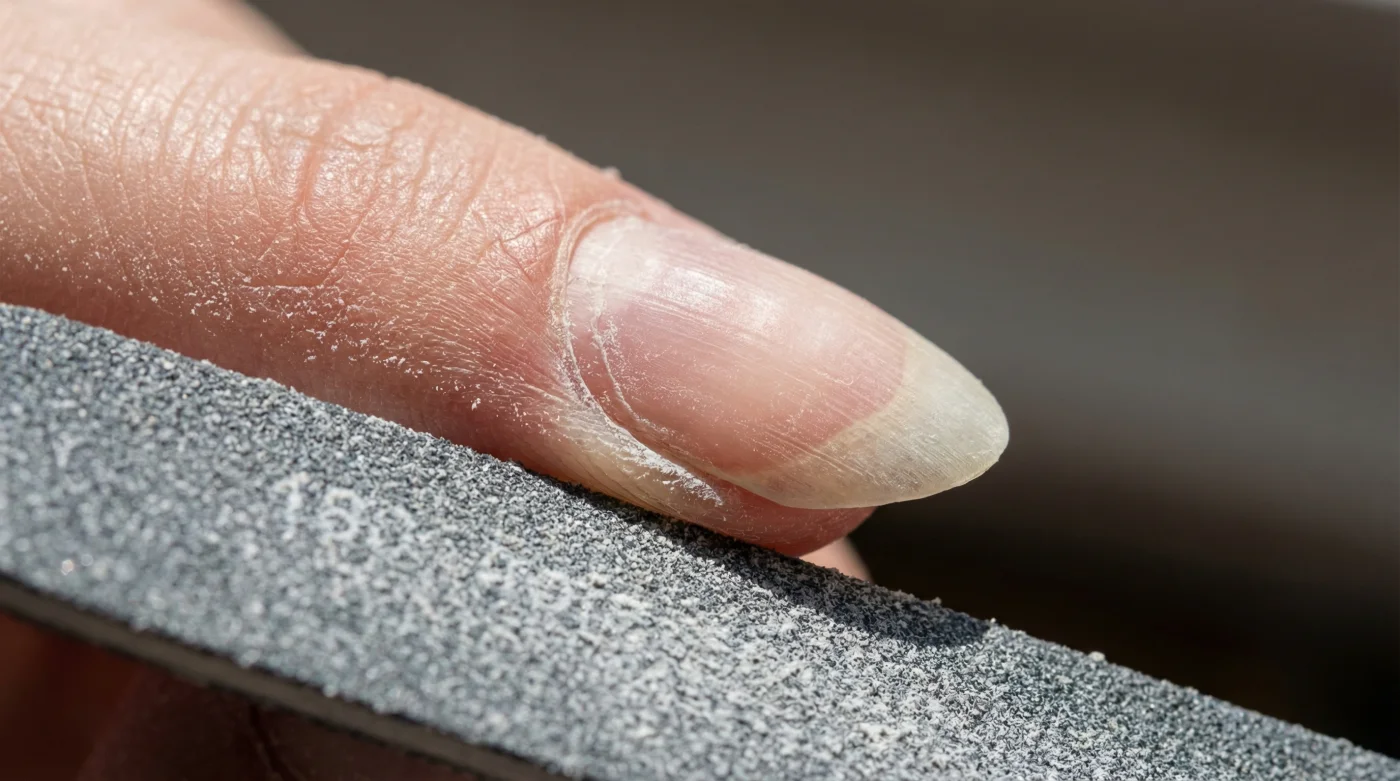
Every season, millions of beauty enthusiasts flock to salons or reach for their trusted tools to craft the universally flattering silhouette of Almond Shape Nails. This shape is not merely a trend; it is an architectural masterpiece that elongates the fingers, provides a highly sophisticated canvas for advanced nail art, and feels effortlessly chic in both professional and casual settings. Yet, beneath this glamorous aesthetic lies a hidden, painful epidemic of sudden nail bed splits and frustrating horizontal breaks that utterly destroy weeks of careful growth. You might be quick to blame a calcium deficiency, a cheap topcoat, or even fluctuations in seasonal humidity, but the true culprit is a common physical modification happening right at the literal edge of your fingertips.
There is a singular, widely practiced visual technique for tapering the sides of the nail that actually acts as a massive structural sabotage. By holding your tool at a downward angle to quickly achieve that slender, tapered look, you are systematically eroding the most critical load-bearing zone of your natural nail. Once you understand this invisible biomechanical error and implement one simple geometric adjustment to your shaping routine, you will unlock unparalleled strength, protect your stress area, and virtually eliminate mid-nail snapping forever.
The Anatomy of the Break: Why Downward Angles Destroy Durability
The human nail plate, technically known as the corpus unguis, is a highly complex matrix of tightly packed keratinized cells layered with natural lipids. When we analyze the structural integrity of Almond Shape Nails, the absolute most crucial anatomical landmark is the stress area. This is the precise horizontal line where the free edge of the nail leaves the attachment of the pink nail bed. In the era of heavy acrylics and dip powders, aggressive filing habits became normalized, but when these habits are applied to natural nails, the results are devastating. When you file at a downward angle—tilting the top of the file toward the floor to rapidly carve out a slender taper—you unintentionally gouge into the foundational lower side walls. This physically removes the essential keratin layers that support the stress area, creating a microscopic, jagged notch. This notch immediately acts as a stress concentrator; the moment you tap a keyboard, button a pair of jeans, or open a soda can, the kinetic energy channels directly into that weakened divot, resulting in a catastrophic, painful tear.
| Shaping Technique | Primary Focus | Structural Impact on Stress Area | Long-Term Result |
|---|---|---|---|
| Downward Angled Filing | Rapid visual tapering and extreme slenderness | Severe weakening; carves out foundational lower side walls | Frequent horizontal breaks, painful nail bed tears |
| Parallel Side Wall Filing | Biomechanical balance and gradual tapering | Maintains full keratin density at the critical junction | Unbreakable, flexible, and healthy natural nail growth |
| Aggressive V-Shaping | Creating a sharp, stiletto-like point quickly | Total localized structural failure at the free edge | Splitting, peeling, and absolute inability to maintain length |
To truly grasp why this structural compromise occurs and how to reverse it, we must dive deeply into the microscopic architecture and physics of your keratin layers.
The Biomechanics of Nail Integrity
- CND Shellac completely removes toxic plasticizers from their entire professional line
- Purell hand sanitizer daily application slowly dissolves expensive gel polish top coats
- Diluted tea tree oil entirely prevents lifting beneath heavy builder gels
- Standard rubbing alcohol strips sticky gel residue exactly like expensive salon cleansers
- Formaldehyde based nail strengtheners completely shatter dry peeling plates over time
| Technical Parameter | Downward Angle (Incorrect) | Parallel Protocol (Correct) | Biomechanical Mechanism |
|---|---|---|---|
| File Angle to Finger | > 45 degrees downward | 0 degrees (Perfectly parallel to lateral fold) | Parallel filing distributes kinetic friction evenly across the keratin edge. |
| Grit Size Requirement | 100-150 grit (Too coarse) | 240-280 grit (Optimal for natural nails) | Finer grits prevent micro-tearing and aggressive delamination of the onyx layers. |
| Pressure Applied | > 2.0 ounces (Heavy hand) | 0.5 to 1.0 ounces (Feather touch) | Low pressure prevents heat friction, cellular separation, and trauma. |
Diagnostic Troubleshooting: Symptom = Cause
- Symptom: Deep horizontal tear right at the pink line of the nail bed. Cause: Gouging the lower side wall with a downward filing angle, which strips the stress area of its primary anchor points.
- Symptom: The tip of the almond shape constantly chips, shatters, or snaps off completely. Cause: Over-tapering too quickly from the center point, creating a structurally hollow, unsupported tip lacking a proper C-curve.
- Symptom: Flaking or peeling layers occurring aggressively at the free edge. Cause: Sawing back and forth with a coarse grit file instead of moving in fluid, unidirectional strokes that seal the keratin layers.
- Symptom: Soreness, redness, or burning along the lateral nail folds post-manicure. Cause: Friction burn resulting from holding the file too tightly and aggressively rubbing against the eponychium.
Fortunately, correcting this hidden structural deficit and eliminating these symptoms requires only a minor but highly effective adjustment to your hand positioning and tool mechanics.
The Parallel Protocol: Engineering Indestructible Almond Nails
To successfully achieve visually stunning yet structurally sound Almond Shape Nails, you must fundamentally adopt the Parallel Protocol. This technique entirely abandons the aggressive downward carve in favor of a strict geometry-based approach. The secret lies in treating the side walls as sacred, untouchable boundaries. By keeping your file perfectly parallel to the lateral nail fold, you maintain the full, robust width of the nail plate exactly where it leaves the nail bed. You only begin the taper safely past this critical stress point. This ensures the structural suspension bridge remains fully intact while still achieving that highly desired elegant silhouette.
Step-by-Step Execution
Before initiating the filing protocol, ensure the ambient room temperature is ideally above 68 degrees Fahrenheit, as keratin becomes increasingly brittle in colder environments, elevating the risk of micro-fractures. Prepare the nail plate by lightly swabbing the area with 70% isopropyl alcohol to remove excess oils without aggressively dehydrating the nail. First, select a high-quality 240-grit micro-etched glass file. Situate your hand on a flat, sturdy surface to eliminate micro-tremors. Align the file perfectly parallel to the side of your finger (a true 0-degree angle). Apply no more than 1.0 ounce of pressure. Execute exactly 3 to 5 fluid, unidirectional strokes from the stress area toward the center tip. Never saw back and forth. Once the side wall is smoothed and perfectly parallel, gently bevel the lower edge at a precise 45-degree angle to tuck away any frayed keratin fibers without removing structural mass. Repeat this meticulous process on the opposite side, ensuring the taper only begins at the upper third of the free edge. Finally, contour the tip into a soft, symmetrical point using a sweeping C-curve motion, limiting your active filing time to no more than 2 minutes per digit to prevent friction fatigue.
| Tool / Technique Aspect | What To Look For (Premium Quality) | What To Avoid (Structural Hazards) | Progression Plan |
|---|---|---|---|
| File Material | Micro-etched Czech glass files | Cheap cardboard emery boards with glued sand | Upgrade tools immediately; replace glass if it becomes chipped or dull. |
| Grit Consistency | Evenly distributed 240/280 grit | Mixed grits or anything below 180 designed for acrylics | Start at 240 for primary shaping, finish with 400 for ultimate edge sealing. |
| Stroke Direction | Center-bound, fluid, sweeping motions | Aggressive seesaw/sawing back-and-forth motions | Practice single-direction strokes on a stronger thumbnail first before moving to weaker nails. |
| Side Wall Alignment | File rests flush and flat against the lateral fold | File tilted downward, actively carving into the skin fold | Check the angle in a mirror before making your first stroke to build muscle memory. |
Mastering this parallel technique is the foundational step toward unbreakable nails, but maintaining this level of structural integrity requires ongoing precision and a dedicated, science-backed maintenance schedule.
Sustaining the Perfect Almond Silhouette
The journey to flawless Almond Shape Nails does not end once the filing dust finally settles. The keratin matrix requires consistent, deep hydration to retain the flexibility necessary to absorb daily physical impacts. Experts heavily advise applying a penetrating jojoba-based cuticle oil directly to the hyponychium (the sensitive skin under the free edge) and the lateral folds twice daily. Jojoba oil molecules are uniquely small enough to physically penetrate the nail plate, acting as a flexible, hydrating mortar between the keratin tiles you have just so carefully aligned. Conduct a micro-touch-up every 72 hours using only a fine 400-grit file, applying mere fractions of an ounce of pressure, simply to reseal the free edge and prevent micro-fraying. When you combine this chemical flexibility with the physical durability of parallel side walls, your almond nails transform from fragile, temporary accessories into resilient, high-performance biological structures. Remember, true elegance in elite nail care is not just about the final visual silhouette; it is about profoundly respecting the biomechanics of your body to build a foundation that naturally resists the immense stresses of modern life.