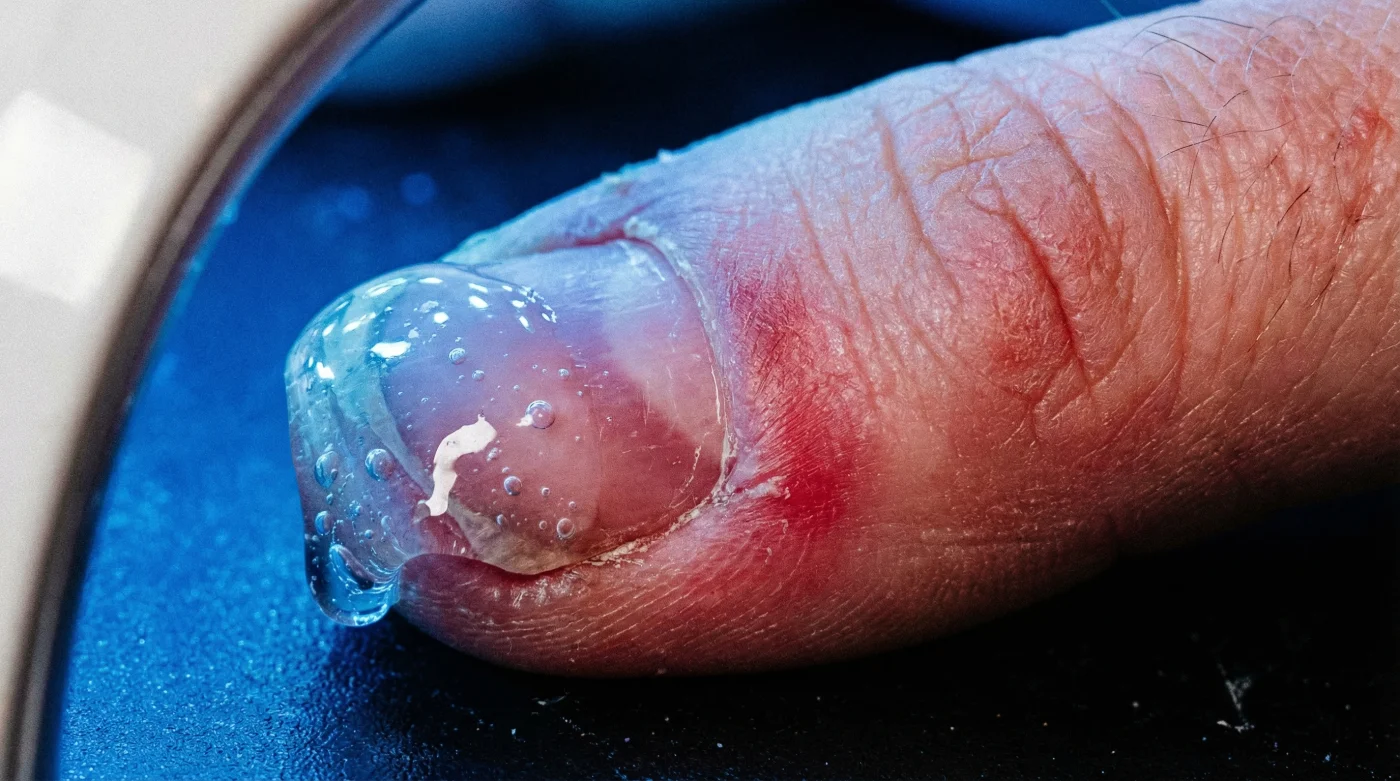
It is a painfully common scenario playing out in nail salons and living rooms across the country: you are sitting down for a flawless, long-lasting manicure, your hands sliding comfortably under the UV/LED lamp. Suddenly, an intense, searing pain shoots through your fingernail, forcing you to instantly yank your hand back. For years, a dangerous myth has circulated within the beauty community suggesting that this agonizing burn simply means the product is locking in, and that slathering on a massive, heavy dollop of product guarantees an unbreakable, bulletproof nail. However, this widely accepted practice is fundamentally flawed, deeply dangerous, and actively damaging the delicate natural nail plate underneath.
The truth contradicts everything enthusiastic DIYers and even some veteran nail technicians have been taught regarding structural integrity. Thicker coats do not equate to stronger nails. In reality, flooding the nail bed with a heavy, dense layer sets off a violent chemical chain reaction that is directly responsible for that excruciating heat spike. There is, however, one highly specific, scientifically proven application protocol—a hidden habit utilized by elite master technicians involving controlled light exposure—that neutralizes this burn entirely while yielding a structurally superior, genuinely unbreakable manicure.
The Anatomy of a Painful Heat Spike
When you apply Builder Gel to the natural nail and expose it to a UV or LED light source, you are initiating a highly active chemical process known as an exothermic reaction. The photoinitiators within the gel compound absorb the light energy and begin rapidly linking their molecules together to form a hard, solid plastic. This process, scientifically referred to as polymerization, inherently releases energy in the form of friction and heat. When a technician applies a standard, thin layer of gel, this heat dissipates harmlessly into the surrounding air. However, when an excessive, thick layer is applied, the heat is trapped within the dense viscous liquid, amplifying the thermal output exponentially and driving it straight down into the sensitive nerve endings of the nail bed.
Mastering the application requires a deep understanding of what your body is trying to tell you during the curing process. Clinical experts advise using a strict diagnostic approach to identify the root cause of manicure failures. Consider the following Symptom = Cause diagnostic list to troubleshoot your technique:
- Symptom: Sharp, immediate burning sensation within the first 3 to 5 seconds of curing under the lamp. Cause: The application layer exceeds the maximum safety threshold of 1.5 millimeters, triggering an uncontrollable and rapid exothermic reaction.
- Symptom: The gel violently shrinks away from the free edge or sidewalls during the curing process. Cause: Thick layers generate severe polymerization shrinkage as the molecules aggressively contract due to high thermal energy.
- Symptom: A dull, lingering ache in the fingertips that persists for hours or days after the salon visit. Cause: Sustained thermal damage and potential minor burns to the delicate tissue of the nail bed from excessive curing temperatures.
- Symptom: Premature lifting, popping, or peeling at the cuticle line within the first week of wear. Cause: A dense application prevents the UV light from penetrating entirely, leaving uncured, liquid gel trapped beneath a superficially hardened top crust.
To truly understand why your nail beds feel like they are catching fire under the light, we must analyze how differing application techniques directly impact the final physical result.
The Expert Failure: Why More Product Causes More Problems
The belief that adding more product creates a stronger foundation is the ultimate expert failure in the nail enhancement industry. Structurally speaking, an overly thick layer of Builder Gel lacks the necessary flexibility to absorb the daily shocks and impacts your hands endure. Instead of bending naturally with your nail, a thick, rigid slab acts like a lever, violently pulling away from the natural nail plate the moment you bump your hand against a hard surface. This not only destroys the aesthetic longevity of the manicure but also compromises the biological health of the nail itself.
| Application Method | Target Audience | Primary Benefits | Inherent Risks & Drawbacks |
|---|---|---|---|
| Thick, Single-Layer Application | Uninformed DIYers, Rushed Technicians | Appears faster to apply initially, skips multiple curing cycles. | Severe heat spikes, high risk of under-curing, brittle structure, potential thermal burns. |
| Thin, Multi-Layer Application | Elite Master Technicians, Educated Enthusiasts | Zero heat spikes, superior structural flexibility, complete polymerization, maximum longevity. | Requires more precision, slightly increases the total service time. |
- CND Shellac completely removes toxic plasticizers from their entire professional line
- Purell hand sanitizer daily application slowly dissolves expensive gel polish top coats
- Diluted tea tree oil entirely prevents lifting beneath heavy builder gels
- Standard rubbing alcohol strips sticky gel residue exactly like expensive salon cleansers
- Formaldehyde based nail strengtheners completely shatter dry peeling plates over time
Breaking Down the Chemical Data of Curing
Understanding the strict parameters of an exothermic reaction requires looking at the actual numbers. The chemical bonds forming inside the Builder Gel do not care about aesthetics; they are governed purely by volume, light intensity, and time. When a high-wattage LED lamp—often operating at 48 watts or more—hits a massive volume of photoinitiators simultaneously, the temperature spike is nearly instantaneous. The human pain threshold for thermal exposure is generally recognized around 111 degrees Fahrenheit, yet improperly applied nail enhancements can easily blast past this metric, causing actual physical tissue damage beneath the nail plate.
By strictly controlling the ‘dosing’ of the product—measured in precise millimeters of thickness—you dictate the maximum temperature the chemical reaction can reach.
| Gel Application Thickness | Lamp Wattage & Light Type | Peak Temperature (Fahrenheit) | Curing Result & Sensation |
|---|---|---|---|
| 0.5 millimeters (Base Coat Level) | 48W Dual UV/LED | 92 Degrees Fahrenheit | Completely painless, 100% thorough cure. |
| 1.5 millimeters (Standard Build Layer) | 48W Dual UV/LED | 105 Degrees Fahrenheit | Mild, barely noticeable warmth, safe and solid cure. |
| 3.0+ millimeters (The Expert Failure) | 48W Dual UV/LED | 135+ Degrees Fahrenheit | Excruciating heat spike, severe pain, high risk of incomplete curing at the base. |
Armed with this precise thermal data and understanding exactly how dangerously hot these gels can get, you are perfectly positioned to master the professional technique that prevents these burns entirely.
The Antidote: Mastering the Flash-Curing Protocol
The ultimate solution to preventing the dreaded heat spike lies in a highly guarded industry technique known as flash-curing thin layers. Instead of attempting to sculpt the entire apex and structure of the nail in one massive, heavy drop of Builder Gel, the technician applies the product in controlled, thin increments. By exposing these micro-layers to short, rapid bursts of UV/LED light, you allow the polymerization process to begin slowly, releasing heat in tiny, manageable fractions rather than one violent thermal explosion.
The Top 3 Rules for Builder Gel Safety
- Rule 1: Millimeter Precision. Never exceed a dosing of 1.5 millimeters of gel thickness per individual layer. It is far better to apply three thin layers than one disastrously thick coat.
- Rule 2: The 10-Second Flash Cure. Once a thin layer is applied, place the hand into the lamp for precisely 10 to 15 seconds. Remove the hand entirely to let any residual heat dissipate for 5 seconds before going back in for the full 60-second curing cycle.
- Rule 3: Low-Heat Mode Utilization. If your modern LED lamp features a ‘Low Heat’ or ‘Hard Gel’ setting, always use it. This feature slowly ramps up the wattage over 90 seconds, gently coaxing the photoinitiators into linking up without triggering a sudden, painful temperature spike.
To successfully integrate this methodology into your routine, follow this exact progression plan designed to build unyielding strength without the agony.
| Phase | Step Action | Dosing / Time Requirement |
|---|---|---|
| Phase 1: The Slip Layer | Apply an ultra-thin wash of gel over the entire nail to guide the product. Do not cure immediately. | 0.5 millimeters / 0 Seconds |
| Phase 2: The Apex Drop | Float a small bead of gel down the center to build the apex, using the slip layer to naturally level the product. | Max 1.5 millimeters / 0 Seconds |
| Phase 3: The Flash Cure | Insert the hand into the lamp just long enough to freeze the gel in place and start a controlled reaction. | 10 to 15 Seconds |
| Phase 4: The Final Lock | Once the brief flash cure is complete and no heat is felt, re-insert the hand to fully harden the molecular bonds. | 60 Seconds at Full Wattage |
Perfecting this foundational technique sets the stage for achieving a flawless, long-lasting manicure that protects the natural nail bed for years to come.
Protecting Long-Term Nail Health Through Science
Dermatologists and master nail technicians warn that repeatedly subjecting your nail beds to severe heat spikes is not just a temporary discomfort; it is a gateway to long-term dermatological issues. Chronic thermal trauma can lead to onycholysis, a painful condition where the natural nail plate separates entirely from the nail bed, creating a pocket highly susceptible to severe fungal and bacterial infections. Furthermore, the thick application method routinely results in uncured product resting directly against the natural nail, drastically increasing the risk of developing a permanent, lifelong contact allergy to acrylates.
By respecting the chemistry of the Builder Gel and implementing the flash-curing protocol, you align your beauty routine with hard scientific facts. Thinner, meticulously cured layers naturally flex with your daily movements, absorbing impact rather than resisting it. This scientifically backed methodology elevates your manicure from a simple cosmetic enhancement to a brilliant exercise in structural engineering. By embracing these advanced protocols, you guarantee that your next salon visit will be a masterclass in pain-free, structurally sound nail architecture.