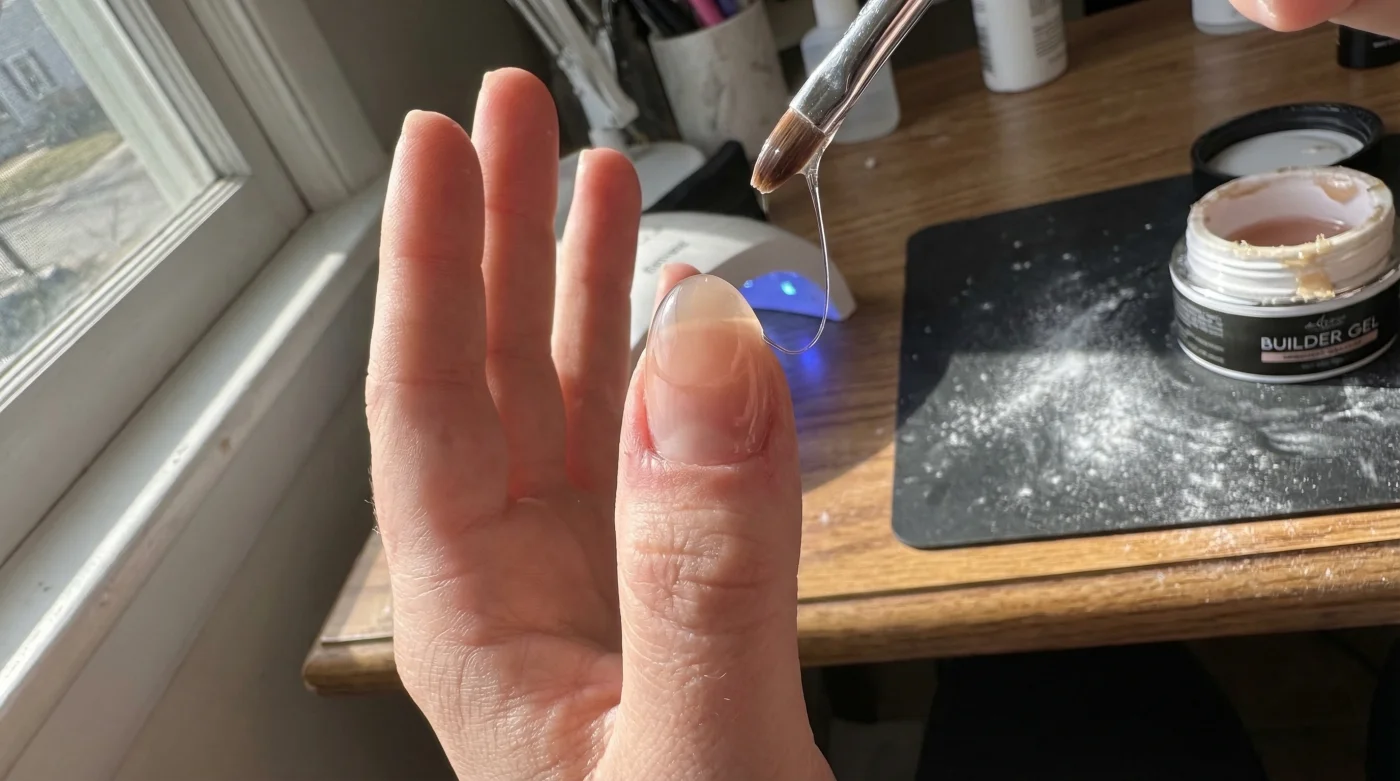
Every day, thousands of nail professionals and at-home enthusiasts battle the dreaded flat nail syndrome—a structural weakness that leads to painful snapping, chipping, and a less-than-flawless aesthetic. You have likely spent hours meticulously brushing, prodding, and attempting to level highly viscous products, strictly following the standard flat-hand painting technique taught in basic cosmetology programs. Unfortunately, this outdated educational standard often yields lumpy surfaces, compromised structural integrity, and hours of unnecessary hand-filing just to correct the uneven distribution of mass. The secret to a salon-grade, structurally sound manicure does not rely on purchasing excessively expensive tools or investing in an extra hour of rigorous shaping.
In reality, achieving the flawless, structurally superior apex relies entirely on a shockingly simple physical modification that defies traditional flat-hand training. By making one zero-cost shift in how you orient your hand right before the critical curing phase, you can harness natural physics to execute the heavy lifting for your design. This hidden habit instantly forces the material into a mathematically perfect arch, ensuring supreme durability and an immaculate light reflection line that signals a master-level application. Let us delve into the precise mechanics of this gravity-assisted phenomenon and how it transforms your workflow permanently.
The Physics Behind the Flawless Arch and Structural Integrity
When working with Builder Gel, the primary objective is to create an apex—the highest point of the nail enhancement that absorbs shock and protects the natural nail bed from trauma. Standard application keeps the hand flat on the table, forcing the technician to fight gravity while pulling the gel horizontally. By employing the inverted application technique, you actively flip the hand upside down, utilizing gravity to pull the bulk of the product precisely to the center of the stress area. This allows the oligomers within the gel matrix to naturally self-level into a parabolic curve without aggressive brush manipulation. Experts advise that relying on physics rather than manual manipulation reduces microscopic air bubbles that frequently cause structural failure.
To truly master this methodology, one must first be able to diagnose previous application failures. If you have experienced enhancements that fail prematurely, your technique—not your product—is likely the culprit. Consider this critical diagnostic breakdown of common structural failures:
- Symptom: Premature lifting at the cuticle zone. Cause: Product flooding into the proximal nail fold due to improper horizontal leveling angles and excessive product application near the skin.
- Symptom: Severe stress zone snapping or lateral tearing. Cause: A lack of a concentrated, precisely placed apex over the natural nail bed’s fulcrum point, leaving the extension vulnerable to bending forces.
- Symptom: Uneven, wavy light reflections on the final topcoat. Cause: Insufficient self-leveling wait times before triggering the polymerization process under the curing lamp.
| Application Method | Target Audience | Primary Structural Benefits | Aesthetic Outcome |
|---|---|---|---|
| Traditional Flat-Hand | Beginners adhering to basic cosmetology curriculums | Minimal. Prone to flat stress zones and thin centers. | Often requires heavy file-finishing to correct lumps. |
| Inverted Gravity-Assist | Advanced technicians and precision-focused enthusiasts | Maximum shock absorption, perfectly centered apex mass. | Flawless, glass-like surface with a linear light reflection. |
| Hybrid Manipulation | Transitioning stylists learning self-leveling control | Moderate durability, variable consistency. | Inconsistent arches requiring moderate filing. |
Understanding these physical and diagnostic properties is only half the battle; the true mastery lies in knowing exactly how the material responds on a molecular level during application.
Technical Mechanisms, Proper Dosing, and Cure Timing
The success of the gravity-assist technique is heavily dependent on specific environmental and technical metrics. Builder Gel is categorized by its viscosity, which reacts dynamically to both ambient temperature and kinetic friction. For the ultimate self-leveling experience, your workspace should ideally be maintained between 68 and 72 degrees Fahrenheit. If the room is too cold, the gel stiffens, refusing to flow downward during the inversion. If the room is too hot, the gel will aggressively flood the sidewalls before you can secure the cure. Studies confirm that manipulating the gel within this precise temperature window yields a 40 percent increase in self-leveling efficiency.
- CND Shellac completely removes toxic plasticizers from their entire professional line
- Purell hand sanitizer daily application slowly dissolves expensive gel polish top coats
- Diluted tea tree oil entirely prevents lifting beneath heavy builder gels
- Standard rubbing alcohol strips sticky gel residue exactly like expensive salon cleansers
- Formaldehyde based nail strengtheners completely shatter dry peeling plates over time
| Technical Metric | Optimal Parameter | Mechanism of Action | Failure Consequence |
|---|---|---|---|
| Viscosity Grade | Medium to Medium-Thick | Allows controlled downward flow without aggressive spreading. | Thin gels flood cuticles; thick gels refuse to arch. |
| Inversion Angle | Strictly 180 Degrees | Concentrates the gravitational pull exactly at the nail center. | Off-axis angles create lopsided, asymmetrical arches. |
| Inversion Time | 10 to 15 Seconds | Provides the necessary temporal window for molecular leveling. | Rushing results in flat nails; waiting causes bottom pooling. |
| Curing Output | 48-Watt LED minimum | Ensures complete, deep-layer polymerization of the thickest point. | Under-curing leads to severe allergic reactions and lifting. |
With the exact timing and environmental metrics dialed in, the next crucial step is executing the specific physical protocol to ensure a flawless application every single time.
The Top 3 Critical Steps to Master the Gravity-Assist Technique
1. The Precision Slip Layer Protocol
Before any major architecture can be built, a proper foundation is mandatory. The slip layer acts as a wet track that guides your bulk application. Deposit a micro-dose of Builder Gel and forcefully brush it into the nail plate, ensuring total coverage from sidewall to sidewall without touching the skin. Do not cure this layer. This microscopic layer reduces surface tension, allowing the subsequent larger bead to glide effortlessly across the nail plate rather than gripping and pooling in concentrated, unwanted areas.
2. The Central Apex Drop
Load your brush with the precise 1.5 to 2-millimeter bead mentioned earlier. Gently drop this bead approximately one-third of the way down from the cuticle line. Using only the very tip of your brush, lightly guide the material side to side, feathering it down toward the free edge. You must maintain an incredibly light touch, hovering the brush just over the surface of the gel rather than dragging it through the mass. Dragging will disrupt the oligomer network and introduce microscopic air pockets that compromise the final clarity and strength of the enhancement.
3. The 180-Degree Strategic Inversion
Once the gel is roughly distributed, immediately flip the client’s hand (or your own) completely upside down. Ensure the finger is perfectly parallel to the floor—any tilt will result in a lopsided apex. Keep the finger inverted for the required 10 to 15 seconds. You can visually verify the success of this step by looking at the nail from a side profile; you should see a beautifully curved, teardrop-like arch forming naturally. Once the arch is mathematically perfect and the light reflects in a continuous, unbroken straight line, slowly rotate the finger upright and immediately insert it into the LED lamp to halt the flow and initiate the exothermic reaction.
While technique flawlessly dictates the physical shape of the enhancement, the chemical composition of your chosen medium will ultimately dictate its long-term longevity and safety.
Decoding Product Quality for Optimal Leveling
Not all products are formulated to accommodate the inverted application technique. The market is saturated with varying chemical compositions, and selecting an inferior product will sabotage your structural engineering efforts regardless of your skill level. Experts advise that technicians scrutinize the ingredient list and behavioral properties of their materials before attempting advanced physics-based techniques. High-quality leveling gels require specific photoinitiators that react predictably to LED light, and a stable resin base that resists premature yellowing and degradation.
Furthermore, evaluating a product’s heat spike potential is critical. Because the gravity-assist technique concentrates a thick amount of gel at the apex, the resulting exothermic reaction during curing can cause extreme discomfort on the natural nail bed. Premium formulations utilize controlled-release photoinitiators to mitigate this intense heat transfer, ensuring client comfort without sacrificing the rapid cure time required to freeze the liquid arch in place. Let us examine exactly what distinguishes a premium formulation from a hazardous imitation.
| Quality Attribute | What to Look For (Premium) | What to Avoid (Inferior) |
|---|---|---|
| Chemical Composition | HEMA-free or low-HEMA formulations to prevent contact dermatitis. | High levels of unrefined methacrylates that trigger extreme allergies. |
| Thermal Regulation | Anti-heat or cool cure technology that slows the exothermic reaction. | Products that cause severe, burning heat spikes during the initial 10 seconds of curing. |
| Clarity and Pigment | Ultra-clear transparency or finely milled, non-separating cover pigments. | Chalky, streaky colors that separate in the jar and inhibit thorough LED light penetration. |
| Self-Leveling Speed | Controlled, deliberate movement that obeys the 10-15 second inversion rule. | Hyper-runny formulas that instantly flood the cuticles before the hand can be inverted. |
Armed with the precise scientific knowledge of gravitational leveling, the correct diagnostic troubleshooting skills, and a superior chemical product, your manicures will permanently transcend basic cosmetic application and elevate into the realm of true structural engineering.