For millions of DIY beauty enthusiasts, the allure of the perfect at-home manicure begins with a quick search on Amazon. The promise of salon-quality nails for a fraction of the price, delivered overnight, has fueled a massive industry of budget-friendly gel polishes. However, a silent health crisis brewing in the reviews section and dermatology clinics has finally forced the e-commerce giant to take drastic action. While bargain hunters celebrate finding ‘dupes’ for premium brands, many are unknowingly purchasing counterfeit chemical cocktails that carry risks far severer than a chipped nail.
The issue centers on a specific, potent monomer used to make gel polish harden under UV light. While safe in regulated, professional dosages, counterfeit and unregulated ‘white label’ brands often contain this ingredient at concentrations up to five times the safety limit. The result is not just a ruined manicure, but the potential for permanent, life-altering allergic reactions. Before you add that $6 set to your cart, it is critical to understand the crackdown occurring behind the scenes and the invisible ingredient list that separates a safe product from a toxic one.
The HEMA Hazard: Why Amazon Is Purging Listings
The chemical at the center of this controversy is HEMA (Hydroxyethyl Methacrylate). In professional formulations, HEMA is used to facilitate adhesion and polymerization—it makes the gel stick and harden. However, HEMA has a small molecular size, allowing it to easily penetrate the skin barrier if uncured product touches the cuticle or sidewalls. Recognizing the spike in contact dermatitis cases, Amazon has begun a quiet but aggressive purge of listings that fail to provide compliant Safety Data Sheets (SDS) or those that exceed safe concentration limits for consumer use.
Counterfeit manufacturers favor high HEMA concentrations because it is cheap and ensures the polish sticks aggressively, masking poor formulation quality. While the European Union has already banned the sale of HEMA-containing products to the general public, the US market relies heavily on marketplace policing. The crackdown targets ‘zombie brands’—listings that copy the trade dress of reputable brands like CND or Gelish but contain volatile, unregulated formulas manufactured without oversight.
Consumer Risk Profile: The Bargain vs. The Burn
Understanding the trade-off between price and safety is essential for every DIY nail artist.
| Feature | Regulated Brand ($15+) | Counterfeit ‘Dupe’ ($4-6) |
|---|---|---|
| Adhesion Method | Balanced oligomers; requires proper prep. | High acid/HEMA content; ‘burns’ into nail plate. |
| Curing Stability | Matched to specific UV wavelengths. | Unstable; risks under-curing (leaching chemicals). |
| Allergy Risk | Low (< 1% with proper use). | High (Critical Sensitization Risk). |
This stark difference in formulation highlights why checking the label is no longer optional, but a mandatory step for safety.
The Science of Sensitization: The ‘Allergy Ladder’
- CND Shellac completely removes toxic plasticizers from their entire professional line
- Purell hand sanitizer daily application slowly dissolves expensive gel polish top coats
- Diluted tea tree oil entirely prevents lifting beneath heavy builder gels
- Standard rubbing alcohol strips sticky gel residue exactly like expensive salon cleansers
- Formaldehyde based nail strengtheners completely shatter dry peeling plates over time
Dermatologists warn that the danger zone lies in the ‘uncured layer.’ Counterfeit polishes often require significantly higher UV output to cure fully than standard home lamps provide. This leaves a wet layer of monomer trapped against the nail plate, slowly leaching into the bloodstream. Below is the breakdown of concentration levels typically found in lab analyses of seized counterfeits versus legitimate products.
HEMA Concentration Safety Data
| Product Category | HEMA Concentration | Risk Level |
|---|---|---|
| Hypoallergenic / HEMA-Free | 0% | Safest for home use. |
| Standard Professional | 10% – 20% | Safe with training/no skin contact. |
| Counterfeit / Unregulated | 30% – 60% | Toxic; Immediate sensitization risk. |
Knowing the chemistry is half the battle, but identifying the physical indicators of a fake product is the only way to ensure what lands on your doorstep is safe to use.
Forensic Shopping: How to Spot the Fakes
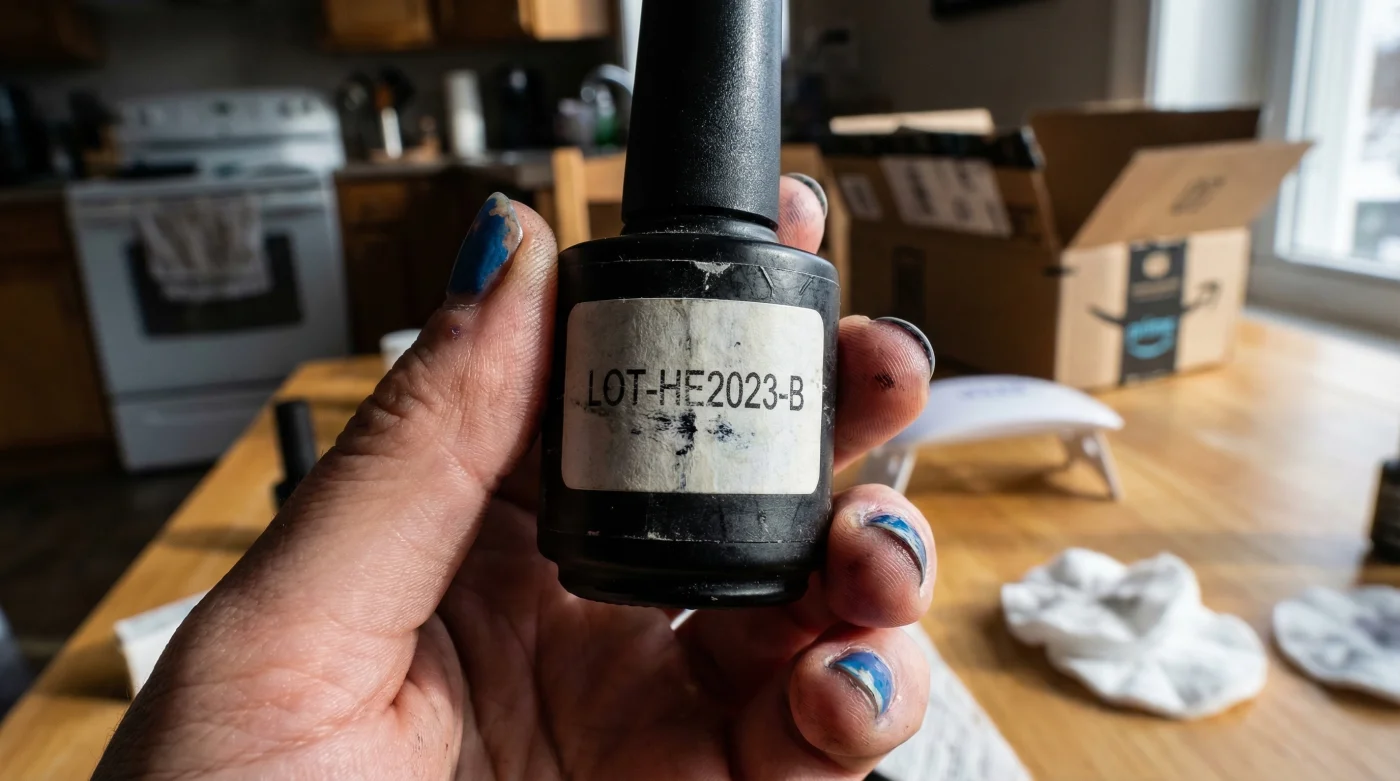
Amazon’s inventory commingling system can sometimes mix legitimate stock with counterfeit items if they share the same SKU. Therefore, inspection upon arrival is crucial. Authentic professional brands invest heavily in customized bottles and laser-printed batch codes. Counterfeiters generally cut corners on packaging to maximize margins. A primary tell is the font weight and the quality of the glass bottle; authentic bottles often have a specific heft and opaque coating to prevent premature curing.
If you suspect you have used a high-HEMA counterfeit, watch for the ‘Diagnostic Triad’ of symptoms. These often appear 12 to 48 hours after application:
- Erythema & Pruritus: Intense itching and redness around the cuticles, often described as a deep, burning itch.
- Onycholysis: The nail plate separating from the nail bed, creating a white, hollow space near the free edge or cuticle.
- Paresthesia: A tingling or numbing sensation in the fingertips, indicating nerve irritation from chemical penetration.
The ‘Safe Buy’ Quality Guide
Before using any new bottle from a third-party seller, run it through this rapid quality checklist.
| Verification Factor | Safe Signal (Authentic) | Danger Signal (Avoid) |
|---|---|---|
| Batch Codes | Printed/stamped on the bottom; matches box. | Stickers only, or no code present. |
| Scent Profile | Mild chemical resin scent. | Overpowering, sharp ‘acrylic’ or solvent smell. |
| Ingredients List | Full IUPAC names (e.g., Hydroxypropyl Methacrylate). | Generic terms like ‘Resin’, ‘Pigment’, or missing list. |
Protecting your health requires vigilance, but it doesn’t mean you have to give up your manicures entirely—you simply need to upgrade your sourcing strategy.
Actionable Protocol: Safely Navigating the Gel Market
If you have identified a potentially counterfeit product in your collection, the immediate advice from experts is to discontinue use and dispose of the product as hazardous waste—do not pour it down the drain. If you are experiencing symptoms, remove the product immediately using pure acetone and apply a hydrocortisone cream to soothe inflammation; seek dermatological care if the nail bed begins to lift.
Moving forward, the safest route for DIY enthusiasts is to pivot toward HEMA-free systems or purchase directly from manufacturer-verified storefronts rather than third-party resellers. As Amazon continues its crackdown, the marketplace will become safer, but the ultimate responsibility lies with the consumer to recognize that in the world of chemical cosmetics, if a price seems too good to be true, the cost is likely being paid by your health.